
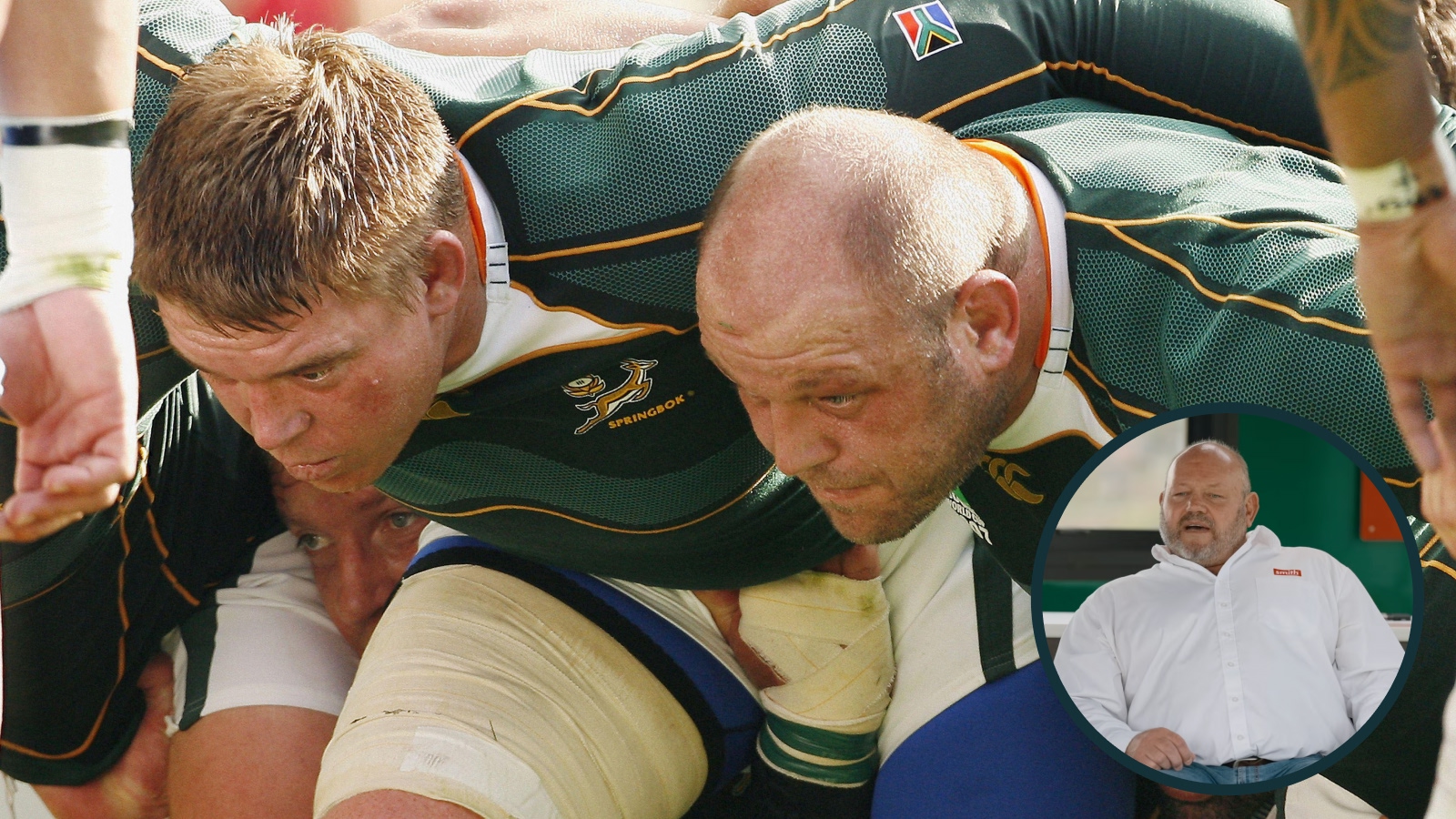
Springboks legend Os du Randt has named three ways rugby has changed since becoming professional in 1995.
Rugby purists will fondly remember the amateur days, but much has changed since. Appearing on Boks Unpacked X The Verdict, Du Randt looked back on an era he played through.
1 Pressure
“I think there’s too much pressure on the school kids these days,” said the double World Cup winner. “Parents put a lot of pressure on winning and sponsorships.”
There’s no doubt the rugby environment can feel a little like a pressure cooker, particularly when trying to forge a professional career as a young player. Being let go from an academy as a youngster can feel like the end of the world.
There’s external pressure from friends and family, the feeling that as a promising prospect, you don’t want to let them down.
There’s also internalised pressure too – the expectation on yourself to ‘make it’, as often this is the ‘one thing’ a young rugby prospect believes they’re good at.
During the amateur days, not making the squad simply meant that the player wouldn’t play rugby that weekend, or they had to play in the second string, or find a new team, but nowadays, in the professional era, not making it into a professional senior squad may mean the player will need to look for an entirely new career.
But it’s not just the pressure of becoming a professional; it’s also the pressure to consistently perform well in the shirt. There’s a lot more riding on the performances in the professional game: sponsorships, bonuses, and the pressure of added viewership, with millions more eyes ready to critique your every movement.
In fact, millions tune into both the men’s and women’s World Cup finals. Attendance increased from 469,664 across all matches in the 1987 World Cup to 2,437,208 in the 2023 edition.
2 Money
“The money changed the whole thing,” he continued. “I mean, the guys can set them up now for life, which is good.
“Being set up for life is one thing, but being well paid to do a job you genuinely don’t want to lose can make the sacrifices required even greater.
“Let’s take an example. When Ollie [Le Roux] was there, he played and made his debut. I came back from injury after my rehab surgery, and then when Nelie Smith wanted to make me a tighthead, I said no. I’d rather play for the B side because there’s no money involved, there’s no fame. We’re not on TV, all those kinds of things. So these days, I imagine you would say yes.
“Look at Thomas du Toit. He made the swap, and my question is: Would that have happened in an amateur era? I don’t think so. I think that’s a big change where mentally and your mindset changes quite a bit.”
Want more from Planet Rugby? Add us as a preferred source on Google to your favourites list for world-class coverage you can trust.
3 Fights
“For anyone who played the game in the early 2000s or before, you’ll remember how each game appeared to turn into a brawl at some stage or other. You may have been stuck into the action yourselves, or watched with bemusement as the melee erupted in the centre field, but the fact is, it happened,” said Du Randt.
“Nowadays, however, particularly in the professional game, it’s simply non-existent. With the increased fines, citations and general punishments for these indiscretions, the most you’re likely to see is some pushing and shoving, with the odd hand to the face.”
“The game was still hard,” Du Randt reminisced, but he does welcome the focus turning back to the game.
“Obviously, in those days, there were a lot more punches. Sometimes I wanted to put up a boxing match afterwards and say, ‘Let’s play rugby and let’s go and box afterwards’.”
Aggression is still, of course, a major part of the game, but sometimes it does still spill over, most notably Springbok lock Eben Etzebeth was banned for 12 weeks after eye-gouging a Wales player in the 2025 Autumn Nations series.
Slightly further back, disgraced French prop Mohamed Haouas was banned for three weeks in 2020 for punching Scotland’s Jamie Richie during a Six Nations match, and then in 2023 banned for four matches for headbutting Scotland’s Ben White.
So these incidents do still happen, but they’re certainly not on a regular occurrence.