
History is reformed from the debris of history itself. These remnants are often erroneously mimed and rewritten into different geographies and cultural knowledge systems. Yet if history is porous and malleable, whose history are we reclaiming or inheriting?
As artificial intelligence dissolves this debris into illegible, encrypted data, our recollections are effectively ghosts in the machine, omnipresent in a virtualised geography – nowhere but everywhere.
Curated by Dr Shelley McSpedden and Sophie Prince, the Australian Centre for Contemporary Art’s NEW26 exhibition examines how new technologies expand or limit knowledge exchange, questioning where human memory ends and artificial intelligence begins. Through disparate vocabularies, artists Amanda Bell, Amanda Bennetts, Nicholas Currie, Naveed Farro, Caesar Florence-Howard, Diego Ramírez and EJ Son reveal what “new” means in our present moment, pronouncing painting as ruin and data as the new prophecy.
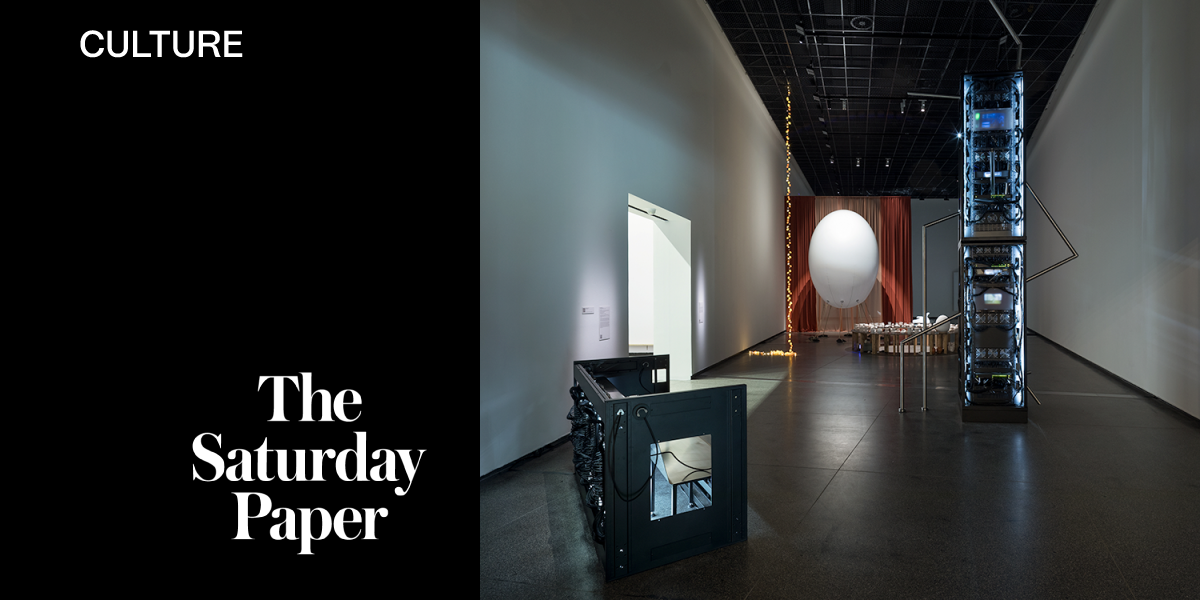
Amanda Bennetts’ Axis Mundi (2026) is the pillar to this divination. Evoking a totalitarian superiority, the data monument predicts human behaviour and measures bodily performance. Constructed from data racks, its self-regulating intelligence and mysticism is analogous to an ancient cuneiform or Jacob’s ladder, oscillating from the earthly to the cosmological. Reflecting her disability, Bennetts’ monument is framed with stainless-steel handrails, highlighting the limits of accessibility and addressing the role of algorithms in either assisting medical predictability or manipulating the disabled with targeted advertisements for mobility devices, medical experiments and coffins.
This raises pertinent questions about how algorithms see humans: Who are “we” to AI? As Jaron Lanier observes in You Are Not a Gadget, “when developers of digital technologies design a program that requires you to interact with a computer as if it were a person, they ask you to accept in some corner of your brain that you might also be conceived of as a program … Being a person is not a pat formula, but a quest, a mystery, a leap of faith.”
NEW26 is a contemplative space with a dystopic sense of the allegorical, revealing the weight of our foreboding future as well as its void.
South Korean–Australian artist EJ Son’s Eggverse (2026) is a centralised towering egg balloon that acts as another symbol of becoming. Son is known for recontextualising ready-made objects such as urinals or teddy bears with hidden cameras, which are often rendered with parody. Here the egg gestures towards the unformed human, unadulterated by social, gender or linguistic categorisations.
Smaller egg-shaped and bisque-fired vessels are arranged as orbiting celestial entities. Some are glazed while others are not, giving promise to the unmasked. For this artist, the glaze is “concealing their naked bodies and entrapping them in a skin they can never shed”. The primordial circle – from which other forms emerge – stands as the nucleus, with no beginning or end. A surveillance camera fixed to the egg further obscures this notion of encircling, this time between object and viewer, observer and observed, as a self-reflexive loop, reorienting the egg into a vision machine.
Second-generation Iranian–Australian artist Naveed Farro examines “otherness” from a different vantage. In The Palace Series (2025-26), he asks what it means to inherit a borrowed culture. Drawing our attention to the process of mimesis, Farro asks whether cultural histories and ancestral recollections can remain authentic through recontextualisation. Here ancient stone Iranian artefacts from Persepolis – a bull’s head from the ruins of the Apadana Palace and a Persian bas-relief depicting a lion attacking a bull – are rendered as 3D printed facsimiles.
Aside from distinguishing original from copy, or fact from fiction, the work questions whether culture is inseparable from a territory, place, soil or ecosystem. While he’s concerned with notions of authorship and the control of knowledge production, Farro’s installation is deceptive: citations, fieldwork and video documentation, including his collaboration with archaeologist Dariush Yusefzadeh, remain ambiguous. A mirror ensnares the viewer’s reflection alongside the counterfeit. Does knowing that the ancient artefacts are copies or that the archaeologist is fictional alter the terms of how we engage with it? Perhaps Farro’s fabulation discloses another kind of aura or truth.
Cultivating his “truth” through chance, Mexican–Australian artist Diego Ramírez uses the 17th century Italian-suited Tarot de Marseille as a guiding oracle. Rather than claiming accuracy, the tarot discloses truth through the act of interpretation itself. Functioning as both a waiting room and an aperture into ACCA’s internal architecture, Bureausis (2026) and A healing fiction (2026) feature the artist’s meta-narrative alongside a Wheel of Fortune tarot wood engraving. As the title suggests, Bureausis is an institutional critique of the bureaucracies, governance, grant applications, processes and rhetorical language employed to be an artist, where the focus is removed from the creative act. In the catalogue essay for NEW26, author Pablo Helguera writes, “contemporary artistic and institutional language has itself become deeply entangled with the very structures it seeks to critique”.
Mununjali artist Nicholas Currie and Caesar Florence-Howard reveal an interplay between hauntology and archaeology in their new series of paintings. Currie’s big X (2026) employs Blak humour to mark the intersection from an end point to a new beginning or overlapping temporalities. References to Mark Rothko, Philip Guston and Gordon Bennett challenge conditioned systems of representation, and personal items such as an inflatable crocodile become objects of remembrance and souvenirs. Florence-Howard’s accumulated mass of gradients – soil, sand, archives and newspaper fragments, as well as stretcher marks that trace the modernist grid – resemble ancient ruins or geological strata.
Badimia Yamatji and Yued Noongar artist Amanda Bell returns to Country with fragmented footage filmed from Tuart Forest in Feel it all. Then let it go (2026). Layered with intensity and emulsion, the weight of repressed histories and dispossession linked to the Frontier Wars radiate an optical dissonance and perceptual dislocation. For generations, this slaughter was omitted from Australian history books, while Noongar oral histories recorded corpses lining the paths of the forest. Bloodstained from genocide, the cinematic mastery in this work reaffirms the artist’s ability to dissolve annihilation into a spatial elasticity where temporality, motion, erasure and stillness fractalise into nothingness.
NEW26 is a contemplative space with a dystopic sense of the allegorical, revealing the weight of our foreboding future as well as its void. It reminds us that the search for remembrance as truth is beyond reach. The discordant works in the exhibition invite us to think about what “new” means now, as memories become data and data divination. We too are becoming remnants or ghosts in the machine where we don’t inhabit anyone’s history: rather, AI is simulating and rewriting ours.
NEW26 is showing at ACCA, Melbourne, until November 22.