
Life just got a lot harder for the more than three million Australian households struggling to pay their mortgages, and for the Albanese government, with the prospect of more pain ahead if the Reserve Bank raises interest rates again on Melbourne Cup day.
The August headline inflation data rising to 4 per cent did nothing to calm the situation midweek. According to one political consultant, focus group research is finding voters are sick of excuses and demanding solutions. The most obvious whipping boy is a government that claimed it had inflation under control, never mind the volatile and rapidly changing circumstances globally since the 2025 election campaign.
Election analyst William Bowe has Labor on a downward trend of support since July 2025, according to his BludgerTrack 2028. It is the only party trending down: One Nation is bouncing around 30 per cent support, while the Liberals have stabilised closer to 20 per cent.
The political consultant says the trend matters and Labor needs to begin addressing the situation urgently. It will need to spend more time showing that One Nation’s stated policies are far from worker-friendly.
A sign of how well One Nation is really tracking will come in the Victorian state election in November. An even bigger test will be the New South Wales election, due in March 2027. The polling data there is stunning.
David Gazard, a former adviser to John Howard and Tony Abbott and founder and director of DPG Advisory Solutions, says his firm’s analysis strongly points to a One Nation state government in NSW with 52 seats.
One Nation must be getting similar feedback, with its state leader, Mike Newman, a Japanese-speaking investment banker, running in the Labor stronghold of Cessnock against a 23 per cent margin.
No one is more acutely aware of the threat to the survival of the Labor government in Canberra beyond the next election than the treasurer, Jim Chalmers.
Chalmers went into overdrive as he embarked on a 24-hour media blitz ahead of the RBA’s Monetary Policy Board’s announcement on Tuesday. His mission was to influence as much of the narrative as possible surrounding the near certainty on the direction of the official cash rate.
Chalmers was aware his opponents would minimise the indisputable damage to the Australian and world economy of Donald Trump’s war of choice in the Middle East. They had been doing it all year.
The blame game is the stuff of contested politics and the opposition would not be doing its job if it didn’t attempt to sheet home as much responsibility as it could to the government. How credibly it does this counts, however.
Opposition Leader Angus Taylor and his treasury spokesperson, Tim Wilson, have greeted every one of the RBA’s four rate rises this year with the same refrain: “This is homegrown. This is of the government’s making.”
Wilson was even more explicit this time, saying “the key thing we need to do to address the problem of inflation is to get government spending down”. He was reluctant to nominate how enthusiastically he would swing the axe in government.
He told a persistent Sarah Ferguson on the ABC’s 7.30 that he would “wait and see” what the government does in the next two budgets before the federal election.
Wilson’s reluctance is understandable. Parties seeking to win back government don’t want to antagonise too many voters. Economist Chris Richardson says “there is no way to bring inflation down without pain”.
The Liberals conveniently ignore the weight the Monetary Policy Board gave to “materialising risks” contributing to elevated inflation. It noted the conflict in the Middle East had “broadened and global energy prices are now much higher than been assumed in the August forecasts”.
The other materialising risk is “AI-related demand” pushing rapid growth in global prices for “technology-related goods”. This is driving up the cost of money worldwide.
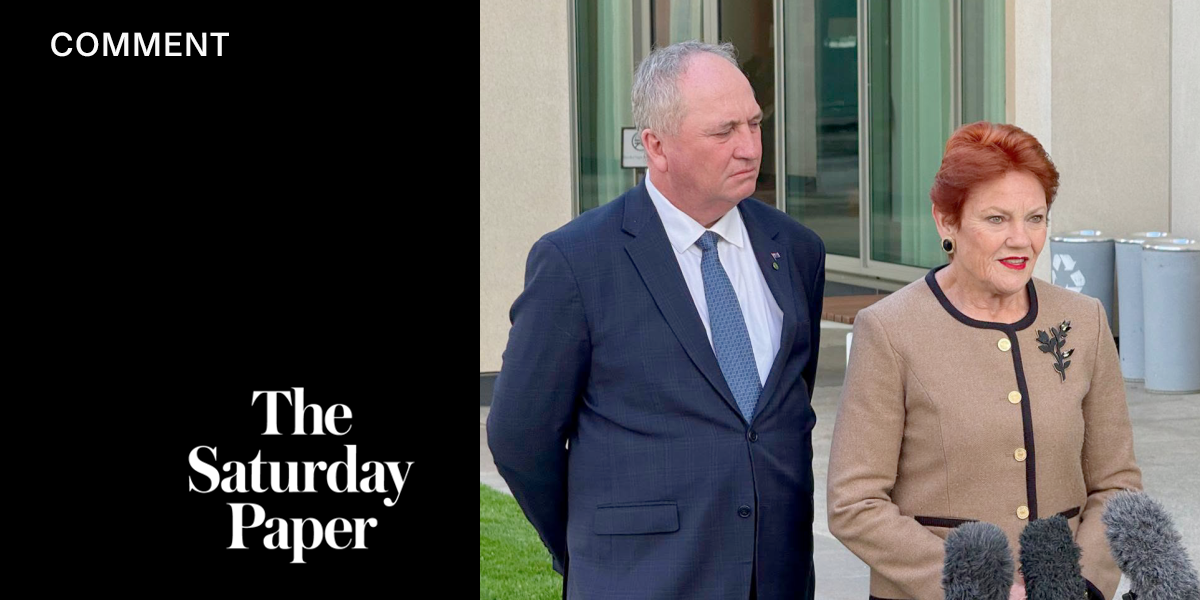
In an extraordinary piece of media management, Pauline Hanson supplied News24 with an exclusive prerecorded video that the network put to air within minutes of the RBA announcement, half an hour before the treasurer’s news conference.
The third factor nominated is the pre-existing domestic capacity constraints.
After the decision, Chalmers was prepared to accept the reality of domestic demand outstripping supply as a factor contributing to the cost-of-living crisis, and that the government played a part in this. He insisted it was also addressing the need for more fiscal restraint.
The treasurer said the “Middle East is not the only factor when it comes to our inflation challenge, but it is a very, very big factor”, and added “the Reserve Bank statement makes that very clear”.
Chalmers said the overwhelming reason for the increases in the August cost-of-living data was the rising price of oil thanks to the war in the Middle East putting pressure on petrol prices in Australia. “This is not an opinion, it is a fact,” he said.
The Liberals weren’t alone in ignoring inconvenient truths. In an extraordinary piece of media management, Pauline Hanson supplied News24 with an exclusive prerecorded video that the network put to air within minutes of the RBA announcement, half an hour before the treasurer’s news conference.
This preferential treatment for Hanson, meted out by the Murdoch-owned news channel, infuriates Liberals such as Garth Hamilton, who holds the Toowoomba-based seat of Groom, a prime One Nation target.
In the clip, Hanson blamed the treasurer for failing to bring inflation under control and called for his resignation. She said her party’s “super pay boost” policy could give “a working family about $82 more a week after tax”.
This promise flies counter to the Reserve Bank’s intention to curb demand. Economist Saul Eslake observed after the latest rate rise that what the government gives, the RBA tends to take away.
The treasurer is frustrated at commentary that ignores public demand has slowed over the past 12 months. He says real spending growth of 2 per cent on average in the period is lower now than it was even before Covid, when the average was 2.6 per cent.
The role of the states in fuelling public demand is also often overlooked. They are rolling out massive infrastructure commitments, which of course add to demand in the economy.
In something of an overstatement, Wilson compares the Albanese government’s debt, deficit and spending to Victoria’s. He conveniently ignores what’s happening in the Liberal National Party-governed state of Queensland.
Unlike in Canberra, where the government has retained its AAA credit rating, S&P Global Ratings last month downgraded Queensland from AA+ to AA. The cause was growing budget deficits and rising infrastructure costs for the 2032 Brisbane Olympics.
Queensland Treasurer David Janetzki – with an astute appreciation of what appeals to voters – said the ratings agency wanted him to raise taxes, reduce services and stop building.
“That’s not going to happen,” he said. “We’ve got a range of capital infrastructure that needs to be constructed and that’s the key focus of our government.”
Indeed, the whole debate over spending is often skewed by partisan and ideological blinkers. Former treasurer Peter Costello used to say there were two kinds of debt: “Labor debt, which is bad, and Liberal debt, which is good.”
Angus Taylor has persistently opposed savings measures proposed by the government. The Liberals ran a ferocious campaign against Labor’s plan to save $748 million over three years by imposing a $5000 annual cap on veterans’ allied health services. The measure was introduced in this year’s budget to curb extreme overservicing by a small number of providers, with safeguards to ensure ongoing care beyond the cap would be provided if genuinely needed.
A group of veterans used their service medals to accuse the government of disrespecting their contribution to the nation. Maybe the implementation could have been handled better, but Albanese caved to the pressure and abandoned the curb on government spending in this case.
There were melodramatic scenes in parliament over the issue. Liberal member for the Townsville seat of Herbert, Phillip Thompson, was suspended for refusing to withdraw his claims that Labor was “lying” and was no friend of veterans.
Never mind that since coming to power in 2022 the Albanese government has invested well over $500 million directly into the Department of Veterans’ Affairs and hired 500 additional frontline staff to reduce the unconscionable backlog of about 45,000 unallocated claims for veterans.
That looks like good Labor spending after the Liberals starved the department of the resources it needed to provide services reasonably expected.
This argy-bargy between the major parties is leaving many voters cold. By midweek the newly elected leader of the Greens, David Shoebridge, served notice that he intends to leverage this grievance more assiduously.
Shoebridge replaced Larissa Waters as party leader after her resignation due to ill health. A noted political operator, he is determined to bring new enthusiasm to the minor party, picking up advice given by British Green Party leader Zack Polanski earlier this year.
Polanski said the Australian Greens should acknowledge the people’s struggle and offer a hopeful alternative. This is precisely what Shoebridge committed to at his first news conference, with the bold statement that under his leadership the Greens “do not seek to reform Labor but to replace them”.
What this means for how the party operates in the Senate will be fascinating in the remaining half of this parliamentary term.