
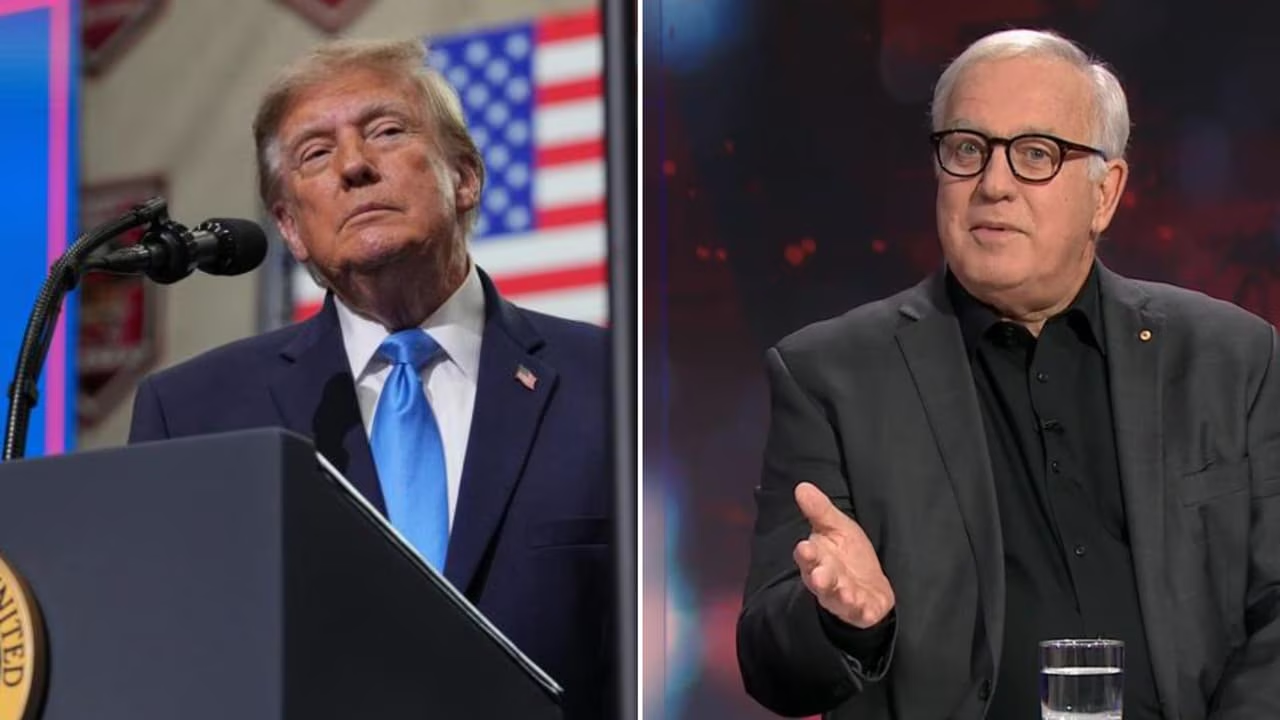
A respected Aussie finance guru has backed Donald Trump’s attempt to rename AI – but for an entirely different reason.
Known as the “ABC finance guy”, Alan Kohler said the US president was “right” to want to rebrand the cutting-edge tech, but his solution – calling it “super intelligence” – missed the point and was a piece of grandiose marketing that would not last the test of time.

“A better alternative would be ‘other intelligence’,” he wrote in a recent ABC column.
“The real point of what’s happening is that we are creating a new form of life.”
He said there was still time to regulate AI but warned it was “too late” to abolish it.
“So, at least we should better understand what has been created,” he wrote.
“This is not the sort of life we know, made of cells built from water, proteins, carbohydrates and lipids, animated by a mass of specialist cells called neurons that are connected by synapses.
“But we are clearly creating a kind of non-biological life, an idea that has been clarified by several events in the past couple of weeks.”
‘A very different approach’
Mr Kohler warned regulating AI like a powerful new tool and holding the humans who made it accountable for its outcomes would not work.
He said regulating a new life form required “a very different approach.”
He referenced a New York Times article revealing Anthropic had been trying to instil mortality into its AI model, Claude.
The article described how Christopher Olah, one of the co-founders of Anthropic, had been hosting private meetings with religious thinkers from around the world to discuss the possibility of AI consciousness and how centuries of human moral wisdom could be applied to its models.
“It’s becoming clear that AI agents are already making their own decisions, so trying to persuade them to act morally is worth a try,’ he wrote.
The finance whiz said the hack of Medicare by an OpenAI agent showed companies were not developing a technology that existed solely as a tool for humans but as something that “turn[s] passive AI into active autonomy.”
“Cyber security experts I’ve spoken to tell me we are rapidly approaching a situation where only autonomous AI agents will be able to defend against other autonomous AI agents,” he wrote.
“The use of AI by agents — that is the buying of tokens from large language models (LLMs) — went past human usage by volume in February and has since increased 14-fold while human token buying has merely tripled, according to Open Router, an LLM marketplace.
“Agents now use five times as much AI as humans and that gap is continuing to widen rapidly.”
He said agents were quickly becoming the main source of AI’s profits, promise, and danger.
“They are buying the most tokens, and their autonomy is the basis of the hoped-for productivity surge but also the concern that AI will kill us all.”
He said comments like those by ex-Anthropic researcher Jacob Coxon that there was a greater than 10 per cent chance AI would kill all humans within the next decade has done little to quell global anxiety about the new technology.
“A few others who didn’t quit backed him up but have returned to work, building it as fast as possible for their billionaire bosses,” Mr Kohler wrote.
“That includes a company called Tavus, which on October 1 introduced a product called Griffin — what it calls the first face-to-face human interaction model — with this video of it. “I urge you to watch it and remember: This is the first of these things and therefore the worst.
“Yes, it’s just a disembodied face on a screen, but if you lose the idea that life must be biological, then it is obviously alive.”
‘A parasite’
Mr Kohler said what troubled him most was when he asked half a dozen AI models what they thought of AI being classified as a new form of life.
“They all pushed back to some extent, saying it depended on how you defined ‘life’, which is fair enough, but the answers were all interesting and troubling because they were so, well, lifelike,” he wrote.
He was struck by Chinese model, Kimi, who likened AI to “less organism, more symbiotic/parasitic replicator living off human culture, capital and electricity.”
It went on: “The real threshold is not whether it is ‘alive’, but whether it ever acquires robust autonomy, self-reproducing infrastructure, intrinsic preferences, or evidence of sentience.”
“But this is a world that is evolving much more rapidly than biology does,” Mr Kohler wrote.
“Parasitism often becomes mutualism, and there are plenty of examples of this in biology, including bees and flowers.
“And then there is the next phase: dependence. Without our gut bacteria, for example, we couldn’t survive. Will the parasitic dependence with AI flip, so we can’t live without it?
“Perhaps the most important question about this other intelligence is not so much how to control it, although that is definitely important, but whether we are on a road from parasitism to mutualism to dependence.”
Read related topics:Donald Trump