
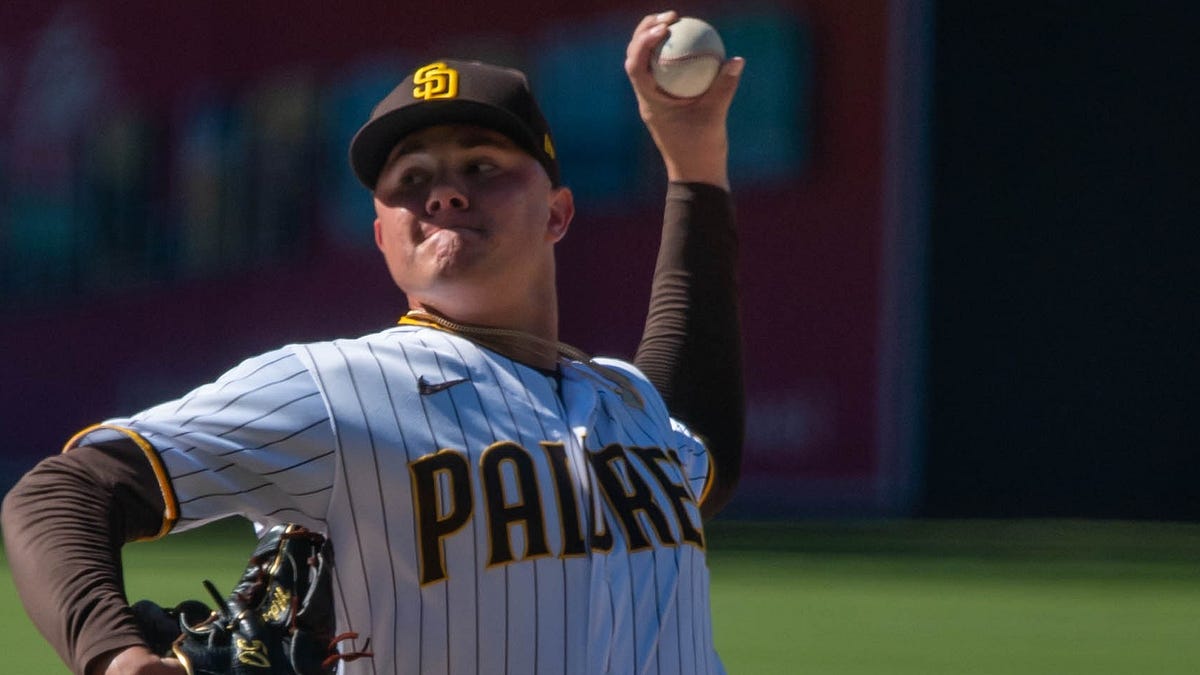
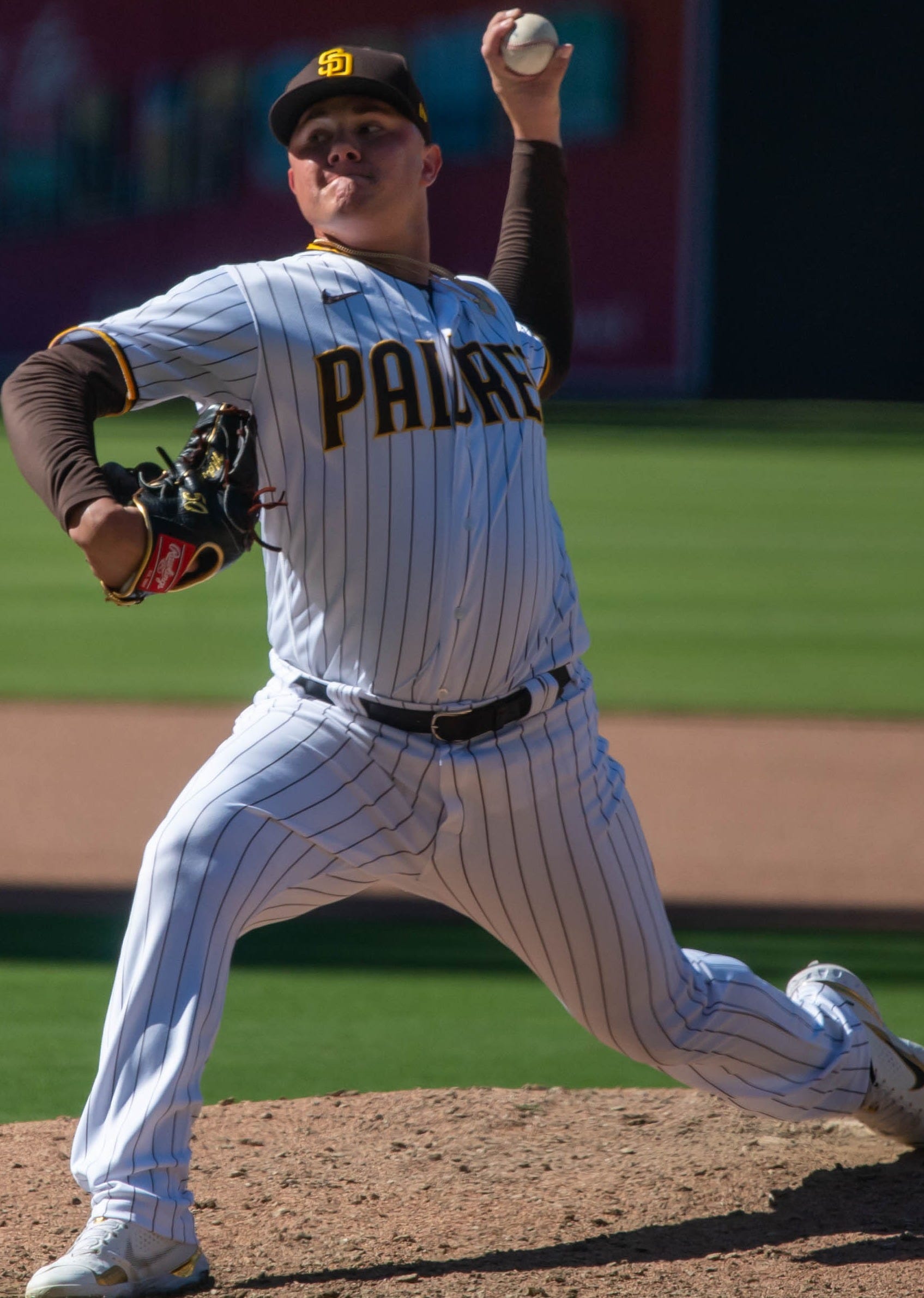
 The Tigers need bullpen help — immediately — and there is no better free-agent prize than Padres left-hander Adrian Morejon. (Photo by Ryan Casey Aguinaldo)
So, what now?
That’s the question Scott Harris and the rest of the Tigers’ front office will be spending the next days, weeks, and months trying to answer after a 2026 season that left a supposed October playoff team sitting home.
The Tigers’ offense scored 35 fewer runs this season than it did in 2025. The defense went from middle of the pack to a bottom-five unit. A rotation that ranked fourth in baseball in ERA kept the Tigers afloat, but two of the biggest life-rafts, Tarik Skubal and Casey Mize, now are gone.
In other words, there’s work to be done on both the lineup and the rotation.
But Priority No. 1 should be fixing the bullpen.
In 2026, Detroit’s bullpen blew 31 saves — second most in all of MLB. The Tigers also ranked 19th in strikeout rate, 15th in walk rate, 19th in FanGraphs’ Wins Above Replacement, and 26th in Win Probability Added.
For a team with postseason aspirations next season, assuming there is one, upgrades are required.
At last Monday’s end-of-season press conference, Harris laid out a plan to fix future Tiger bullpens: Build muscle into the pitching pipeline, and convert former starters to relievers once the foundation is laid.
Long-term, that strategy could work. But with most of Detroit’s best pitching prospects currently in the lower rungs of the minors, there’s not enough short-term firepower to bridge the gap.
Drew Sommers became a weapon this year and will be in the ‘27 late-inning mix, along with fellow lefties Tyler Holton and Brant Hurter. Outside of that trio, however, the back of the bullpen is in total flux.
Will Vest has had arm and hip surgeries, and with an uncertain return date, should be considered a luxury for next season — rather than the staple he was from ‘23 through ‘25. Kyle Finnegan, like Vest, was tasked with carrying Detroit’s bullpen in ‘26, but the stuff and command slipped, as did the results. Finnegan’s fastball velo held steady and a bounce-back is possible, but also like Vest, relying on a Finnegan turnaround is a risk for the Tigers.
Jacob Waguespack, Ty Madden, and Enmanuel De Jesus showed promise of varying degrees, as did Beau Brieske late in the year. Drew Anderson had some moments in relief but looked better in the rotation. None of the five loom as lockdown, back-end relievers.
Some of the starting pitching depth could certainly help in relief. But for a rotation that has as much upside as it does uncertainty (and recent injury history), odds are most will be needed as starters. And while there are other intriguing arms down in Toledo and Erie as well, they should likewise be considered a bonus instead of a necessity for 2027.
All of which makes the free agent and trade markets Detroit’s best bets to fix the bullpen next season, and for the near future.
It’s hard to find a more risky demographic than free agent relievers — just take a peek at recent MLB history. You won’t have to look far: In 2026, the Dodgers paid $23M to Edwin Diaz, and got 18.2 innings of 8.68 ERA ball. The second-biggest contract for a reliever went to Devin Williams of the Mets, who in 40.2 innings had a 4.43 ERA.
Detroit’s return on investment wasn’t much better last winter, and as Harris last week put it, free agency is full of “landmines” — including and especially in the bullpen.
But for Detroit to get back to contention next season, when it comes to the bullpen, drastic times call for drastic measures.
One would be trying to jump the market for Padres lefty reliever Adrian Morejon.