
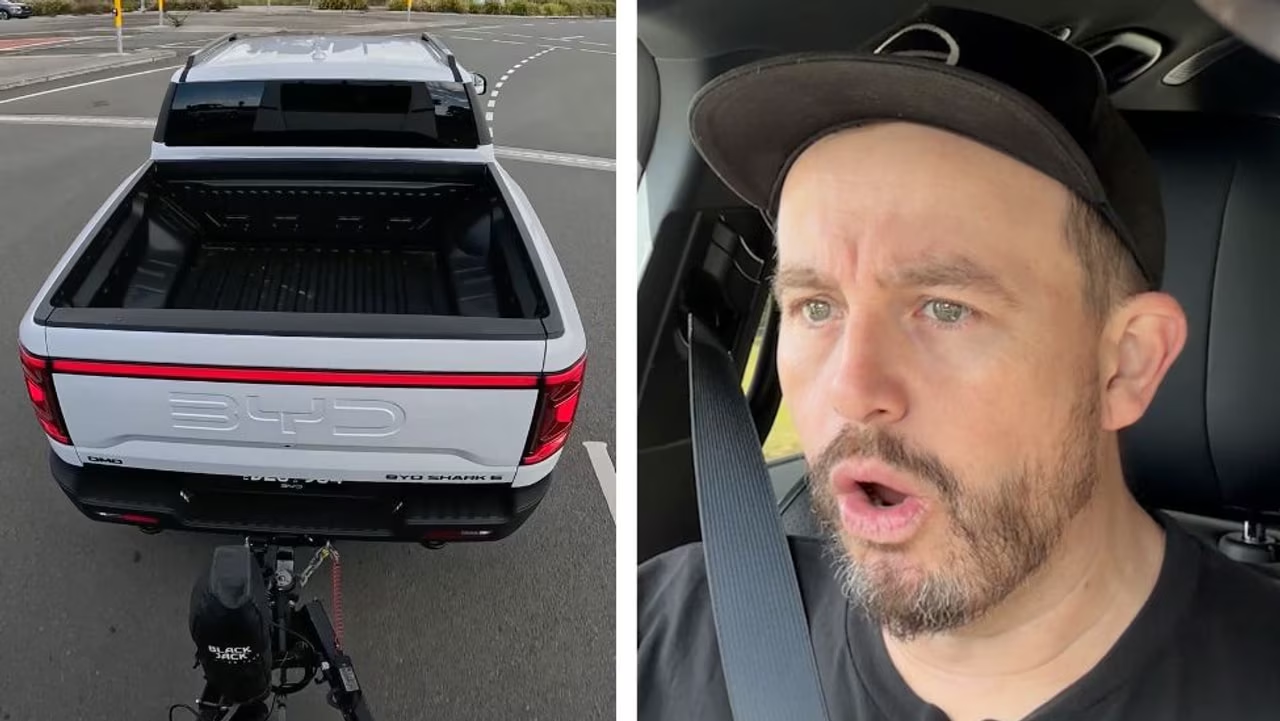
The BYD Shark 6 was already one of the best utes money could buy – and now it’s even more competitive.
The Chinese brand recently added the Shark 6 Performance to its range, which goes from a 1.5-litre engine to a larger, more powerful 2.0-litre unit. And while you might be thinking that move was all about, er, performance, this thing didn’t really need more oomph.
MORE: Why Mercedes cars now talk to each other
The existing 1.5L models were already faster than the far-more-expensive Ford Ranger Raptor, and for what it’s worth, this one is quicker again: 0-100km/h is completed in just 5.5 seconds, which is no mean feat for a five-seat family car, let alone an off-road capable dual-cab ute.
Instead, the performance part of this equation is the big improvement to its towing specs – the bigger-engined Shark 6 Performance now meets the market expectation.
The new version has 750kg unbraked towing, but now matches the likes of the big-name players in the market – Ranger, HiLux, D-Max, etc – with 3500kg maximum braked towing capacity.
The existing 1.5L model – which continues on in cheaper grades – was capped at 2500kg.
MORE: BYD Shark 6 Performance driven
So we thought it best to put it to the test, rather than just take the claim as a boast.
Enter the 3200kg Avida Topaz dual-axle off-road caravan used for this test, thanks to our mates at Avida RV in Emu Plains.
This huge caravan has showcased some problems in previous towing tests.
It made the Kia Tasman look unfinished, and showed the Triton to be a bit frightened by this much mass behind it.

The Shark has weight on its side, though. Usually, you wouldn’t think a heavier vehicle is better for, well, anything. But when you’re towing, the heavier the vehicle doing the pulling is, the better it tends to perform.
The Shark 6 Performance tips the scales at 2775kg, which is similar to how much a dual-cab D-Max with 500kg in the tray weighs.
The best way to describe the towing experience in the Shark is solid.
MORE: BYD issues fix following hacking
It feels well and truly planted on the road surface, with a grounded nature at both the front and rear axles that many other dual-cab utes can’t replicate – especially on broken back roads.
The freeway cruising capability is brilliant, but once you encounter hills you will hear the engine kick to life and rev pretty hard, as it did on my loop that included some hill climbing into the lower Blue Mountains.
The engine and electrics work so cleverly together, though, that it’s hardly worth whinging about. And compared with some of the truck-like rattly diesel engines in this class, it’s positively refreshing to be able to hear the person next to you or the footy call on the radio without having to strain.
With four-wheel disc brakes and regenerative braking with two different modes, you can let the powertrain take a bit of the load when slowing, and it is otherwise predictable in its dynamic performance.
MORE: ‘Our Way’: Tesla faces fresh fight
And an added bonus is the safety tech, which disables the lane keeping tech when you’re towing, and there’s a terrific surround view camera system for manoeuvres. You can even use the rear camera to keep an eye on things on the move, if needed.
Payload is a consideration here, too. The capacity for the vehicle is 725kg, but it does have a huge gross combination mass (GCM) of 6650kg. Even so, with a 10 per cent towball down weight, you need to be mindful that you’d be working with a very limited amount of payload usability for passengers and gear.
Potential customers need to take note that this ute is mostly hampered by its fuel tank capacity.
If you started off with an empty battery, with just 60 litres of fuel at your disposal, you’d probably be able to get from Sydney to Canberra. Just.
If you’ve got a tailwind you might do a little better, and the less hilly the terrain, the better. But honestly, the driving range could be the biggest issue, and it used about 20 litres per 100km during my testing, so it’s not as efficient as some diesels I’ve done similar testing with (13-15 litres per 100km).
The argument about petrol vs. diesel pricing is valid, at least at the moment, but this machine does require 95RON premium unleaded, too.
However, there is no denying that the BYD Shark 6 is now considerably more appealing to more customers who need to tow heavy loads. Oh, and it does it for considerably less money than a high-spec Ranger or HiLux.
Read related topics:China