
Since Pelagia Kolotouros joined Lacoste as creative director in February 2023, the house, whose story dates back to 1933, has taken an entirely new direction. Kolotouros has made its somewhat predictable sporting aesthetic exciting again, introducing inventive ideas and designs that push the boundaries of expectation. In just a few seasons, she has positioned Lacoste among the most interesting brands of today, with shows that are now eagerly anticipated. This season was no different at Paris Fashion Week, where Lacoste presented its Spring 2027 collection and once again earned nothing but praise.
Related: Lacoste unveiled new versions of its cult-bound hit bag
Since taking the helm at Lacoste, Kolotouros has found inspiration in the life and work of its founder, René Lacoste, whose story goes far beyond that of one of the greatest tennis players of his time. Match after match, Lacoste made tennis history, becoming the world’s best player in 1926 and 1927. Yet it is his character and willingness to push boundaries that particularly intrigue Kolotouros today. One anecdote illustrates this perfectly: one of Lacoste’s most recognisable symbols was born out of defeat. After losing a match, and with it a bet, he earned the nickname the Crocodile, then asked his friend and stylist Robert George to embroider a crocodile onto the white blazers he wore when arriving on court. That little green crocodile later became Lacoste’s signature. René also pushed boundaries through his approach to dressing on the tennis court. In 1933, he introduced something of a revolution in the form of a lightweight polo shirt made from petit piqué cotton, challenging the traditional shirts that had previously been standard attire on tennis courts. This rebellious spirit was also a major source of inspiration for Pelagia Kolotouros when creating the Spring 2027 collection.
That rebelliousness is an important part of Lacoste’s heritage, but it also contains an intriguing contradiction. The polo shirt, once a departure from tennis conventions, gradually became one of the foundations of the preppy aesthetic, and it is precisely this predictability that Kolotouros now wants to rebel against. Her Spring 2027 collection therefore explores the boundary between what Lacoste is and what is expected of it, restoring a touch of defiance to the brand’s recognisable codes. Polo shirts take on unexpected shapes, while the crocodile, usually a strictly defined brand emblem, appears in a reinterpreted form.
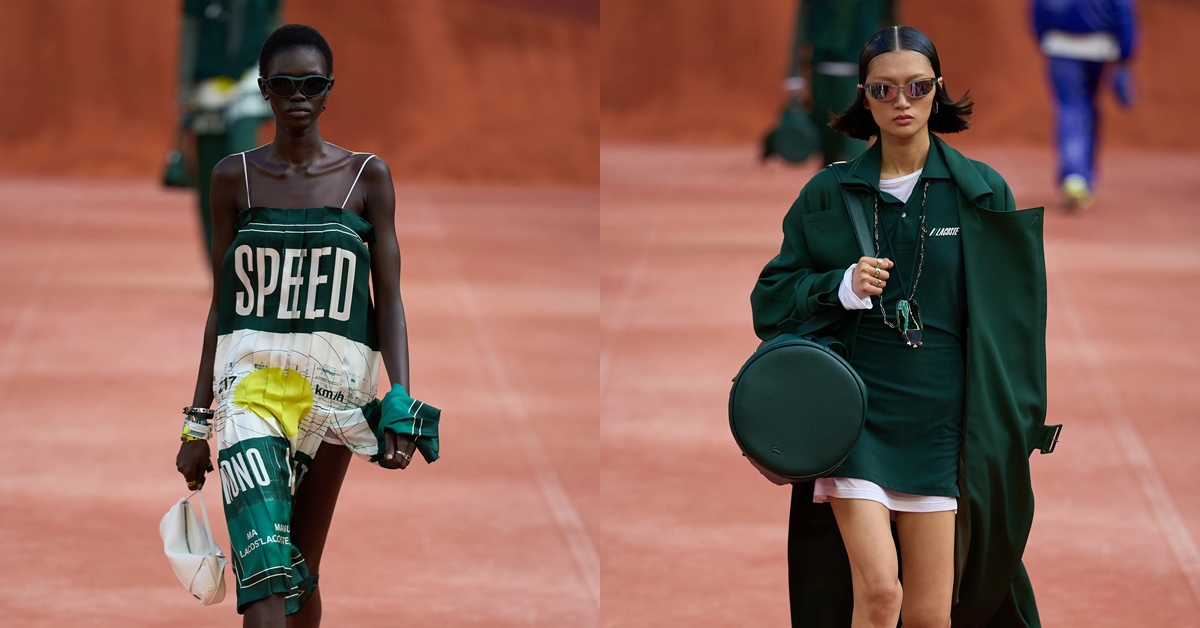
Kolotouros brought a touch of rebellion to every detail of the Spring 2027 collection, in which Lacoste’s recognisable codes do not always appear as we might expect. One way she reinterpreted them was through the idea of speed. While watching Novak Djokovic play in Athens last November, she was inspired by the speed of his serve, which reached 217 kilometres per hour. She transferred that number onto pleated drop-waist dresses and hoodies, turning a scoreboard statistic into a graphic motif.
Related: How to wear the season’s it-bag, according to trendsetters

Lacoste Spring 2027, Getty Images
She took a similar approach to the net. The moment a tennis ball hits the net and distorts it inspired the mesh structure that wraps around the upper of the new ACE-T1 trainer, which has a tennis ball in its heel.
Kolotouros also moved the collection’s aesthetic away from Lacoste’s usual neatness. Olive green, cobalt blue, orange and silver brought a playful quality to the palette. Standouts included designs embellished with large sequins reminiscent of tennis balls, shirts that looked as though they had just come off the court, still wet with sweat, and looks that appeared to be stained with the orange clay of a tennis court. Ties were worn casually over polo shirts, while layered outfits also featured white oversized T-shirts printed with Irving Penn’s photograph of a Lacoste polo shirt bearing the crocodile emblem. In Pelagia Kolotouros’s vision, tenniscore is anything but stuffy.
Discover some of the most interesting looks from Lacoste’s Spring 2027 collection below.