
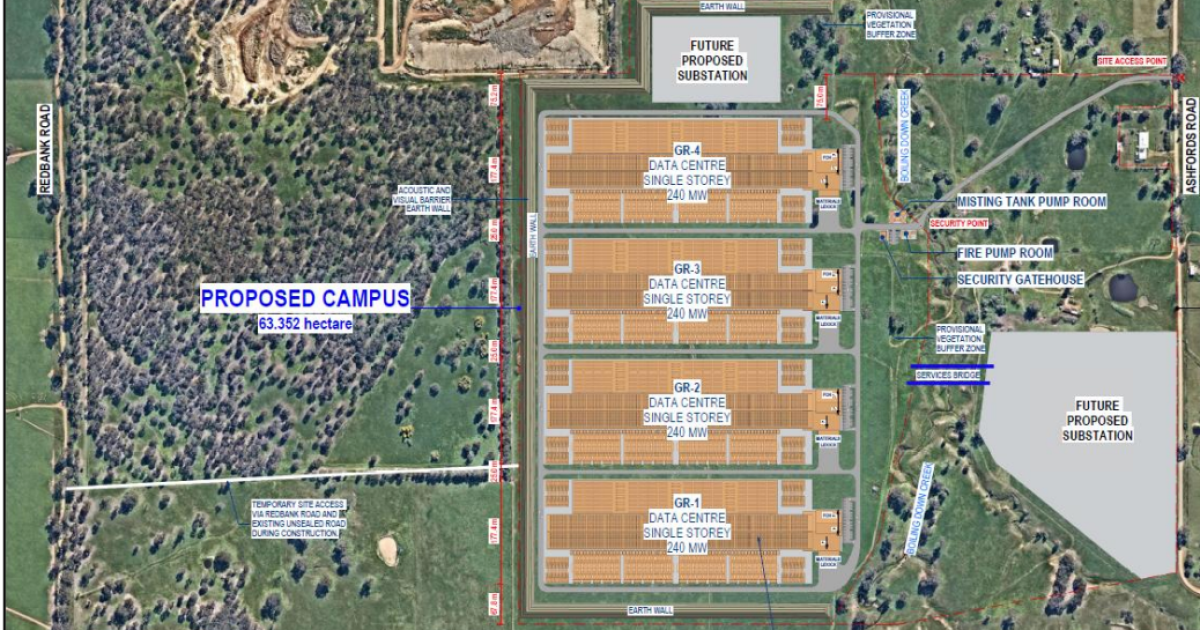
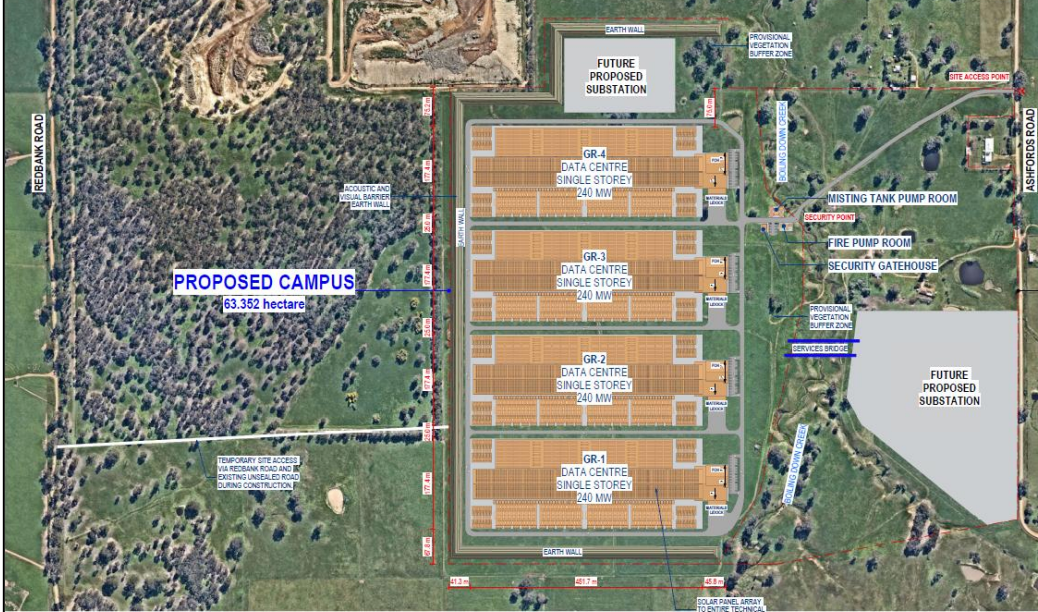
It’s big: The Wagga Wagga data centre site plan. Photo: EJE Architects 2026.
Change is coming to the regions – and many don’t like it.
Yet at the same time as communities lash out at “inappropriate development”, they bemoan the loss of services, and their councils are on the rack financially.
In Wagga Wagga, a proposal from Canberra firm CDC Data Centres for a massive $15 billion, four-building project near the tip has sparked two petitions that are catching fire.
The concerns echo those voiced about renewable energy projects such as solar and wind farms and big batteries.
People worry about pollution, farmland loss, impacts on roads and services, and broader fears that the area’s rural character will be destroyed.
In Canberra’s backyard, Yass Valley Council last week backed a mayoral minute from Mayor Jasmin Jones to keep data centres out of the shire because of water, land availability and amenity concerns.
She told the meeting that there was “no greenwash on a data centre”.
“You can’t hide the fact that it is energy hungry. … It should be corralled to an area of an industrial estate, not anywhere in our rural community.”
Her position aligns with her previous stances on wind and solar farms.
The latest anti-industry push comes after electricity network operator Transgrid suggested Yass and Wagga Wagga could each host between 1 and 2 GW of data centre-related infrastructure because of their proximity to transmission lines.
Marulan (near Goulburn) and Canberra are also flagged as host sites for up to 1 GW.
Ironically, Yass Valley Council will hold an extraordinary meeting on 14 October to address its unsustainable financial situation, which requires “decisive action”.

Yass Mayor Jasmin Jones says data centres aren’t appropriate for her shire. Photo: Facebook.
That begs an obvious question. Can Mayor Jones afford to blithely turn away potential investment?
The push into the regions comes as land dries up in the great metropolitan heartlands on the east coast, along with population pressures and unaffordable housing.
In NSW, industry, particularly in the data and energy sector, is looking to regional locations, while it is obvious that Sydney cannot continue to cram more people into its boundaries.
As a result, regional centres such as Albury, Wagga Wagga, Goulburn and Canberra are attracting greater interest.
The issues raised are valid but they can be managed. Regional councils want and need growth. Industry brings jobs, new residents lift their rates base, boost business and ensure financial sustainability.
The question is what is deemed appropriate growth. There are much dirtier and more problematic industries than renewable energy and data centres, especially those using modern, water-efficient technology and sourcing their own power.
Constraints on regional development in Australia have long included water, transport and isolation, but the internet means many can work from anywhere, and the hoped-for rollout of a fast train line will tame the tyranny of distance and let established towns grow, and new communities spring up, particularly in southeast Australia.
Water will remain a formidable barrier to development, although there may be a technological solution to that, particularly in how it is managed and used.
If people are concerned about water, they should be more worried about coal mines and gas fields than data centres.
If the inland regions cannot or will not embrace growth, the result will be a coastal megalopolis like the one developing in southeast Queensland.
It is understandable for people to resist change and defend the idea of arcadia, but change is coming whether they like it or not.
It is better to manage it, ensure the impacts are benign, and extract the benefits it can bring than to say no every time a project is proposed.
This is not an argument for open slather, the occupation of prime farmland or growth at all costs.
Environmental and planning rules must still apply; land must be appropriate for the use and residential areas and agriculture respected.
But a knee-jerk reaction to proposals and a circling of the wagons is not the way to maintain the integrity and prosperity of regional Australia.