
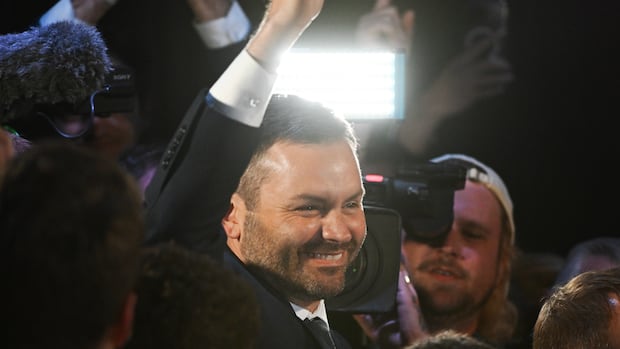
Quebec’s electoral map has been completely redrawn, with the Parti Québécois securing enough seats to form a minority government.
Paul St-Pierre Plamondon succeeded in growing his party from only three seats in the previous election in 2022 to 59 on Monday.
But the PQ leader didn’t get the majority he coveted, which will make it more difficult to follow through on his plans — including holding a referendum on Quebec independence.
Here is a closer look at where things stand and what to expect from the next government.
PQ held to minority
In his victory speech, St-Pierre Plamondon promised to work with other parties and be “direct and transparent” with Prime Minister Mark Carney, setting the stage for a tense relationship with Ottawa.
Speaking in English, he also addressed his “English-speaking friends in Quebec.”
“I just want to let you know very clearly that I’ll be the premier of everyone in Quebec,” he said, adding, “we share the same future.”
WATCH | PQ leader addresses English speakers: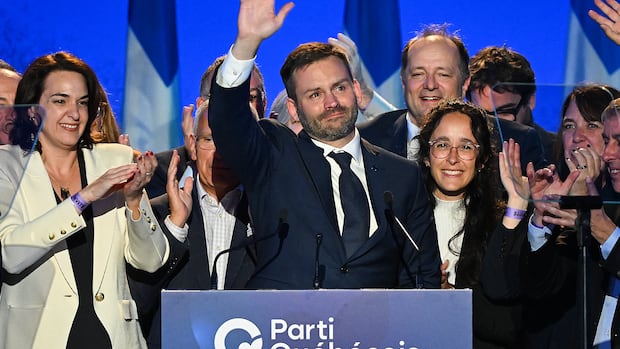
Parti Québécois leader addresses English-speaking Quebecers in victory speech
Paul St-Pierre Plamondon took a moment to speak to anglophones in the province, saying that all Quebecers face the same challenges, and that he looks forward to solving problems together.
Near the end of his speech, St-Pierre Plamondon told supporters he still dreams of making Quebec a country, speaking of the “courageous struggle of francophones” to preserve their culture.
“We deserve it just as much as any other people who possess their own country and democracy,” he said.
In practical terms, however, a referendum doesn’t seem likely — at least in the short term.
The PQ would now need the backing of Québec Solidaire, the only other sovereigntist party in the National Assembly, to push forward with a referendum.
St-Pierre Plamondon said he would delay a referendum until 2029 or 2030, after U.S. President Donald Trump leaves office, but minority governments in Quebec typically last less than two years.
CAQ wiped out
Just four years after winning a massive majority, the Coalition Avenir Québec (CAQ) was entirely wiped off the map.
The party did not win a single seat.
Christine Fréchette, who took over as premier from François Legault, failed to win over voters frustrated after eight years of CAQ rule.
“I have Quebec tattooed on my heart,” she said in her concession speech, noting she was the second woman to lead the province. “I gave everything I could.”
There will be questions about the future viability of the party, which had little grassroots support and no longer has a single MNA.
It was co-founded by Legault as an alternative to the old debates between the Liberals and PQ over sovereignty — a dynamic that appears likely to play out once again at the National Assembly.
WATCH | Fréchette after a difficult night: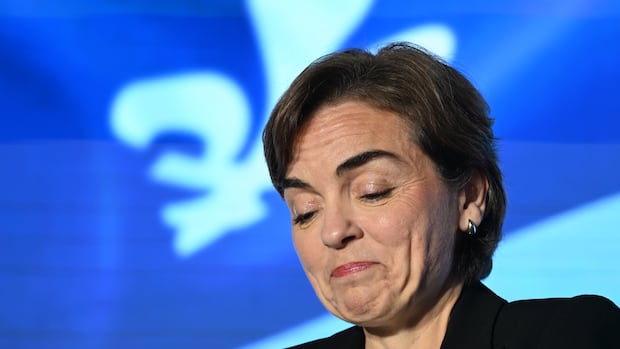
CAQ Leader Christine Fréchette takes ownership of party’s fall in concession speech
At party headquarters in Trois-Rivières, Que., Fréchette thanked her National Assembly colleagues. She said the party’s fall was her responsibility alone, and that being premier was the greatest honour of her life.Liberals in opposition
The Liberals are in a stronger-than-expected position after Monday, jumping from 19 seats to a projected 40.
Speaking to supporters, Liberal Leader Charles Milliard said Quebec voters elected a National Assembly without a majority, so the PQ will have an obligation to consider proposals coming from other parties.
He said the Liberals will be reviewing proposals put forward by the PQ and considering if they are in the province’s best interest.
“Preparing your referendum will find you facing a clear opponent in the Liberal Party,” Milliard said.
Switching to English, he said his party will collaborate on many issues, but “there is no way we will collaborate on a potential referendum.”
Conservative breakthrough
The Conservatives also had a good night, jumping from zero seats in 2022 to 19. The party could prove to be a partner to the PQ on some of its shared priorities.
Conservative Party of Quebec Leader Éric Duhaime, who campaigned on tax and spending cuts, will now have a seat at the National Assembly.
“Tonight, hope has returned to Quebec,” Duhaime said. “We have just written a page in history.”
WATCH | Duhaime celebrates rise of Conservatives: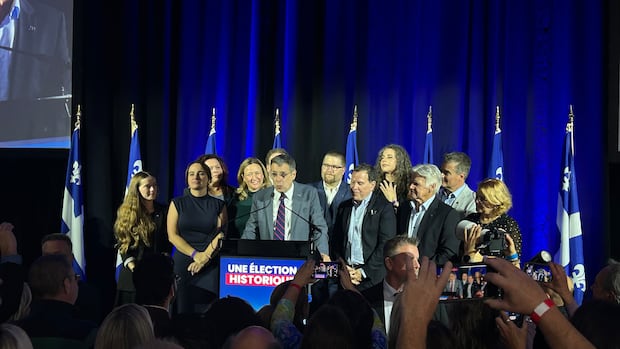
Quebec Conservative Leader Éric Duhaime touts party as ‘credible alternative’ for anglophones
During a speech that celebrated the Conservatives’ rise, Duhaime made a direct appeal to English-speaking Quebecers, encouraging them to look past the Quebec Liberal Party to his own.Québec Solidaire ‘resisted’
Québec Solidaire had a better night than many expected, winning nine seats, compared to 11 in the last election.
The party campaigned on a plan to increase taxes for Quebec’s wealthiest, and putting that money into public education and the health-care system. It could now hold the balance of power in a minority parliament.
“We resisted,” Ruba Ghazal, the party’s co-spokesperson, told supporters.
“Québec Solidaire is the energy I see here tonight — the energy of people who fight with all their heart.”
Time for electoral reform?
During the campaign, St-Pierre Plamondon, along with the Conservatives and Québec Solidaire, promised to finally overhaul the province’s voting system.
Monday’s results will only add urgency to that pledge.
For the first time in Quebec history, a party will form government with less than 30 per cent of the popular vote.