
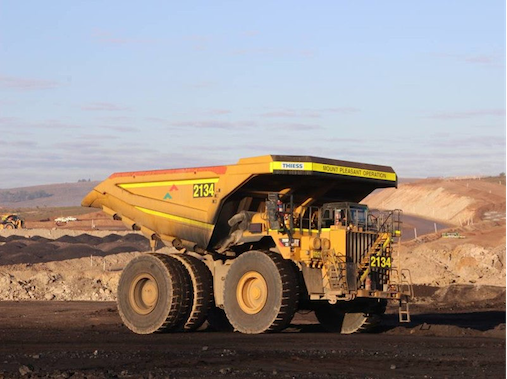
Australia’s most senior court ruled on Wednesday against a huge expansion of a coal mine several hours north of Sydney.
Three of the five judges in the High Court ruled that planning authorities must consider the emissions caused by burning fossil fuels, even if the coal is exported to other countries for use overseas.
The case involved the expansion of the Mount Pleasant mine in the Hunter Valley, an open-cut mine near the town of Muswellbrook, that local environmentalists have been battling since New South Wales planning authorities approved the expansion in 2022.
ALSO SEE: ‘Power Grid Inequity Hindering Asian States’ Shift to Renewables’
The verdict has been hailed as a landmark decision likely to be the first of many such rulings and the start of a slow process of shutting the door on coal mining and Australia’s prominent role as a coal exporter.
Australia was the source of more than a third of the world’s coal exports last year and the world’s biggest coal exporter by value, but it ranks second behind Indonesia in terms of export volume.
Those exports, from mines in all states but South Australia, generated $43.7 billion in 2025 for coal mining companies.
Local mining firm Mach Energy had sought permission to extend the life of the open-cut Mount Pleasant coal mine by more than 20 years until 2048.
Mach Energy argued that coal shipped off and burned overseas could not be clearly linked to environmental impacts felt in the Hunter Valley, north of Sydney.
But environmental campaigners disagreed, saying every ounce of greenhouse gas released into the atmosphere made bushfires, floods and drought more likely.
Campaigners were delighted by the verdict, saying the decision set a “binding national precedent” that required climate change damage to be considered when mulling fossil fuel projects.
Retired science teachers Wendy Wales and Tony Lonergan have fought for years to halt expansion of the Mt Pleasant mine, AFP reported.
“Today, the high court has said what we have always known,” Wales said. “We cannot dig up coal, ship it overseas, watch it drive climate change, and then pretend the consequences have nothing to do with us and won’t be felt by us.”
Lonergan said: “This isn’t the end of coal overnight. But it is the end of coal mine approvals that look the other way on climate.”
Wales and Lonergan first managed to halt the project in the lower courts of New South Wales. But Mach Energy appealed, eventually sending the case to the High Court in Canberra.
‘Historic ruling’
The High Court dismissed Mach’s appeal in a brief written judgment. It said the state’s planning commission failed to consider imposing conditions on the mine that would limit emissions “to the greatest extent practicable”.
Lawyer Anita O’Hart said it was a “historic” piece of environmental law. “The implications extend well beyond Mount Pleasant,” O’Hart, one of the lead lawyers in the case, said.
“This ruling will be applied by courts and planning authorities across Australia, and it will be studied internationally as one of the most significant domestic climate law decisions in the world.”
Mach Energy said it was “disappointed with the outcome” but accepted the court’s decision.
“We will continue to actively pursue all available options to ensure the long-term continuity of the Mount Pleasant operation,” the company said in a statement.
Australia’s coal mines have seen a boom in exports, because closure of the Strait of Hormuz has forced Asian countries to buy more coal as an alternative to disrupted gas supplies, analysts say.
That news comes at an awkward time, given the nation is preparing to champion clean energy as lead negotiator for the UN’s climate summit.
Instead of falling, as predicted by the International Energy Agency in December, global coal demand will rise 1.2% to a record 8.94 billion tonnes in 2026, the agency’s mid-year report forecast.
Australia is president of negotiations for the UN Conference of the Parties, or COP31, to be held in Turkey in November, where it will seek to highlight the peril of climate change to low-lying Pacific Islands, accelerate clean energy and mobilise investment.
Australia’s government said it has delivered Aus$3.9 billion ($2.7 billion) in climate finance from 2020 to 2025.
It is also shifting the population to renewable electricity, with a 2035 target to reduce emissions to 62-70% below 2005 levels. A third of households already use rooftop solar.
Pacific nations call for help
Pacific leaders pressed wealthy nations for more funds to help them “survive” climate change on Wednesday at a gathering aimed at drawing the world’s attention to life on the frontline of global warming.
This week’s “pre-COP” meetings in the Fijian city of Nadi are a precursor to COP31 in Turkey next month.
The South Pacific is among the regions most vulnerable to global warming – from rising seas jeopardising homes to increasing temperatures causing coral bleaching.
Speaking on the sidelines of the summit, Papua New Guinea Prime Minister James Marape told journalists it was an issue of “morality”.
“Nations who have sovereign borders are facing the threat of being nations no more,” he said. “We live with the burden of decisions made elsewhere.”
Pacific nations are using the pre-COP platform to push for more backing for the countries most affected by climate change.
The EU’s climate commissioner Wopke Hoekstra told journalists “we’re clearly not doing enough”.
A UN report released in August found developing countries needed $310 billion to $365 billion to adapt, yet had only $26 billion in adaptation finance available in 2023.
Regional leaders have set up the Pacific Resilience Facility with the hopes of raising $500 million, but it has so far brought in commitments for less than half of that.
Fiji on Wednesday announced an addition of $10 million for that fund. Fiji’s climate minister Lynda Tabuya told AFP one of her main messages to delegates in Nadi was the need to speed up the distribution of money for climate solutions.
“Part of our appeal going to COP is to make the current finance structure to be restructured so that it’s simplified,” she said.
“It’s frustrating. We are the least emitters in the Pacific, and yet we are the most disproportionately affected.”
Australian leaders also said it would invest US$2 million in regional road and communications infrastructure projects in Papua New Guinea, Fiji, Kiribati and Tuvalu.
Stocks dip, oil rises on Mideast flare-up
Oil prices rose on Wednesday on fresh concerns about Middle East supplies following a warning that Iran appeared to be stepping up attacks in the Strait of Hormuz, weighing on stock markets.
Crude futures had steadied on Tuesday, helping Wall Street to fresh highs, with a large amount of the support coming from a rush back into the AI trade that saw chip titan Nvidia push towards a $6-trillion market value.
“In Europe, where there is a lower representation of AI-related names, investors are taking a more cautious stance,” noted Russ Mould, investment director at AJ Bell.
“Oil prices remain above $100 a barrel and the inflation risks are clear to see,” he added.
Figures have shown Tehran increasing strikes on tankers in the crucial Strait of Hormuz.
UK Maritime Trade Operations on Tuesday said there had been nine attacks this month, representing half of the September total in the waterway and the Gulf combined.
But US Secretary of State Marco Rubio said on Wednesday that Iran has “lost complete control” of the Strait of Hormuz. “There’s almost as much oil flowing out now as there was before this conflict began,” he told reporters during a visit to Athens.
Chris Weston, head of research at broker Pepperstone, said “reports of increased flows across the (Mideast) region have offered some downside pressure on crude, but this has been offset by varying reports around the scale of attacks on vessels moving through the Strait”.
“For now, the market remains highly sensitive to headlines and geopolitical risk,” he added.
Meanwhile, Indian stocks slipped and the rupee steadied on Wednesday as the Indian central bank hiked interest rates for the first time in more than three years.
The euro fell heavily versus the dollar for a second time this week as worries about France’s high debt levels spook bond markets.
Key figures at around 1030 GMT
London – FTSE 100: DOWN 0.7% at 10,467.36 points.
Paris – CAC 40: DOWN 1.1% at 7,779.82.
Tokyo – Nikkei 225: DOWN 0.9% at 70,035.71 (close).
Hong Kong – Hang Seng Index: DOWN 0.6% at 24,130.50 (close).
Shanghai – Composite: Closed for a holiday.
New York – Dow: UP 0.5% at 51,521.28 (close).
Brent North Sea Crude: UP 1.2% at $101.77 per barrel.
West Texas Intermediate: UP 0.5% at $89.89 per barrel.
Dollar/yen: UP at 158.30 yen from 158.17 yen on Tuesday.
ALSO SEE:
Investors Shaken by Global Sell-off of Government Bonds
China Opens Joint Airbase in Laos, Extends Probe Into US Trade
Australian Rates Hit 15-Year High, Asian Stocks Fall, Oil Up
TikTok Settles Child Safety Trial; Meagre US-China Trade Deal
US Pushes AI Hotline With China, AI Heads Warn UNSC of Risks
Big Oil Must Pay to Repair Damage Done to the Atmosphere: UN Chief
Chinese Ministry Denies ‘Industrial-Scale Theft of US AI Tech’
Global Bond Yields Hit Multi-Decade Highs on War, Inflation Fears
More Climate Crises Loom Across the Asia-Pacific, UN Agencies Say

Jim Pollard is an Australian journalist based in Thailand since 1999. He worked for News Ltd papers in Sydney, Perth, London and Melbourne before travelling through SE Asia in the late 90s. He was a senior editor at The Nation for 17+ years.