
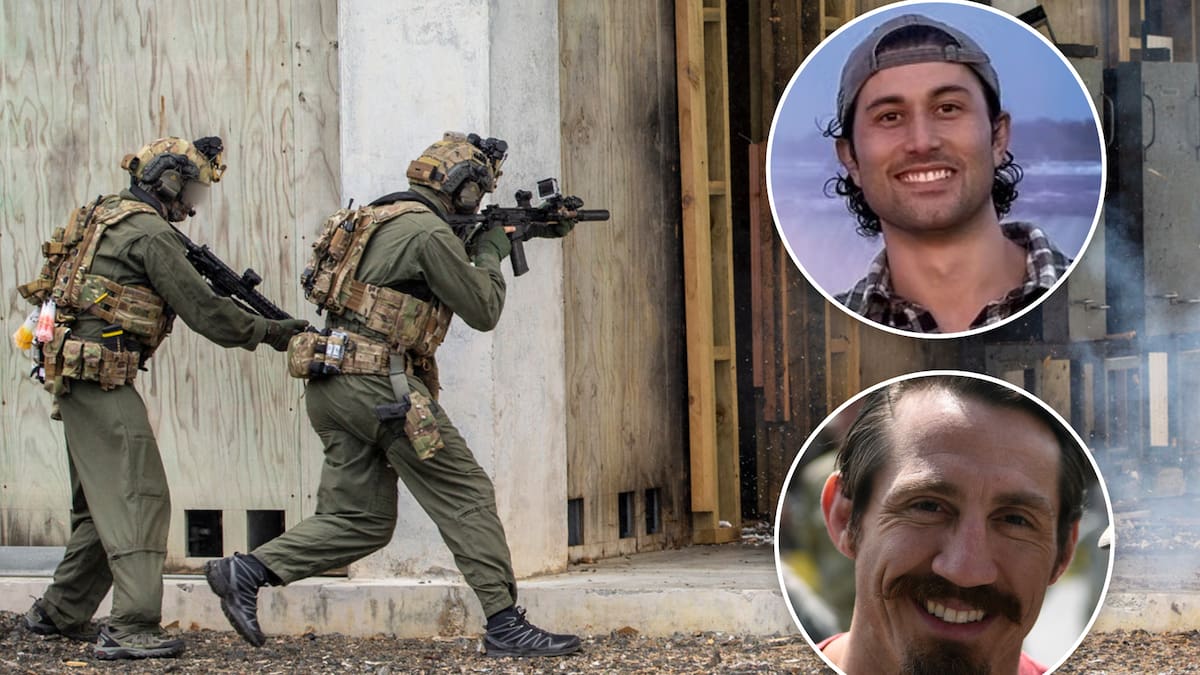
Conaglen was a lance corporal with the NZSAS who took leave without pay from NZDF in March before formally leaving the military in August.
Conaglen was returned to New Zealand, where he was met in Auckland by family and those he served with in the NZSAS.
The Herald has been told the family had been welcomed at the NZSAS base in Papakura before returning to the Far North. A spokesman for NZDF said: “The NZDF is supporting the family with some arrangements, but we have no further comment to make.”
A funeral for Conaglen was held yesterday with a number of those from the NZSAS attending to support family and pay their respects.
Reliable information about the incident which claimed Conaglen’s life has been difficult to establish from the DRC, where decades of conflict have intensified sharply in recent years.
Former NZSAS operator Justin Conaglen.
Veteran conflict journalist Robert Young Pelton, who has reported extensively on private military companies and Erik Prince’s operations, said Justin Conaglen was killed in the September 17 incident while Kennedy was seriously injured.
Pelton described Kennedy as part of what he called a “Tax Brigade” private military contracting element – apparently a reference to Prince’s operation protecting mining revenues, combating smuggling and improving tax collection for the Congolese government.
He said Kennedy was medically evacuated to the United States through Bujumbura and Johannesburg.
The Herald – which first reported Conaglen’s death – had been told before Kennedy was publicly named that an American was wounded in the same incident.
On the Tier1 Podcast last night, former Green Beret and Delta Force operator Brent Tucker – whose show regularly features veterans from elite US military units discussing special operations and combat – said he “found out about it a few days after” it happened and had kept quiet until he had corroborated it.
“These are the facts. [Kennedy] was shot in the Congo in Africa. He was doing contracting work. He was shot on 17 September. He was in a three-man element. There will be more information but as of right now, we will call it an ambush.
“There were three of them. Beside Tim Kennedy who was shot, I believe four times, there was a Kiwi, a New Zealander, an SAS member that was a part of the contract. He died. And the third guy also was hit multiple times.”
Tucker said more facts were needed before he could explain why Kennedy was there. He said “everyone jumps to the negative reasons” but there were also positive roles occupied by private military contractors and urged people not to jump to conclusions.
“Of the three-man element, two of them were shot up pretty badly and one lost his life in the Congo.” It was, he said, “a pretty small element to be rolling around the Congo with”.
Tucker, who has previously been an outspoken critic of Kennedy over disputed claims about his military record and accounts of combat, said one risk of working as a private military contractor was the absence of support on the scale provided by state military forces.
“One of the resources you’re going to want is if something goes wrong, someone to come get you and to get you quickly. We also know that didn’t happen.”
Tucker said he had been told it was 8-10 hours “they were out there waiting to get recovered”.
Former Green Beret turned UFC fighter Tim Kennedy who is reported as injured in the same incident that claimed the life of former NZSAS lance corporal Justin Conaglen in the Democratic Republic of Congo on September 17.
Tributes for Conaglen and messages of support for Kennedy have emerged.
The Australian company Precision Lifting, which describes itself as “veteran owned and operated”, posted a message of support to Conaglen’s family and friends through Instagram before his return to New Zealand.
It said Conaglen was “more than simply someone who worked for us”. “He became part of our crew, and someone whose presence, character and friendship left an impression on the people who had the privilege of working alongside him.
“We are grateful that, for a chapter of his life, Justin chose to be part of ours.”
The company said Conaglen had served with the NZSAS before joining it and described him as carrying “the discipline, humility and quiet professionalism that came from his years of service”.
With reference to Conaglen returning to New Zealand, it said: “There is something incredibly fitting in knowing that the men he once stood beside will be there to receive him home.”
A social media account belonging to the Republican Party in Adams County, Colorado, where Kennedy has strong military connections, has also said Kennedy suffered severe injuries during a private security operation in the DRC.
The post did not cite first-hand knowledge and offered prayers for Kennedy’s recovery.
“Throughout his entire life, Tim has always been someone who stands up for the oppressed, placing himself between danger and those in need whether on active military deployments, through humanitarian missions, or in his civilian work.”
Prince-linked contractors have been documented operating in South Kivu, including around Uvira and the Minembwe highlands, where Congolese forces were fighting groups aligned with M23, a rebel paramilitary force.
Reuters reported Prince-linked contractors had been redirected from mineral-revenue work to support military operations.
On September 17, fighting was reported around several approaches to Minembwe as pro-government forces reinforced the area. Almost 42,000 people had already been displaced by fighting in the region.
There is no confirmed information placing Conaglen or Kennedy at any of those engagements.
The UN Group of Experts found Prince had set up Vectus Global and had signed a contract with DRC’s Finance Ministry to increase mining revenues by tackling cross-border smuggling, corruption and tax fraud, including establishing a “mining brigade”.
The UN said the contract also contained a secret military component covering border security, strategic military advice to FARDC, aircraft and the recruitment of former foreign military personnel. Training, advice and equipment were intended in part to help Congolese forces counter threats including Rwandan jamming technology.
By February, a Vectus representative told UN investigators that the Congolese government had asked the company to help plan operations to retake Uvira and that company personnel had been deployed into eastern DRC.
By September, conflict monitors were reporting Prince-linked contractors supporting the government offensive towards Minembwe, including drone and air-defence work alongside Congolese special forces.
The Herald has been told Conaglen may have been working for Vectus, although that has not been independently confirmed.
Vectus Global was approached for comment by the Herald more than a week ago and again today. It has yet to respond. The Herald has also approached the US State Department and Maryland National Guard for comment.
This story initially reported that Conaglen’s body had been returned to New Zealand. Later details have said Conaglen was cremated.
David Fisher is based in Northland and has worked as a journalist for more than 30 years, winning multiple journalism awards including being twice named Reporter of the Year and being selected as one of a small number of Wolfson Press Fellows to Wolfson College, Cambridge. He joined the Herald in 2004.
Sign up to The Daily H, a free newsletter curated by our editors and delivered straight to your inbox every weekday.