

ASX healthcare led the market in September as its recovery gains momentum. Pic: Getty Images
ASX healthcare rose 3.64% in past five days as broader market fairly flat up 0.04%
CSL in deal with Swiss biotech Alentis to co-develop potential first-in-class treatment for inflammation and fibrosis in rare kidney and liver diseases
Neurizon receives positive feedback from the FDA on regulatory pathway for its amyotrophic lateral sclerosis drug candidate NUZ-001
Healthcare and life sciences expert Scott Power, a senior analyst at Morgans Financial for 29 years, and his team share their insights on the ASX healthcare sector for the week.
The ASX healthcare sector is continuing its recovery moving higher this week after defying a historically softer September for global markets to be the top performer for the month, beating the benchmark which fell 2.42%.
The XHJ has moved up 3.64% over the past five days, while the benchmark S&P/ASX 200 (ASX:XJO) is fairly flat gaining just 0.04%.
“The rotation into healthcare continues and we have defied that September weakness which sets us up well into the end of the year,” Power said.
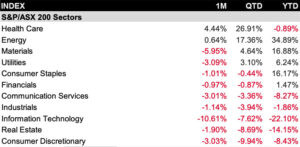 Source: S&P DJI
Countdown to AGM and quarterly reporting season
AGM season and quarterly reporting season is also approaching, providing investors with an opportunity to gauge company performance and outlook.
“There will be plenty of information to digest over the next few weeks, which will hopefully set the sector up for a solid run into the end of the year,” Power said.
“Against a soft Australian economy, we are expecting positive trading updates from Sigma Healthcare (ASX:SIG) and EBOS Group (ASX:EBO) and key clinical/regulatory milestones from Imricor Medical Systems (ASX:IMR), Vitrafy Life Sciences (ASX:VFY), Tetratherix (ASX:TTX) and Blinklab (ASX:BB1).
“Buckle up it will be a fun ride.”
CSL rebuilds pipeline, one partnership at a time
CSL (ASX:CSL) has entered an exclusive agreement with Switzerland-based biotechnology company Alentis to co-develop and co-promote lixudebart, a potential first-in-class treatment targeting inflammation and fibrosis across rare kidney and liver diseases.
CSL will pay US$355m upfront, fund development and share global profits 55:45.
In a research note, Morgans healthcare analyst Derek Jellinek wrote the deal was positive and may provide a meaningful external addition to CSL’s nephrology pipeline, while addressing a key weakness identified in its strategic reset of insufficient R&D productivity.
“However, while a potentially more capital efficient route to growth than internal efforts, with lixudebart still in Phase II development, the deal is more strategic than a near-term earnings catalyst and remains subject to clinical execution risk,” he wrote.
Lixudebart is being evaluated in a rare, severe and potentially life-threatening autoimmune condition, ANCA-associated vasculitis with rapidly progressive glomerulonephritis (AAV-RPGN), which can cause severe and rapid kidney damage, with planned development in other rare kidney diseases.
“We view this opportunity as particularly relevant to CSL Vifor, where CSL has been seeking to rebuild its nephrology franchise following the division’s soft performance and the loss of VELPHORO/TAVNEOS revenues (>\~A$500m in combined sales),” Jellinek wrote.
He wrote that lixudebart operates via a novel mechanism of action, targeting inflammation and fibrosis, potentially distinguishing it from existing approaches, although clinical efficacy remains to be demonstrated.
“The transaction is consistent with CSL’s stated strategy to improve R&D productivity through life-cycle management, novel modalities and external partnerships rather than relying solely on internally generated assets,” he wrote.
“While US$355m upfront and commitment to fund multiple trials represents a meaningful investment, we view the 55% share of global profits as attractive if lixudebart successfully progresses through development and commercialisation.”
Morgans has a buy rating on CSL and 12-month target price of $187.71.
Neurizon gets FDA clarity on registration pathway
Neurizon Therapeutics (ASX:NUZ) has received positive feedback from the US Food and Drug Administration (FDA) on the regulatory pathway for its amyotrophic lateral sclerosis (ALS) drug candidate NUZ-001.
NUZ has received written responses from the FDA to its Type C meeting request with the regulator indicating that the Phase 2/3 HEALEY Regimen I trial could serve as the sole registrational study for a traditional approval application.
In a research note Morgans healthcare analyst Iain Wilkie wrote the feedback was consistent with its existing assumptions, with the broker already modelling a single Phase III study leading to a New Drug Application (NDA).
The FDA also left the door open for the company to resubmit for Fast Track designation (FTD).
Morgans said the update removed a regulatory risk that emerged following the FDA’s rejection of its FTD application in January 2026, which had raised the possibility that the regulator could require a confirmatory trial.
The FDA also agreed with NUZ’s approach to measuring plasma neurofilament light chain (NfL), a marker of nerve damage, and outlined the types of evidence that would be needed for NfL to support accelerated approval.
Wilkie pointed to tofersen (brand name Qalsody), an FDA-approved treatment for patients with SOD1-mutated ALS, as a precedent for using NfL as a biomarker to support an accelerated approval pathway.
However, he noted tofersen targeted a genetically defined form of ALS, whereas NUZ-001 was being developed for the broader ALS population.
Wilkie wrote this could make it more challenging to establish that changes in NfL reliably predict clinical benefit across the more diverse sporadic ALS population.
An expanded access program funded by the US National Institutes of Health, expected to involve about 200 US patients for up to 96 weeks from Q1 CY27, is expected to generate longer-term safety and biomarker data that could contribute to supporting evidence
“With the regulatory path now clearer, focus again shifts squarely to the HEALEY Regimen I topline readout in Q2 CY27, which remains the key value inflection point for NUZ,” Wilkie wrote.
Morgans retains a speculative buy recommendation on NUZ and a 12-month price target of 20 cents per share.
Saluda’s CAP24 moves to US commercial rollout
Saluda Medical (ASX:SLD) has started the US commercial release of CAP24 following a successful limited market launch across selected centres, opening the door to a previously unaddressed ~30% of the US$3bn US spinal cord stimulation (SCS) market.
SLD’s CAP24 is a paddle lead for its Evoke spinal cord stimulation system and was granted FDA approved in June 2026.
In a research note Jellinek wrote CAP24 was the first FDA approved paddle lead purpose built for physiologic, dose controlled closed loop therapy allowing neural responses to be measured and stimulation adjusted in real time.
It is now broadly available to neurosurgery and orthopaedic spine practices following a successful limited launch, including positive physician feedback on device performance and clinical integration.
“We view the full commercial release of CAP24 as an important FY27 catalyst, expanding SLD’s addressable market while providing an opportunity to increase revenue productivity across its existing US commercial infrastructure,” Jellinek wrote.
“With broad commercial availability established, the focus shifts to surgeon activation, procedure volumes and utilisation.
“We expect a gradual revenue contribution as surgeon training, hospital adoption and field inventory scale.”
Morgans has a speculative buy rating on SLD and 12-month target price of $2.17.
Good and bad news in Clarity’s trial updates
Clarity Pharmaceuticals (ASX:CU6) has reached the recruitment target of the cohort expansion (main group) for its Phase 1/2a Secure trial.
CU6 said 16-patients enrolled with metastatic castration-resistant prostate cancer (mCRPC) were now being evaluated for the efficacy and safety of up to six cycles of its targeted copper-67-based targeted radiopharmaceutical therapy 67Cu-SAR-bis-PSMA .
Recruitment continues for additional participants in the cohort expansion to be treated with the combination CU6’s therapy and enzalutamide.
However, in a research note Wilkie noted CU6’s two key Phase II diagnostic trials for prostate cancer Amplify and Clarify were now expected to deliver results early next year.
“The more important snippet though sits in a single line within the chairman’s commentary that both registrational diagnostic trials (Amplify and Clarify) are now guided to read out early next year,” Wilkie wrote in a research note.
“Amplify and Clarify are the major near-term catalysts on the diagnostics front so likely a small pushback on timing expectations.
“This delays the NDA, which is the first real value-crystallisation event, by a quarter or more.”
Wilkie noted there was no specific update on Clarify and Amplify recruitment.
“Likewise, no specific call out or update on Clarify recruitment status but note the clinical program overview still has Clarify not marked as recruitment closed as it does with Amplify so it would appear there is more risk to these timelines,” he wrote
CU6 is also planning a Phase III theranostic trial, which Wilkie sees as a longer-term potential catalyst, with the program unlikely to become a major event before CY27 “at best”.
The consensus price target for CU6 is $7.20.
Imricor reaches another FDA module
Imricor Medical Systems (ASX:IMR) has achieved a key regulatory milestone with the FDA completing a review of the third PMA module for its next-generation MRI-guided ablation platform.
The review covered extensive non-clinical testing of the Vision-MR Ablation Catheter 2.0, RF-5000 System and irrigation tubing.
Power said no deficiencies were identified for the catheter or tubing, with only one issue relating to an outdated third-party software operating system in the generator, which has already been updated.
FDA approval for Atrial Flutter is targeted for Q4 CY26 or early CY27.
“The fourth (and final) module is the clinical data which is expected to be submitted in November,” Power said.
“The timing of the FDA approval is expected shortly thereafter, whether it is achieved before year end of early in the new year will be in the hands of the FDA.”
It’s been a big year of catalysts for IMR, which has developed the world’s first guided cardiac ablation catheter for use with MRI.
In January IMR received FDA 510(k) clearance for the Vision-MR Diagnostic Catheter, followed by 510(k) clearance for its NorthStar Mapping System in February.
A 3D mapping and guidance system, NorthStar directs the company’s cardiac ablation catheters to the right spot.
In July, the company’s Vision-MR diagnostic catheter and NorthStar guidance system were also cleared for paediatric use.
A European pivotal trial for its second indication ventricular tachycardia (VISABL-VT) continues with results in CY28.
Morgans has a speculative buy on IMR and 12-month target price of $2.90.
The views, information, or opinions expressed in the interview in this article are solely those of the interviewee and do not represent the views of Stockhead.
Stockhead has not provided, endorsed or otherwise assumed responsibility for any financial product advice contained in this article.
Disclosure: Scott Power owns shares in CSL and Imricor. Iain Wilkie own shares in Clarity Pharmaceuticals. The journalist owns shares in CSL.