
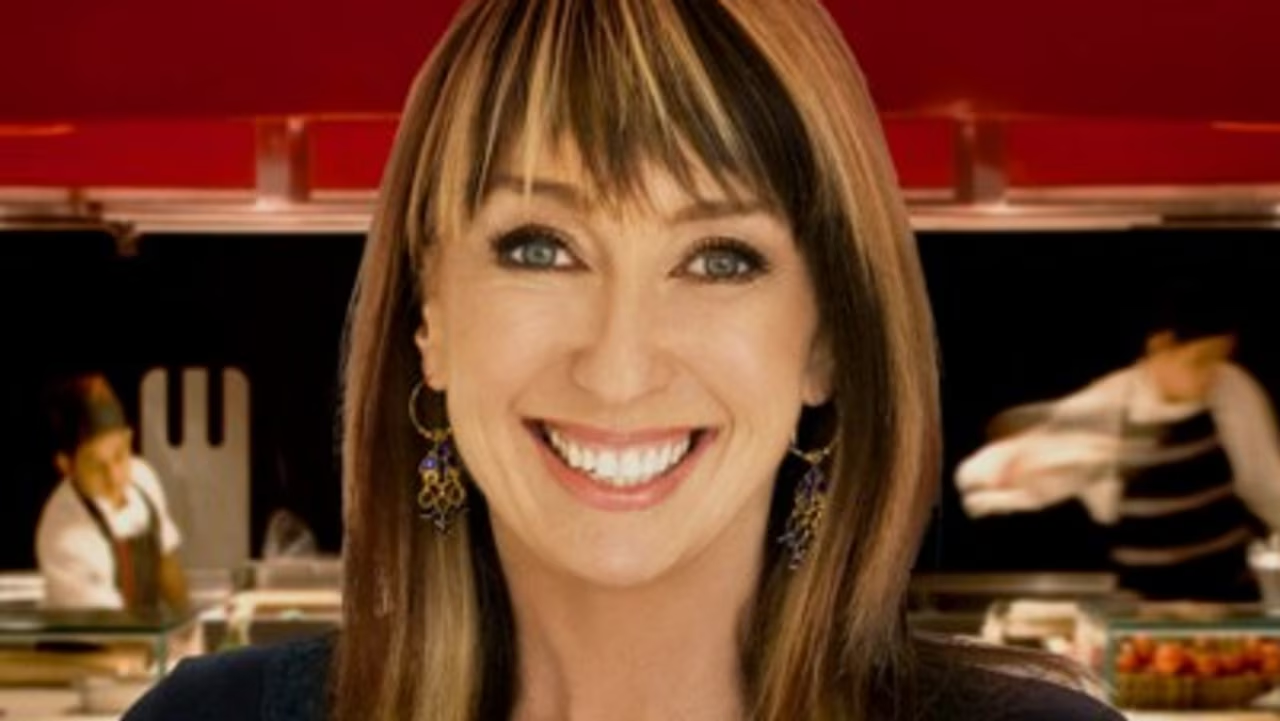
Few television programs have captured Australia’s changing relationship with food as effectively as Food Safari.
Across multiple seasons and two spin-offs, the series documented the foods, traditions and communities of our nation.
Obsessed with celebrity news? Download our new app and never miss a headline
While other cooking shows taught Australians how to prepare a meal, Food Safari (currently streaming on Tubi for free) showed us where those meals originally came from. Each episode was about cooking, yes, but it was just as much a lesson in culture, migration and identity.
How Maeve changed the menu
Central to the show’s success and longevity was host Maeve O’Meara herself – a food journalist and broadcaster whose career has centred on documenting the people behind Australia’s increasingly diverse food scene. She grew up in Sydney’s “whitebread suburbs”, eating a traditional Irish-Australian diet of “plain meat and three veg”.
A backpacking trip through Europe after college changed everything when she realised she “never wanted two days of her life to be the same” – a philosophy that would eventually lead her into journalism.
She joined SBS in 1990 and worked alongside her colleague and longtime food journalist, Joanna Savill, to co-author the book The SBS Guide to Ethnic Eating. The duo then co-created and presented The Food Lovers’ Guide to Australia alongside chef Tony Tan in 1996, a landmark series that aired periodically for almost nine years.
It was during this time that O’Meara also established Gourmet Safaris, inspired by a simple outing with her mothers’ group to a Lebanese restaurant in Punchbowl.
The tours take guests into diverse communities through walking and bus tours, exploring local culinary traditions in Australia and overseas.

These experiences ultimately laid the groundwork for Food Safari, with O’Meara’s partner, director Toufic Charabati, recognising the potential to turn the tours into a TV series. Together they formed Kismet Productions and developed a show that took the same approach – demystifying unfamiliar ingredients, showing viewers where to find them and how to cook authentic dishes at home.
She wasn’t interested in celebrity chefs. She spent her time with home cooks, market vendors, migrant families and restaurant owners, giving them a platform rarely seen on Australian television.
A recipe for change
O’Meara recognised something years before the rest of the media did: Australia’s most exciting food experiences weren’t in Paris or Rome, but in Cabramatta,
Lakemba and Preston. Instead of taking viewers overseas in search of “exotic” cuisine, Food Safari revealed those cultures were already here.
In doing so, the series encouraged Australians to eat beyond their comfort zones.
Long before social media influencers were recommending hidden gems, viewers were discovering Lebanese bakeries, Vietnamese restaurants, Serbian butchers,
Persian grocers and Ethiopian cafes through the program.
The franchise later expanded with Italian Food Safari and French Food Safari, before branching out into ingredient and technique-focused series including Food Safari Fire, Food Safari Earth and Food Safari Water.
She also went on to publish eight editions of the Food Safari cookbooks, with the original Food Safari – Glorious Adventures Across a World of Cuisines selling more than 80,000 copies.
O’Meara was unique in that she never presented herself as the expert. More often she turned up, asked questions and let cooks, shopkeepers and families do the talking and, in the process, made unfamiliar cuisines feel accessible and less intimidating.
Food Safari was often well ahead of the curve, introducing cuisines and ingredients long before the rest of the country caught up. For example, in the Peruvian episode,
O’Meara had already explored the cuisine with Sydney chef Alejandro Saravia when she’d heard predictions that Peruvian cuisine was about to become the next big thing in food.
The episode introduced viewers to ingredients including quinoa and Peruvian chillies at a time when the cuisine was still relatively unfamiliar in Australia. As O’Meara later put it, one of the pleasures of the show was being able to “shine the light” on foods before they entered the mainstream.
Her influence extended well beyond Food Safari. She later became a regular presenter on Better Homes and Gardens, bringing the same curiosity about Australia’s diverse culinary traditions to one of the country’s top-rating lifestyle shows.
It’s hard not to see the parallels between Food Safari and great Australian travel shows. Just as each episode made viewers want to get on a plane and explore another country, O’Meara encouraged people to cross the city, explore a neighbourhood they might never have visited before and try something completely new.
Stream Food Safari and Food Safari Fire for free on Tubi.
Read related topics:What To Watch