
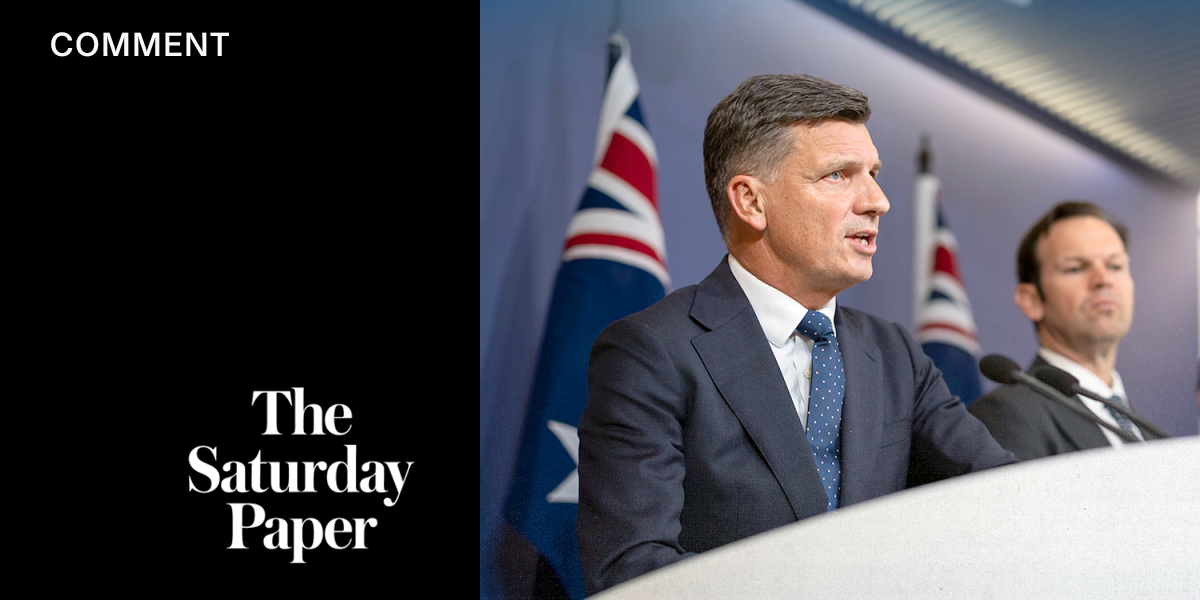
The leaders of Australia’s conventional parties of government, Anthony Albanese and Angus Taylor, are struggling to make any headway against an insurgency intent on destroying the hitherto accepted status quo.
Albanese’s three days at the Australian-bankrolled climate conference in Tuvalu and Fiji, rather than being seen as a bold initiative to advance the global response to catastrophic climate change, were slammed by political opponents as an indulgence and largely irrelevant to dealing with the immediate cost-of-living crisis.
Taylor, whose Liberal Party is still running third in the polls behind One Nation and Albanese’s Labor, unveiled his long-awaited immigration policy to near universal rejection from peak business groups, migration experts and the government.
The opposition leader promised to deliver the largest cut to immigration in Australian history by reducing the stock of temporary visa holders by about 650,000 over four years. He will somehow reduce net overseas migration to 100,000 – despite the fact that figure is at the mercy of the free movement of Australian citizens and New Zealanders as well as, because of our free trade deal, the surging numbers of visiting Brits.
The largest cut to Australian immigration was during the pandemic, when the international borders were closed to varying degrees from March 2020 to February 2022. This was not net zero but absolute zero and its negative impacts on supply and inflation were a major contributor to the cost-of-living crisis we have today.
Former deputy secretary of the Department of Immigration Abul Rizvi says net overseas migration boomed in 2022/23, mainly due to Coalition policies introduced at the end of the pandemic. They included unrestricted work rights for students, free applications, a Covid visa and a 30 per cent increase in work and holiday visa caps.
Labor, Rizvi says, was too slow to tighten the relaxed visa requirements, probably because it shared the worry of the Morrison government, which was that the economy needed a migration boost to recover.
Taylor’s scorn at Australia being a “guest worker” economy is a cheap shot that relies on voters forgetting he is as responsible as anyone for the situation.
Albanese and Bowen were the only officials of the attending countries to decline the traditional courtesy extended to visiting dignitaries. The smiling refusal was caught on camera and they were stand-out dissidents in the group picture.
Alan Gamlen, director of the Australian National University’s Migration Hub, says the Taylor policy is “a fizzle” based on false assumptions. He gave two interviews to the ABC, four hours apart, and in the latter said he doubted Taylor would be able to deliver the policy even if he won the next election.
Home Affairs Minister Tony Burke and Bran Black, chief executive of the Business Council of Australia, are in complete agreement on the dangers the policy poses.
According to Black, “We must avoid a race to the bottom based on an arbitrary migration figure that could hurt Australia’s economy while worsening the skills shortage.”
Pauline Hanson said the plan was “a photocopy” of One Nation’s. She says the Liberals’ plan is to “build more houses, then bring in more people to compete for them”. She says only One Nation can be trusted to deliver net negative migration for three years. It’s the equivalent of saying only her party can guarantee to crash the economy.
Meanwhile, in Tuvalu, Albanese created the jarring image of refusing to accept a floral head garland as part of a welcome ceremony. It was particularly unfortunate as Australia was reported to have spent $20 million helping the Pacific nations stage a conference ahead of the annual United Nations climate change convention in Türkiye next month.
Climate Change Minister Chris Bowen, who is president of COP31 negotiations, told reporters in Fiji the spending was in line with estimates that would be accounted for in the budget. Diplomacy, he said, costs money.
The diplomatic effort has everything to do with strengthening Australia’s standing in the region at a time of strategic competition with China. On this important goal, climate change is a major issue.
Albanese and Bowen were the only officials of the attending countries to decline the traditional courtesy extended to visiting dignitaries. The smiling refusal was caught on camera and they were stand-out dissidents in the group picture.
According to one source, media in the Pacific tend to portray Australians as self-important and superior, a stereotype not helped by the Morrison government’s noted neglect of the region. The Albanese gaffe would not have done much to counter this impression.
In this instance, the Australians misread advice from a Tuvaluan official who informed them that accepting the garland was optional and no one would mind if their preference was to go uncrowned.
Shadow minister for energy and emissions reduction Dan Tehan showed little sympathy, describing the Pre-COP31 event as “a farce” and noting the absence of invited world leaders after the United States, China, France, Japan and New Zealand declined to attend.
Tehan said that during the cost-of-living crisis the money would have been better spent at home in Australia. That may well resonate with hard-pressed voters but, as Albanese pointed out at the closing session of the conference, we are preparing for a summer of extreme weather events that experts warned are inevitable unless more is done to reduce emissions and curb global warming.
Although Bowen also faces criticism from within the Labor Party for the way the Pre-COP31 event was set up, the minister was unapologetic. He said the purpose was to amplify the focus of the world community on the impact of climate change on Pacific nations – and it has “achieved that”, he said.
The Pre-COP meeting may have seemed a good idea at the time, but the global impact on energy prices and inflation from the conflict in the Middle East has swamped concerns over climate change, according to the latest RedBridge Group poll in The Australian Financial Review.
The poll, taken in the week of the fourth interest rate rise this year, is seen by some in the commentariat as a turning point for the Albanese government.
“That’s too pessimistic,” says one cabinet minister. A week is a long time in politics, but Labor surely can’t afford too many more like it.
The treasurer is aware of the concerns and is flagging spending cuts in the midyear economic review. The need for further fiscal tightening can no longer be ignored.
Liberal Senator Andrew Bragg was dismissive: “Whatever savings Chalmers and Albanese come up with will be a pimple on the elephant’s arse.”
Maybe more means testing of entitlements is needed, but so is a mindset other than slashing and burning. What about saving $128 million by not paying Australia’s richest woman, Gina Rinehart, and her Hancock Prospecting the diesel fuel rebate? Or properly taxing the other mining companies that are cleverly avoiding paying what they owe?
Then again, what about imposing export caps that would help create strategic gas reserves that decouple Australian prices from Gulf geopolitics?
These ideas could take a lot of consumer heat off the government and even reverse the very dim view of the prime minister and treasurer shown in the published polls this week.
In the RedBridge poll, cost of living ranked as the top issue, according to 73 per cent of respondents. Immigration comes in at fourth and climate change at eighth.
This is not to say climate change is an issue to be ignored nor that the measures designed to reduce harmful emissions are dispensable, despite what will be said by One Nation and even the Liberals and Nationals.
The conflation of climate change action with domestic power bills is a trick as old as the successfully led Tony Abbott opposition of 2013.
One Nation’s treasury spokesman, Barnaby Joyce, has now dragged fighting inflation and cutting government spending into the climate scepticism frame.
On Monday, Joyce told Network Seven’s Natalie Barr that One Nation would immediately scrap the Department of Climate Change, Energy, the Environment and Water and “Chris Bowen’s secret Capacity Investment Schemes”. With an extravagant hand gesture, the One Nation MP said both would be “gone”.
Asked if wind and solar power projects “would all go under you?“, Joyce responded, “Ah, yes.”
By “secret Capacity Investment Schemes”, he means the government’s flagship policy to hasten Australia’s transition to clean energy and to have 82 per cent of the grid powered with renewables by 2030, something Albanese told the Pre-COP31 conference he is confident of achieving.
Joyce thought this climate action vandalism would save at least $38 billion.
Far from saving public money, though, Joyce said One Nation would be putting money into building “off-the-plan” Chinese-designed coal-fired power stations. He claimed they would cost about $3 billion each, which sounds like a gross underestimate.
Labor’s Josh Burns urged Joyce to take off his “tinfoil hat for a second” because what he was proposing was just “mad”.
That’s not the half of it.