
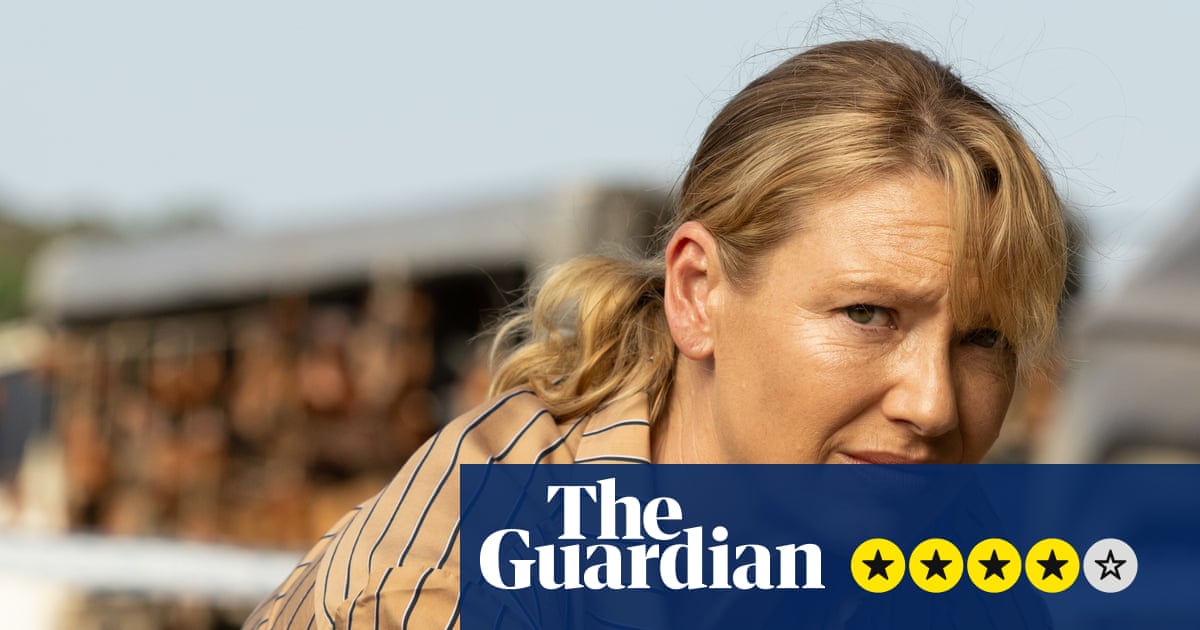
Everybody knows that knives spread butter, Kylie Minogue sings catchy songs, and Australian screen detectives return to their small-town homes. This tried-and-tested narrative, where a crime collides with the ghosts of the past, has again been deployed in Dustfall, a six-part crime drama anchored by another very strong and persuasive performance from Anna Torv (so good in The Newsreader) as the flinty-but-fair detective Antigone “Tig” Pollard.
Tig has relocated to the town of North Gap in Queensland when the show begins, living in the house of her recently deceased grandmother – to the chagrin of her mother, Olivia (Juliet Stevenson), who wants it sold – and feeling emotionally drained after a bruising, high-profile rape trial. But when an 18-year-old girl is discovered naked in a local cane field, with very limited recollection of the previous evening, Tig has another disturbing investigation on her hands.
Dustfall deploys familiar genre elements but it wouldn’t feel right to describe it as formulaic, thanks to the intense thoughtfulness brought by director Emma Freeman and her writers (Beatrix Christian, Dianne Taylor, Belinda Chayko and Stuart Page), adapting Vikki Petraitis’s novel The Unbelieved. They’re less interested in the mechanics of crime than the conditions surrounding a complex social issue, using the rape of 18-year-old Edie (a painfully powerful Zoe Phillips) to examine a wide range of orbiting themes including institutional and societal misogyny, victim-blaming and complicity.
Weaving all this together – while maintaining a sizzling momentum – is no easy feat, though Freeman has previously demonstrated her ability to steer morally sophisticated, psychologically charged productions such as her thrilling immigration detention drama Stateless (co-directed with Jocelyn Moorhouse). Dustfall has an emotional pull not commonly found in detective dramas. Australia is excelling at making these shows right now, delivering several cracking examples in only the last few months including Treasure & Dirt, The Killings at Parrish Station and Last Seen (though the latter technically follows a former detective).
Talia Walker (Lila McGuire), Remi Jolicoeur (Bert LaBonté) and Tig Pollard (Anna Torv) in Dustfall. Photograph: Vince Valitutti
When Edie’s story spreads, a nurse at the local hospital (Alice Ansara) observes: “It’s feeling a bit like that case on the beach.” This line is delivered naturalistically, though there’s no hiding its narrative significance: there’s more going on here than a single isolated crime. As the plot thickens and the suspect pool widens, the whodunit format is cleverly used not just to keep us asking questions but to make a point that almost nobody is beyond doubt when problematic attitudes towards women – and outright misogyny – are felt virtually everywhere.
There is a difference, of course, between problematic attitudes and shocking crimes, which the writers acknowledge while also arguing that they’re part of the same system. One small but telling moment occurs when a police investigator examines footage from a pub and asks: “What sort of a bloke drinks lime and soda?” He’s misguided from an investigatory perspective – Tig’s police partner Remi (Bert LaBonté, also excellent) informs him that such a drink order potentially provides many clues and leads. But it’s the gendered nature of the comment that sticks out; the patriarchal thinking that seeps into everyday language and behaviour.
skip past newsletter promotion
Sign up to Saved for Sunday
Ease your Sunday scaries with the best of Guardian Australia’s culture and lifestyle journalism.

after newsletter promotion
On top of all that, there’s no shortage of twists and fakeouts in Dustfall. The recurring presence of a python slithering around Tig’s home, with all the symbolism that slides around with it, feels perhaps just a touch on the nose. But this is rock-solid, socially conscientious drama, imbued with weight and thought.