
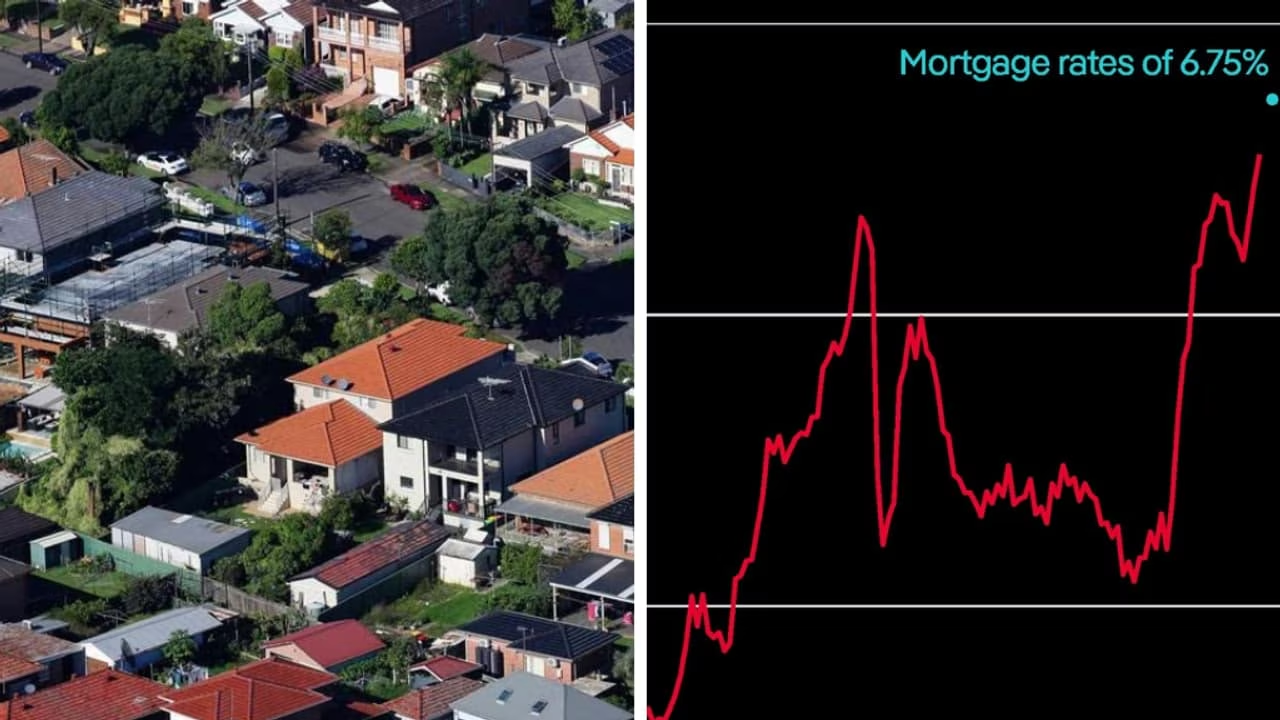
Aussie households will be saddled with a mortgage burden not experienced since the late 1980s should the Reserve Bank of Australia hike interest rates when it meets again in November.
Mortgage repayments would consume a whopping 37.4 per cent of a typical household’s income if the central bank hikes the cash rate to 4.85 per cent next month and pushes the average mortgage rate to 6.75 per cent, according to new analysis compiled by REA economists.
Want more finance news? Download our new app for even more coverage
This would put the repayment burden just short of the record 37.5 per cent of income reached in December 1989, when a typical mortgage rate was a staggering 15.56 per cent with the RBA’s cash rate peaking at 17.5 per cent in 1990.
REA economist Luc Redman said the data put into perspective the “classic line” used by older generations who paid 17 and 18 per cent interest rates. That is, that they had it harder.

“I think this sort of thing puts a lot more in perspective of, yes, that was obviously a difficult time, and it caused a recession. But ultimately, that price-to-income ratio is just so much higher now than with any sort of new home loan and basically any home loan,” he told news.com.au.
“You’re essentially feeling the burden of the equivalent of what they did prior to the [1990s] recession, which I think is quite important for people to understand the current housing market right now. Despite some recent price falls.”
Mr Redman said the analysis was based on a 30-year loan term and a 20 per cent deposit, so the reality was many first-home buyers would be facing a higher burden if they bought with a smaller amount.
“A lot of first-home buyers actually tend to have a lower than 20 per cent deposit and potentially also lower income, which potentially means their mortgage repayments as a share of income may be actually higher than that figure in a lot of cases,” he said.
Mr Redman said the main reason households were facing a higher burden today was due to real wage growth being a lot slower relative to house prices.
“That base, that mortgage that they would need to take out is significantly higher,” he said.
Responding to the data, Treasurer Jim Chalmers said a big reason why repayments were making up a larger share of household expenses was the rise in house prices. Since 1989, house prices have skyrocketed 540 per cent.
“House prices have increased at almost twice the rate of incomes since 1989 – a big motivator behind our budget changes which are helping more people into home ownership,” he told The Australian Financial Review.
Thousands more Aussies ‘at risk’ of mortgage stress
The latest Roy Morgan research showed 32.3 per cent of mortgage holders, or 1,718,000 people, were “at risk” of mortgage stress in August.
This was down 0.2 per cent from July, but up a significant 8.4 per cent since January after the RBA’s three previous rate hikes in February, March and May.
The highest level of mortgage stress ever recorded is still during the GFC when the figure hit 35.6 per cent and interest rates were at a 30-year high of 7.25 per cent.
An estimated 22.7 per cent of mortgage holders, or 1,207,000, were considered “extremely at risk”, which is above the long-term average over the last two decades of 16.4 per cent.
The “extremely at risk” level is based on people putting between 25 and 45 per cent of their after-tax household income towards their home loan.
If the RBA hikes rates again in November, Roy Morgan expects the number of mortgage holders considered at risk would increase to 33.9 per cent, equivalent to 1,801,000 mortgage holders and up 83,000 from now.
But most households have strong buffers
Mr Redman said the RBA’s financial stability review showed a lot of households had strong cash buffers and were in a relatively strong position.
“It’s a very limited number that are actually negative equity. So there’s actually quite strong equity gains that are kind of held by a lot of households,” he said.
The RBA’s review noted that while financial pressures had increased, most borrowers “continue to have sufficient income to meet their scheduled mortgage repayments and essential expenses”.
The estimated share of borrowers experiencing cash flow shortfall increased a little over the first half of 2026, but remains relatively low at around 2 per cent.
Most borrowers in a cash flow shortfall are estimated to have savings that would enable them to cover this for at least six months if they cut their consumption down to essential levels.
The latest APRA data shows balances in offset accounts are at near record highs at $340 billion.
According to the Big Four banks, between 85 and 88 per cent of customers are ahead on their repayments.
Mr Redman said households who are purchasing a mortgage now, compared to those who have held a mortgage for longer, were in a “worse position” and would be facing more stress.
“But when you consider someone who might be 10 years into a mortgage and they’ve been meeting their repayments and they’ve been setting money aside in their offset, they’re obviously in a lot less of a mortgage stress position,” he said.
Calls and chats to the National Debt Helpline reached 187,905 in the 12 months to the end of August, up 11.8 per cent compared to the same period the year before.
Calls in August alone hit 4,513 people, which was up from 2,990 at the same time last year.
Westpac and ANZ economists are expecting the RBA will hike rates again in November, while markets are pricing in a one in three chance of a rate hike in November.
If the RBA hikes rates in November, Canstar analysis found it would add an extra $92 to a $600,000 loan. Across five interest rate hikes, it would increase repayments by $456 a month.
Read related topics:Reserve Bank