
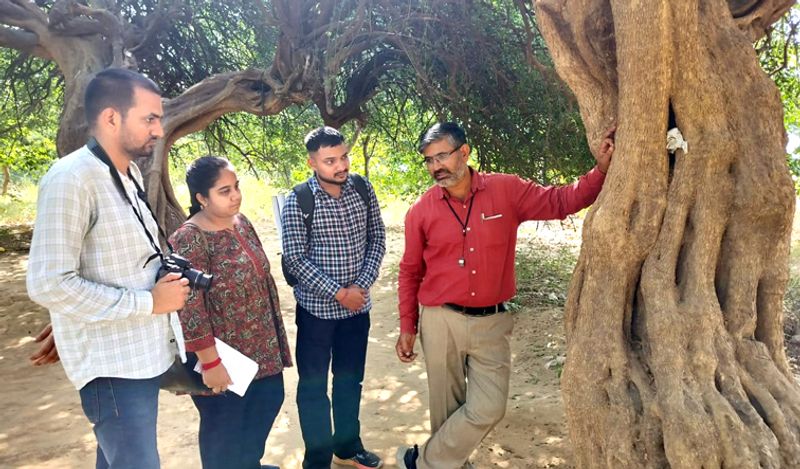
Despite Haryana’s rich heritage of medicinal plants, its natural reservoirs of traditional remedies are steadily shrinking due to habitat degradation, unplanned urbanisation, overexploitation and climate change.
These are the findings of a research conducted by Prof Surendra Singh Yadav of the department of botany at Maharshi Dayanand University (MDU), Rohtak, who figures in the World’s Top 2% Scientists List 2026 released by Elsevier and Stanford University, USA, recently.
Prof Yadav’s research documents the medicinal wealth of the Morni Hills, the Aravalli ranges and village community forests, known as Banis, where hundreds of plant species continue to serve local healthcare needs.
“Medicinal plants such as Ashwagandha, Baheda, Giloy, Guggul, Gokhru, Harad, Khejari, Nirgundi, Punarnava and Vasaka, among others, continue to be used by locals to treat common ailments. However, Haryana’s medicinal plant diversity is declining due to habitat degradation, unplanned urbanisation, overexploitation, climate change, pollution and the invasion of exotic plant species,” said Prof Yadav, who also serves as a member of the State Advisory Group of the Haryana State Biodiversity Board.
He stressed the need to restore degraded ecosystems, conserve medicinal plants in their natural habitats, maintain gene pools in herbal gardens and promote the cultivation of threatened species. He also called for greater community awareness, comprehensive databases and scientific research to guide conservation efforts. “Despite Haryana’s rich herbal heritage, limited research has examined the role of medicinal plants in primary healthcare across the state,” he said.
Prof Yadav, who earned his PhD in botany from Panjab University, Chandigarh, in 2007, has gained international recognition through his inclusion in the World’s Top 2% Scientists List for his contributions to botanical research, scientific publications and citations. His research interests span biodiversity conservation, ethnobotanical documentation and the bioprospection of medicinal plants.
He has published over 100 research papers, garnering more than 2,900 citations, with an H-index of 28 and an i10-index of 43. He has supervised 10 PhD scholars, guided 94 postgraduate students and completed five major research projects funded by government agencies, including the DST, UGC and MoEFCC.
“My research focuses on documenting and scientifically validating medicinal plants used by the local communities. My studies examine their traditional uses, phytochemical constituents, antioxidant properties and antimicrobial potential, linking scientific methods with traditional knowledge to advance healthcare research, biodiversity documentation and the preservation of indigenous practices,” said Prof Yadav, who belongs to Birar village (Jhajjar).