
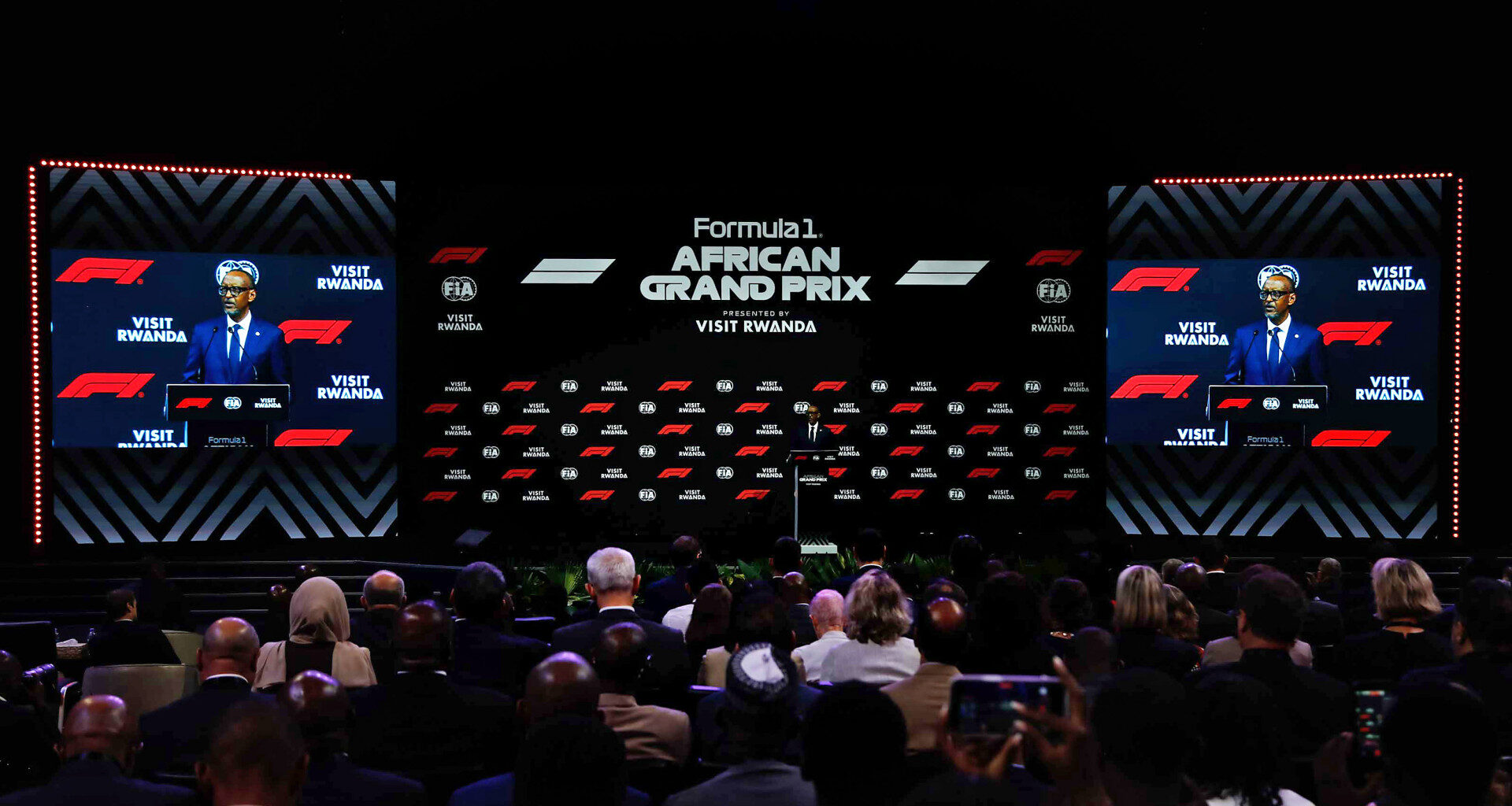
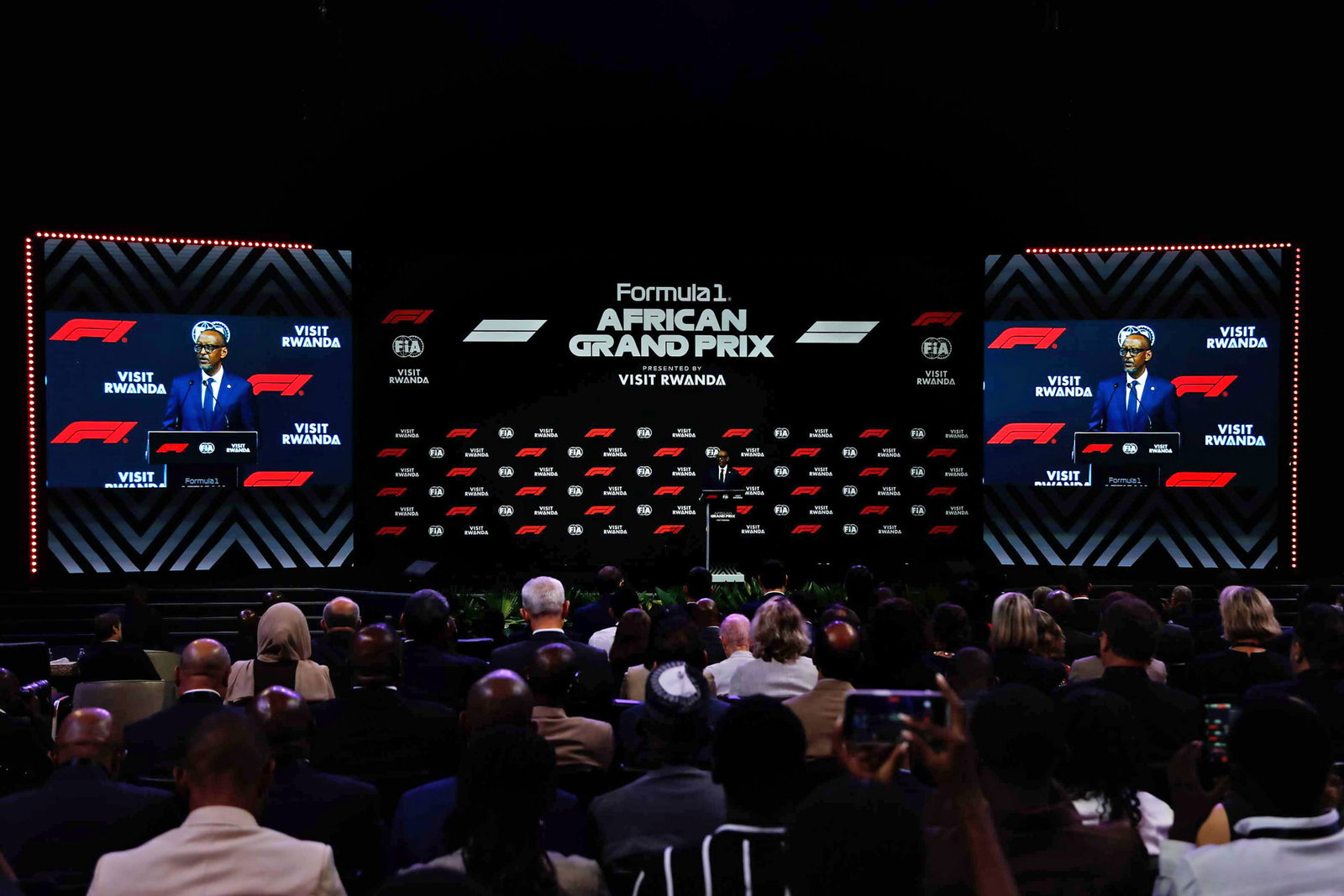
 President of Rwanda Paul Kagame speaks at the announcement of the African Grand Prix. Image: Formula 1
Following Tuesday’s confirmation of a 10-year agreement to host the African Grand Prix, further details have emerged about the proposed venue and the country’s wider ambitions for the championship.
Known as the Rwanda Motodrome, the purpose-built circuit will be located in Bugesera, south of the capital Kigali, with a six-kilometre, anti-clockwise layout featuring 17 corners.
Designed by Tilke Engineering in collaboration with former F1 driver Alex Wurz, the track will take advantage of the area’s natural landscape, incorporating two hills and a lake.
The circuit will feature 197 metres of elevation change, almost twice the 102 metres at Spa-Francorchamps, alongside banked corners and a one-kilometre straight leading into a hairpin designed to encourage overtaking.
Wurz has already completed thousands of simulated laps, with several current drivers and world champions also having experienced the proposed layout virtually.
The intention is to create a circuit that challenges drivers while providing opportunities for close racing across multiple motorsport categories.
Spectator experience has also been a major consideration, with the dramatic terrain allowing for extensive views of the circuit.
Managing director of Tilke Engineering Carsten Tilke said the site’s natural landscape had played an important role in shaping the design.
“We were very, very lucky because it’s a very hilly topography,” he said.
“We have a lake. We have everything you dream of when you design a track.
“This also gives the character of the track; very flowing, very fast. It’s really shaped by the natural features and beauty of the site.
“And this is why we also have a lot of elevation changes. It’s really is a roller coaster track with a lot of banking.
“It goes up and down 12 to 13 percent.”
F1 confirms historic return to Africa
The venue is expected to accommodate approximately 100,000 spectators, with plans extending beyond F1 to include karting, off-road facilities, a driving experience centre and spaces for concerts and other events.
However, significant work remains before the first race can take place.
Construction of the circuit will coincide with the development of Bugesera International Airport, which is expected to open in 2028.
The airport is considered a major component of the project, with organisers also facing the challenge of establishing transport infrastructure capable of handling the anticipated crowds.
Those requirements partly explain why F1 has committed to an early 2030s debut without specifying an exact year.
Beyond the infrastructure, Rwanda is also seeking to establish the event as a significant milestone for motorsport throughout Africa.
That ambition explains the decision to name the event the African Grand Prix rather than the Rwandan Grand Prix, with organisers hoping to attract involvement from other countries across the continent.
Rwanda Development Board chief executive Jean-Guy Afrika believes the event could eventually encourage further additions to the F1 calendar elsewhere in Africa.
“We want to make it bigger than just Rwanda,” Afrika said.
“We want to make it the moment when the sport came back to Africa and then never left.”
Only two African countries have previously hosted World Championship F1 races, with 24 grands prix held on the continent since the championship began in 1950.
Morocco staged a single race at Ain-Diab in 1958, while South Africa hosted the remaining 23, with Kyalami providing the setting for the final event in 1993.
Seven-time world champion Lewis Hamilton has been among the strongest advocates for an African return, repeatedly expressing his desire to compete on the continent before retiring.
The 41-year-old previously suggested he could extend his career to achieve that ambition, although Rwanda’s proposed debut remains several years away.
The agreement has nevertheless attracted criticism, with Amnesty International accusing Rwanda of attempting to improve its international image through major sporting partnerships.
The organisation highlighted allegations of arbitrary detention, torture and restrictions on freedom of expression, while questioning F1’s decision to commit to the country.
“A 10-year Grand Prix ‘presented by Visit Rwanda’ is a sportswashing prize for the Rwandan authorities,” Amnesty UK’s head of campaigns Felix Jakens said.
An F1 spokesperson defended the agreement, maintaining that the championship could positively influence communities while reaching an estimated 100 million supporters across Africa.
Rwanda has already expanded its international sporting presence through events including the 2024 FIA Awards and 2025 UCI Road World Championships.