
For the third straight month, workers’ paychecks did not keep pace with rising prices, the Labor Department’s final inflation report ahead of the midterm elections revealed.
U.S. consumer prices rose 0.6% from the month before in September, above forecasters’ expectations. Over the year, prices for all items were up 3.7%, surpassing August’s 3.4% pace. In comparison, average hourly earnings for employees on private, nonfarm payrolls increased 3% over the year last month.
A 9.1% rise in gas prices led the month-over-month increase in prices.
As workers struggle with the cost of living, consumer confidence is sitting at a 12-year low and 52% of Americans surveyed by WalletHub said they believe inflation is going to “ruin” Christmas this year.
Voters may be looking for political candidates who can make their lives more affordable before heading to the polls on Nov. 3, but economists say there is no guaranteethat prices will come down any time soon. Several factors are contributing to inflation’s stubbornness, including — but not limited to — war in Iran, tariffs, and the AI buildout.
While those things remain largely out of the Federal Reserve’s control, its policymakers have committed to delivering price stability. They voted to raise the Fed’s benchmark for short-term interest rates to help tame inflation last month. The Labor Department’s September report, which shows year-over-year inflation is still well above the Fed’s 2% target, will help inform their next rate decision on Oct. 28.
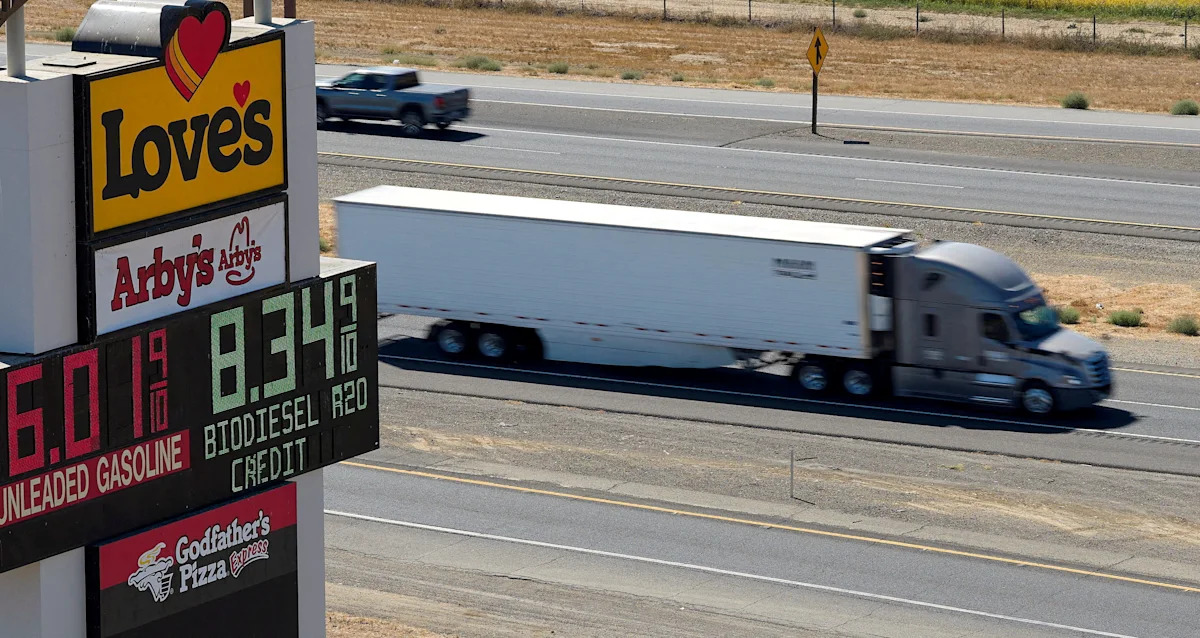
 FILE PHOTO: A semi drives past a sign advertising gas and diesel prices along Interstate 5 in Williams, California, U.S., September 28, 2026. REUTERS/Fred Greaves/File Photo
More: Nearly 72M Social Security recipients to get 3.6% COLA raise in 2027
What is the core US inflation rate?
“Core” consumer price inflation, the department’s way to measure price changes while excluding more volatile food and energy costs, rose 0.3% in September as recreation, used vehicles, education, airline fares, medical care, and apparel got more expensive.
Core CPI was up 2.6% over the year in September after a 2.4% increase in August. It’s closely watched for signs that price pressures are easing or evidence that supply shocks, like limited oil supply due to global conflicts, are beginning to raise the price of other goods and services.
“There is increasing evidence that the energy price shock caused by the war in the Middle East is starting to produce price increases in other core goods and services,” Christopher S. Rupkey, chief economist of FWDBONDS LLC, said in a note after the report’s release. “It is clear that as long as geopolitical risks lead to higher energy costs, there will be cost pressures on many businesses that force them to pass the inflation hot potato on to other consumers and companies.”
More fodder for the midterms
With midterm elections weeks away, Democrats blamed Republicans and President Donald Trump for September’s inflation increase.
“President Trump promised to end inflation and lower costs ‘on day one.’ More than 600 days into his second term, he has done the exact opposite, driving up costs for American families with his disastrous war in Iran and reckless tariff taxes,” Pennsylvania Rep. Brendan Boyle, the Democrats’ ranking member on the House Budget Committee, said in a statement.
White House National Economic Council Director Kevin Hassett painted a rosier picture of the report in a NewsNation interview.
“The topline number was driven by a surge in energy prices, which we believe to be temporary, but there is a whole bunch of good news in the report,” Hassett said, highlighting price declines for some food products and a 1.2% drop in prescription drug prices.
Are gas prices still climbing?
A jump in gas prices drove the all-items increase again. They rose 9.1% in September, accounting for over half of the monthly all-items increase, the Labor Department said. Gas prices are up 34.2% over the year.
War in Iran, the Russia-Ukraine war, and conflict in the Red Sea are limiting the global oil supply. As of Oct. 14, futures for Brent crude, the international benchmark are trading at $106 per barrel and futures for West Texas Intermediate, the U.S. benchmark, are trading near $96.
Consumers are well aware of higher prices at the gas pump. The national average price of a gallon of regular unleaded gasoline is $4.33, up from $3.08 this time last year, according to AAA.
As of Oct. 14, the national average price for a gallon of regular gasoline has remained over $4 for 158 days this year, according to GasBuddy, surpassing the previous annual record of 157 days set in 2022, the year Russia invaded Ukraine.
What about diesel?
Americans may be grateful their car doesn’t run on diesel, the average price of which is hovering near $6.30 per gallon, but much of the U.S. economy depends on it.
The rise in diesel costs is a point of concern for economists as it fuels the transportation of many goods sold in the United States and disproportionately affects truckers, farmers, and fishers. Over time, high diesel prices can lead to higher price tags for a wide range of products and services.
Under a new deal, Trump said Russia would supply hundreds of thousands of tons of diesel fuel to the American and global marketplace to bring diesel costs down. Experts are skeptical that plan will work.
“That deal is unlikely to have a meaningful impact,” Jill Cetina, a professor of finance at Texas A&M University and former vice president of bank supervision at the Dallas Fed, said. “I would view that more as a symbolic thing.”
Some grocery costs ticked down but dining out stayed pricey
Americans may have paid a bit less when checking out at the grocery store in September depending on what they bought. The Labor Department’s food at home index ticked down 0.1% over the month, but grocery costs were up 1.8% over the year.
The monthly decline was driven by a 2% drop in milk prices and a 1% dip in beef prices. Still, some items got more expensive. Carbonated drink prices rose 1.5%, fruits and vegetable costs rose 0.5%, and the index for cereals and bakery products ticked up 0.1%.
Dining out again got pricier last month. The “food away from home” index rose 0.2% in September and was up 3.5% compared to September 2025.
What does this mean for the Fed?
The Federal Open Market committee, tasked with keeping unemployment low and prices stable, voted last month to raise the target range for short-term interest rates to 3.75% to 4% in a bid to tame the pace of rising prices, though monetary policy famously works on a lag.
After U.S. employers added a disappointing 29,000 jobs, past months’ payroll gains were revised down, and the unemployment rate ticked up in September, the question is whether the committee members will vote to raise the range again.
The hot September inflation report increases the odds of another hike after the Fed’s meeting at the end of the month, according to Bill Adams, Fifth Third Commercial Bank’s chief U.S. economist.
“If the Fed hikes in October, it would in part be because they see increased possibility that the Iran War’s disruptions to energy supplies persist into 2027,” Adams said in a note.
The day before the Labor Department inflation report’s release, 78% of traders bet on an October pause, and 70% expected a quarter-point hike in December, according to CME FedWatch. After the report’s release, 52% are betting on a quarter-point hike this month, and traders are about evenly split on whether the range will be 4% to 4.25% or 4.25% to 4.5% after the Fed’s December meeting.
(This story was updated to add new information.)
Reach Rachel Barber at rbarber@usatoday.com, follow her on X @rachelbarber_, and subscribe to her newsletter “Making More of Your Money” here.
This article originally appeared on USA TODAY: Energy, gas costs push inflation higher. Paychecks are lagging behind