
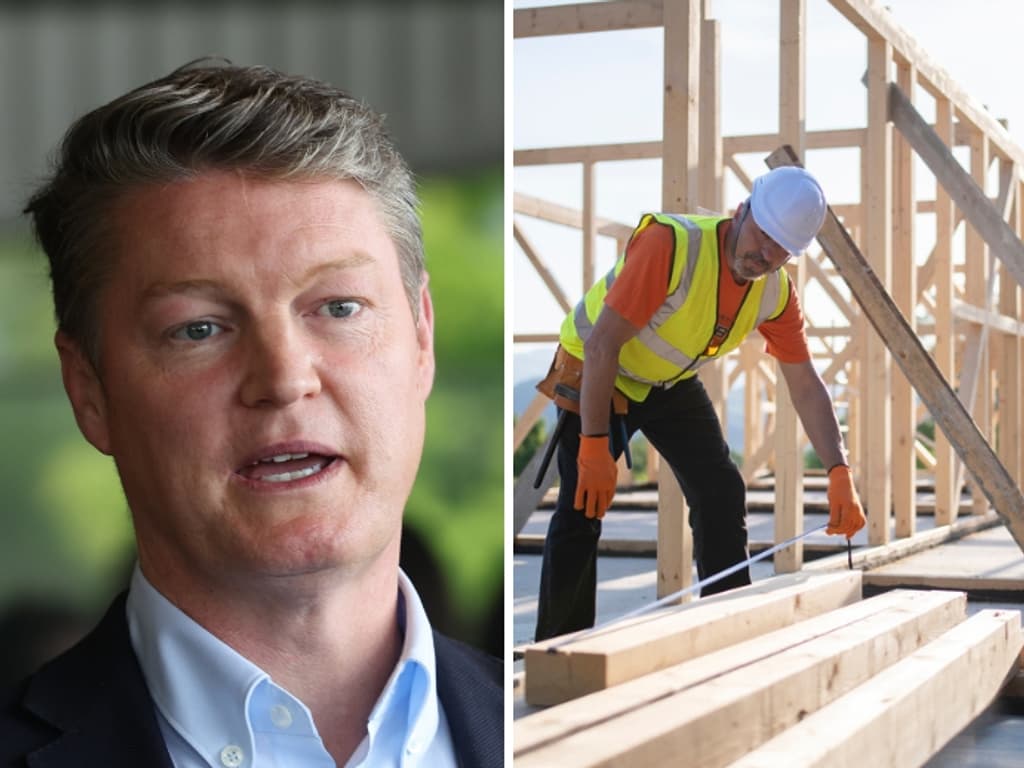
A re-elected Carroll government is planning to reopen the state’s door to foreign investors wanting to buy Victorian homes after a decade-long crackdown.
Although property and building groups welcomed the Wednesday announcement as a step in the right direction to help address the state’s housing crisis, they said it wouldn’t do much to deliver more affordable homes and called for broader reforms.

The Victorian Labour government has promised to review state’s Absentee Owner Surcharge and Foreign Purchaser Additional Duty if it is re-elected in November.
Treasurer Colin Brooks said if the Labor government was re-elected in November, it would review the state’s Absentee Owner Surcharge and Foreign Purchaser Additional Duty.
RELATED: Japanese investors surge into Australian property as Chinese sell
Victorian landlords face mandatory licences and three-strike bans
One in 10 Victorian auctions in doubt as tough new laws start
This would include looking at how revenue is collected, how it impacted foreign investment in construction and the impact on first-home buyers.
Mr Brooks added the government was updating guidelines so developers who build affordable housing would be exempt from the Surcharge during construction, if they met the Development Facilitation Program’s criteria.
This particular change is expected within the next three weeks or so, ahead of the government entering caretaker mode on November 3, ahead of the November 28 election.
The DFP provides expedited planning pathways for eligible projects and allows the Minister for Planning to bypass local council decisions on developments.
Victorian Treasurer Colin Brooks says first-home buyers are Labor’s priority and it wants enough homes built for them to be able to purchase. Picture: NewsWire/Andrew Henshaw.
Victoria was the first Australian state to introduce the AOS and FPAD, under former Premier Daniel Andrews, more than a decade ago.
The FPAD is an extra 8 per cent surcharge on the dutiable value of residential property acquisitions by foreign buyers, levied on top of standard stamp duty.
The AOS is a state land tax surcharge applied to nonresident and foreign individuals, corporations and trusts who hold Victorian land.
Housing Industry Association Victorian executive director Keith Ryan says more detail is needed on the government’s plans including what exactly will qualify as affordable housing worthy of the tax cuts.
Housing Industry Association Victorian executive director Keith Ryan said in order to be eligible for the DFP, housing projects were generally required to have a minimum $50m spend for Melbourne and $15m for regional Victoria, to offer multiple units and be either medium-density or high-density.
He said a fair interpretation of the announcement would be that the government had realised its current tax regime had scared off foreign investors, but they needed them to help meet the state’s home building targets.
Victoria has set a goal of building 800,000 homes in a decade, but is currently only producing about 55,000 a year.
Mr Ryan said the Victoria’s current tax settings had driven away investors, including overseas-based ones, as government taxes, regulatory costs and charges accounted for more than 40 per of the cost of developing a typical new house-and-land package in Melbourne.
HIA research has shown it is adding hundreds of thousands of dollars to the cost of building a home.
Ray White chief economist Nerida Conisbee says it will not be easy to win foreign investors back to Victoria’s shores.
However, Mr Ryan added cutting the AOS was “very unlikely to be sufficient to make these medium and high-density residential development projects feasible”.
“Essentially it’s not really going to do much to deliver more affordable homes and we’re already hearing that a lot of these projects, even when they do get DFP approval, aren’t necessarily going ahead – a minor tax cut might help a few get going,” Mr Ryan said.
“But from what I’m hearing, there’s so many other challenges that it’s very unlikely they’re going to get very far, so I think it’s useful step but it’s not going to do much.”
Ray White’s chief economist Nerida Conisbee said most of the apartments in Melbourne’s CBD wouldn’t have been built without foreign investment.
“A lot was done to scare them (foreign investors) off,” Ms Conisbee said.
“It won’t be easy to get them back.”
The Property Council of Australia Victorian executive director Cath Evans says a government commitment to examining the impact of Victoria’s property changes is encouraging after years of the sector calling for tax reform.
The Property Council of Australia welcomed the government’s commitment, but said broader changes were needed.
The organisation’s Victorian executive director Cath Evans said the Ben Carroll-led government had “recognised the impact Victoria’s property tax settings are having on investment and housing delivery, and these changes are a step in the right direction”.
“We know the 2023 doubling of the Absentee Owner Surcharge has had a significant impact on investment in Victoria, with an estimated $5bn in lost economic activity,” Ms Evans said.
“Victoria cannot afford to keep losing investment to other states.
“We need to see more substantial commitments from all parties to address our uncompetitive property tax settings, restore investor confidence and make it easier to deliver the homes, workplaces and infrastructure our growing state needs.”
Sign up to the Herald Sun Weekly Real Estate Update. Click here to get the latest Victorian property market news delivered direct to your inbox.
MORE: ‘Pretty much guaranteed’ Victorian auction pain to hit state budget
Why a threatened frog became part of new Melbourne’s new community
Australian homeowners warned expensive smart-home tech fails to boost property sale prices