
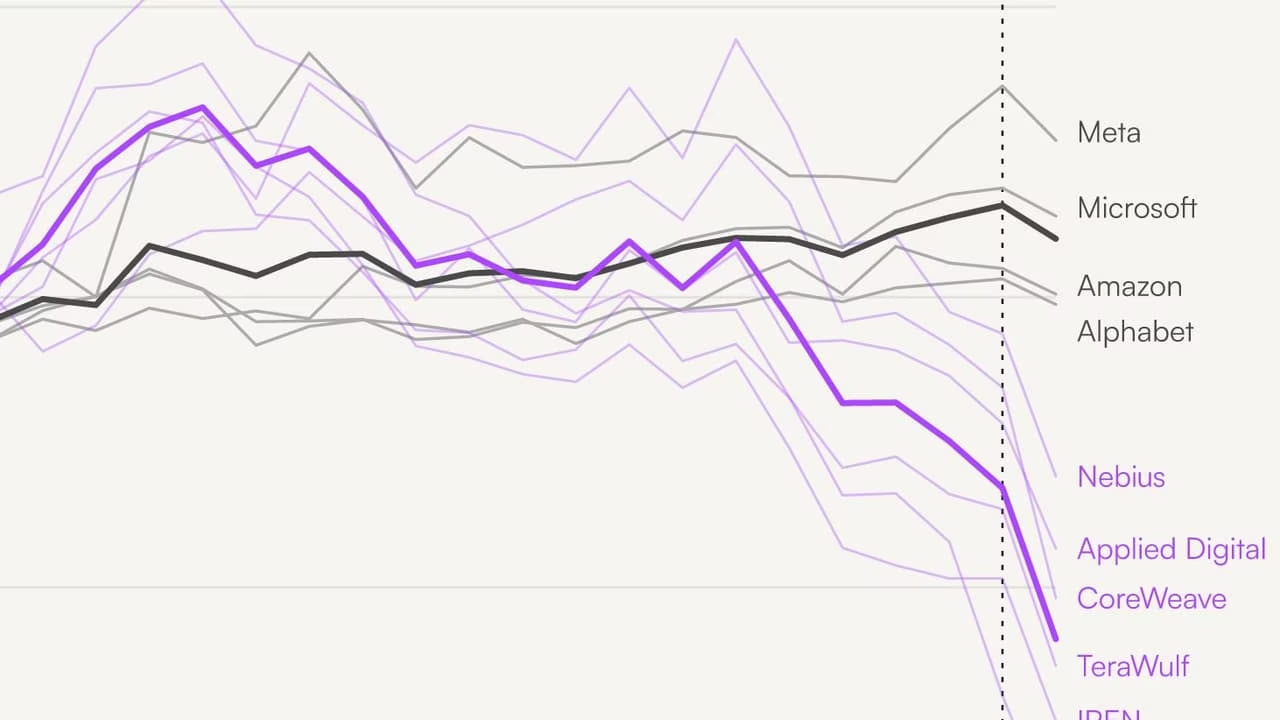
An ominous move has occurred in the AI industry as the shares of US data centre operator CoreWeave plunged overnight over worries over its huge debt pile in a period of rising interest rates.
The world’s richest man Elon Musk appeared concerned over the development, writing a single word response to the sell-off which sparked a chain reaction as other debt-reliant AI firms like Nebius, Applied Digital, TeraWulf, and Cipher Mining also saw their share prices plunge.

“Yikes,” wrote Mr Musk in response to a graph posted on X showing how the slump rippled through the market, causing a 12 per cent fall across all ‘neocloud’ companies listed on Wall St.
A neocloud is a specialised cloud provider built from the ground up to deliver high-performance graphics processing units (GPUs) and artificial intelligence infrastructure.
‘They’re going to get wiped out’
CoreWeave, a New Jersey company which builds data centres and loans the operations to tech giants like Meta or Microsoft, slumped 15.5 per cent at $65.78.
The company has turned to debt to finance hefty purchases of pricey semiconductor chips from Nvidia. CoreWeave had $35.6 billion in debt at the end of June, according to US securities filings.
On Wednesday, yields on CoreWeave bonds due for repayment in 2031 and 2032 surged to near 15 per cent, reflecting heightened angst over the company’s prospects.
The company’s financial position leaves CoreWeave especially vulnerable to a sudden weakening in AI financing, said Gil Luria, an analyst at DA Davidson.
“If the AI cycle sputters… CoreWeave is gonna be the first to go,” Mr Luria said Wednesday on the Prof G Markets podcast. “The equity value is going to be zero.
“And the reason is, it’s a poster child for bad behaviour, for borrowing at very high rates to build a speculative asset.
“This is a speculative investment, and they’re borrowing at 9 per cent to fund that. And the returns they’re getting are around 1 per cent right now, and at best they’re guiding they’re going to get to four or 5 per cent.
“This is like an individual investor taking a margin loan at 9 per cent to buy treasuries that yield 5 per cent. That’s destruction of value.
“That’s the essence of CoreWeave. If if things don’t go well, they will not be able to make their interest payments. They’re going to get wiped out.”
CoreWeave Chief Executive Mike Intrator told employees the market was behaving “irrationally,” according to a memo cited by Bloomberg that reiterated confidence in the company’s business model.
CoreWeave made its Wall Street debut in March 2025 at $39, rising quickly in the ensuing months on AI enthusiasm before falling later that year.
The global debt jitters also follow the sensational collapse of Australia’s own mega-float. Just days ago, AI data centre operator Firmus was forced to dramatically pull its planned $44 billion blockbuster listing on the ASX after institutional investor demand evaporated.
Backed by Nvidia, the firm had pitched what would have been one of the biggest floats in Australian corporate history to fund its regional “AI factories”, but the deal was abruptly shelved amid mounting investor skepticism over eye-watering valuations, massive debt, and market volatility.
Markets rattled globally
The move came in the midst of a volatile day on Wall St that was rocked by the latest US inflation data.
All three major American indices dropped overnight but the tech-heavy Nasdaq suffered the deepest declines, losing nearly two per cent.
The impact has spread to Asian markets this morning. Japan’s benchmark stock index lost more than three per cent on Thursday and South Korean shares shed six per cent.
Tech giants Samsung Electronics and SK hynix were sharply down, extending recent falls in the tech sector as investors question the longevity of the AI boom.
The US consumer price index was up more than analysts expected in September — rising 3.7 per cent year-on-year, a marked increase from August’s 3.4 per cent reading.
“On concerns over inflation, US stocks have broadly declined, and following that trend, Japanese stocks are expected to start with selling pressure dominating,” Japanese online brokerage Monex said.
Globally, tech firms had taken a hammering this week, amid concerns about China’s progress in developing AI chips and following comments by Broadcom’s chief executive likening the AI buying frenzy to gambling.
On Thursday morning in South Korea, memory chip giant Samsung Electronics was down around seven per cent, while its domestic rival SK hynix was down nearly nine per cent.
Here in Australia, the ASX200 opened in the red but has since recovered since the latest jobs data came out this morning.
Fresh Australian Bureau of Statistics figures show the jobless rate came in at 4.7 per cent in September up from 4.6 in August.
Economists say this will give the Reserve Bank reason to pause rate hikes this year which would be a welcome move for mortgage holders but also businesses wanting to borrow money.
US hit by rough inflation spike
Part of the reason for the global market jitters was that US consumer inflation was hotter than anticipated in September according to government data, as Washington’s continued war with Tehran pushed energy costs higher.
The uptick underscores voter worries over high costs of living, and comes as President Donald Trump is campaigning in US states to shore up support for his Republican Party as it tries to retain control of Congress in the midterms.
The spike to 3.7 per cent was a notable acceleration from 3.4 per cent in August.
Inflation picked up pace on a month-on-month basis too, accelerating from 0.4 per cent in August to 0.6 per cent last month.
Fuel costs accounted for more than half of the monthly CPI jump, surging 9.1 per cent in September.
The higher-than-expected inflation reading has raised the odds of a second straight interest rate hike at the US central bank’s October 27-28 policy meeting, although many expect the Federal Reserve to proceed cautiously.
Economist James Knightley at ING noted that Fed officials John Williams, Philip Jefferson and Christopher Waller have suggested “that we don’t need to see back-to-back interest rate increases,” instead leaning towards “a slow and steady” approach.
He expects the Fed will want to be “careful and cautious in terms of its policy tightening.” Traders see a 37.1 per cent chance that the Fed will raise rates by another 25 basis points in October, according to CME Group’s FedWatch tool. The probability was around 22 per cent a day prior.
“We expect at least two more rate hikes by early 2027, starting in December,” said KPMG chief economist Diane Swonk. “September gave the Fed more reason to hike, even if officials hold in October.”
Industries sensitive to interest rates, including housing, are already under pressure from steeper borrowing costs.
Yields on US government bonds spiked after the inflation report. The 10-year Treasury yield, which influences rates on mortgage and auto loans, rose to 5.3 per cent from 5.2 per cent. But it has since moderated.
Energy prices have soared since the United States and Israel attacked Iran in late February, prompting Tehran to block off the Strait of Hormuz, a vital route for oil and gas shipments.
Average prices at US fuel pumps have surged more than 45 per cent since the start of the Middle East war to $4.33 per gallon, according to AAA motor club data.
Diesel prices have soared even more, by 67.7 per cent, boosting the cost of transporting goods and threatening further spillovers to consumers.
“Again, the Iran-US conflict has led to higher motor fuel costs that everyone is experiencing,” ING’s James Knightley told AFP.
“The US is also seeing substantial increases in airline fares,” he said, adding that this will likely contribute to additional price pressures.
Core CPI, which excludes volatile food and energy prices, was up 2.6 per cent from a year ago.
Although high fuel and diesel prices drove about half of the September spike in inflation, “it’s starting to spill into other areas,” warned Heather Long, chief economist at the Navy Federal Credit Union.
“Airfares, used cars and recreation all had big price jumps,” she added. “Americans are seeing their pay totally wiped out by inflation. That’s been the case for half a year now.”
With the underlying US economy remaining strong as massive spending linked to the artificial intelligence buildout boosts demand for chips and labour, economists also caution that higher costs could continue filtering through to households.
— with AFP
Read related topics:Elon Musk