
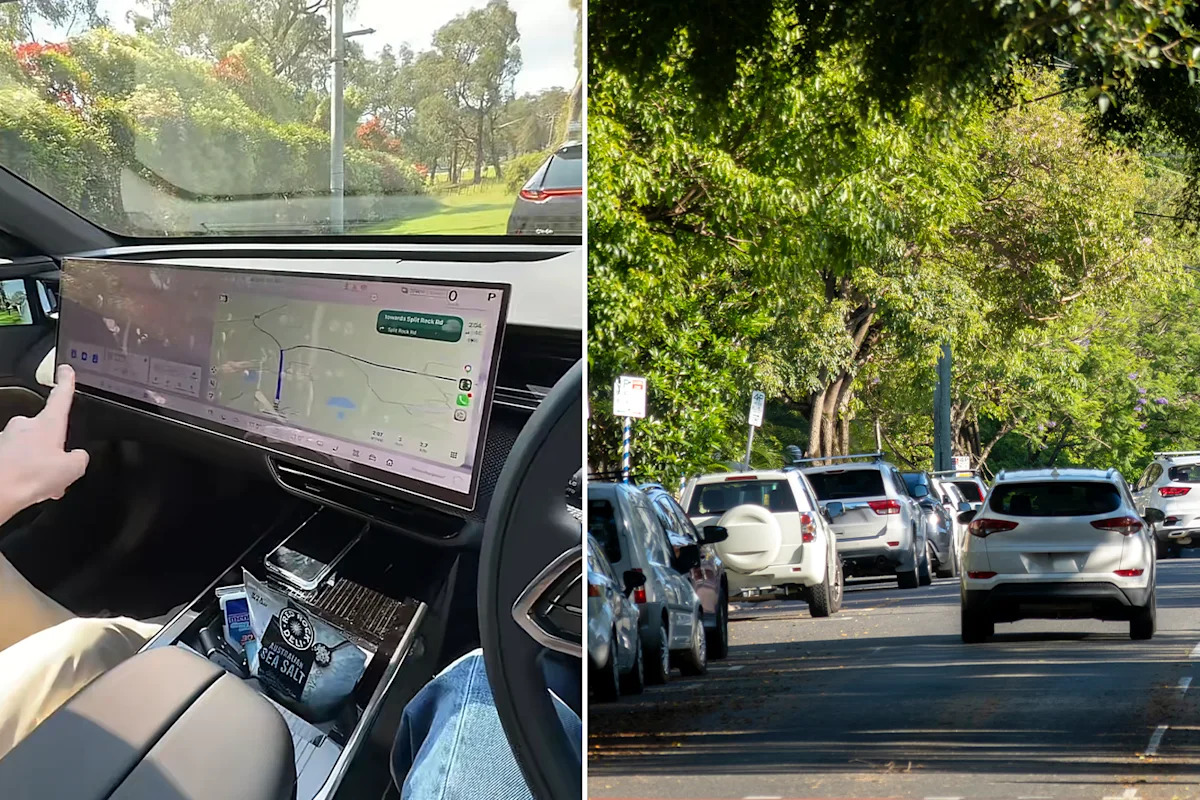
Road safety experts are sounding the alarm over a dangerous feature becoming increasingly widespread in Australian cars, which they say can effectively “blind” drivers for over 30 metres.
Australia, like most countries in the world, strictly bans the use of mobile phones behind the wheel.
In stricter states, like Queensland, for example, they can’t be anywhere on your body — including even resting on your lap.
So why is it then that so many new models of cars — electric vehicles in particular — seem to boast enormous electronic touch-screen displays?
That’s a question many have been asking recently as more and more high-tech vehicles flood the market from overseas.
 Are touch screens dangerous on the road?
Research commissioned by the Australian Automobile Association (AAA) found that in one vehicle, an incredible 11 steps were required to perform a task, taking about a second per prompt.
RAC WA Manager of Vehicles and Fuels, Alex Forrest, told Yahoo News Australia that the research “clearly shows” there is a direct link between the number of steps a task takes and “the number of seconds the driver’s eyes are off the road”.
“If you take your eyes off the road for just two seconds at 60km/h, you’ve travelled 33 metres blind,” he said.
University of Newcastle researchers, who conducted the study, used eye-tracking glasses and other technology to assess how distracting different in-car infotainment systems were for drivers.
The study examined 10 built-in systems, including those found in BMW, Toyota and Tesla vehicles, alongside Apple CarPlay and Android Auto.
Apple CarPlay came out on top, requiring an average of just two steps to complete a task and taking drivers’ eyes off the road for slightly more than one second. At the lowest end of the scale was the system fitted to the Cupra Ateca.

The Cadillac Escalade IQ’s impressive in-car touchscreen. Source: Just Jana
Should in-car touchscreens be subject to the same rules as mobile phones?
Yahoo News Australia asked the Chief Executive Officer of Australasian College of Road Safety, Dr Ingrid Johnston, whether she thought large in-car touchscreens were as distracting as mobile phones.
She said, “Yes, potentially”, but believes “screen size alone is not the key issue”.
Dr Johnston explained that the real danger wasn’t necessarily the size of the screen, but how much attention drivers had to divert from the road to use it.
Systems that force motorists to scroll through menus and make multiple selections can be particularly distracting and unsafe.
“At 60 km/h, a vehicle travels approximately 100 metres in six seconds,” Dr Johnston said.
She also raised concerns about manufacturers replacing traditional buttons with touchscreens.
RELATED:
However, this shouldn’t be seen as a case of “touchscreens bad, buttons good”, Dr Johnston said, acknowledging that screens still have a place.
She argued that ultimately, Australian road rules have struggled to keep pace with rapidly evolving vehicle technology.
That’s created the disconnect people keep talking about between what motorists can legally do on their phones and the functions available through built-in screens.

A Queenslander recently received a fine for having her phone attached to her body on a lanyard. Source: Supplied
“It creates an understandable tension,” Dr Johnston said.
“The law may impose strict limitations on interaction with a handheld mobile phone while a vehicle’s integrated system can offer many of the same communications, entertainment and navigation functions,” she said.
But changes are underway.
Dr Johnston said the Australasian New Car Assessment Program (ANCAP) is taking a closer look at how easy it is for drivers to use important controls, including touchscreens, when assessing vehicle safety.
There was a strong case to be made for tougher standards that focused on how distracting a system was, instead of the physical device being used.
“Distraction should be treated consistently regardless of whether the source is a mobile phone, a touchscreen supplied by the vehicle manufacturer or another device,” Dr Johnston said.
In other words, both should be held to similar safety standards if they pose the same risk.
You can also follow us on Facebook, Instagram, TikTok, X and YouTube.