
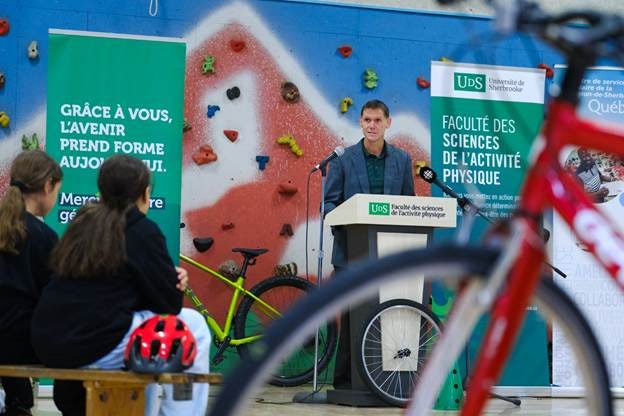
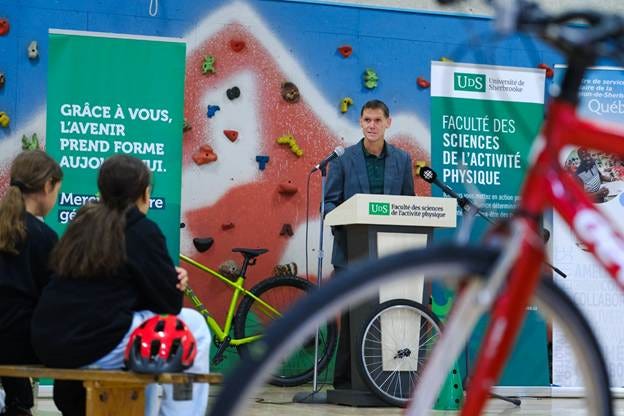
Université de Sherbrooke professor Jérôme Leriche speaks about a three-year cycling project intended to help 292 pupils at Sherbrooke’s Jean-XXIII elementary school develop their riding skills. Photo courtesy of Université de Sherbrooke.
Get local news like this every morning. Subscribe free below.
A three-year Université de Sherbrooke project aims to give 292 pupils at Sherbrooke’s Jean-XXIII elementary school regular opportunities to develop cycling skills while researchers study the effects on their confidence, motor skills and well-being.
In a release dated Oct. 16, the university said the initiative will involve children from four-year-old kindergarten through Grade 6.
Plans include expanding the school’s bicycle fleet, acquiring safety equipment and offering educational activities that encourage active transportation.
The project, called “À vélo pour des milieux scolaires plus actifs et inclusifs,” is supported by the Fondation Justin Lefebvre, Fondation MB Capital and Fondation de La Fontaine.
Researchers from the university’s Faculty of Physical Activity Sciences will lead the work, with cycling instruction expertise from the Centre national de cyclisme de Bromont.
Jean-XXIII already offers cycling activities. The initiative aims to organize those activities into a lasting program that helps pupils build their skills throughout elementary school.
According to the university, the school serves an area with a high deprivation index. Its existing commitment to outdoor activities and healthy living, along with support from staff and school leadership, helped make it a suitable setting for the project.
Jérôme Leriche, the professor leading the research team, said school cycling outings can reveal gaps in children’s riding skills.
“We find that when we offer school cycling outings, up to a third of the pupils in a class still don’t know how to ride a bike,” Leriche said in the release, translated from French.
His observation helps explain the project’s focus on regular learning opportunities throughout elementary school.
For principal Marie-Pierre Tardif, making cycling instruction available is also a question of equal opportunity.
“We were surprised to realize that a large proportion of the children did not know how to ride a bike,” Tardif said in the release, translated from French.
Tardif said cycling instruction gives pupils opportunities to develop balance, independence, safety awareness and confidence — skills she believes may also support their school experience.
The approach goes beyond a one-time introduction, giving children opportunities to practise and apply what they learn in different settings over several years.
The research team plans to examine the program’s effects on motor skills, confidence, active transportation and well-being.
A master’s student will help implement and evaluate the initiative, documenting its effects and the conditions that support its success.
Researchers also want to understand parents’ perspectives and how cycling instruction can fit into everyday school life.
“The project could have concrete benefits for children, teaching staff and the entire school community,” Leriche said in the release, translated from French.
The Bromont cycling centre will contribute practical expertise in learning and teaching cycling, complementing the university team’s research.
The findings are intended to help identify what schools need to establish and sustain a cycling program. They could also guide efforts to adapt the approach for other Quebec schools.
Don’t miss the next story that affects your community.
Join thousands of readers getting The Pulse every morning—plus breaking news alerts when it matters most.
If you value this kind of local journalism, consider supporting it.
Subscribe, share and like!