
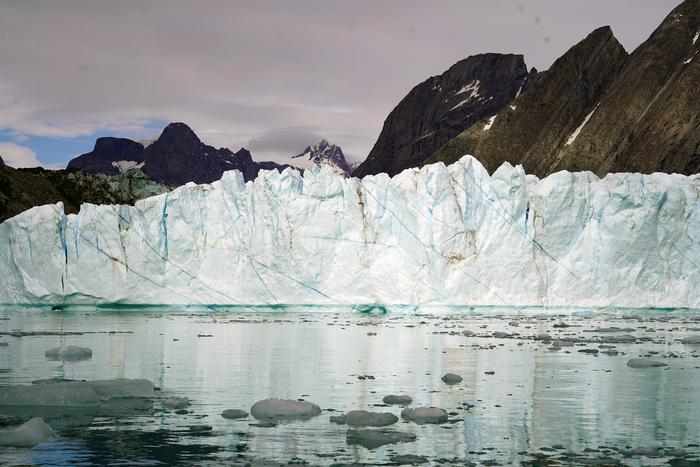
How has Antarctica’s ice sheet changed over time? This is what a recent study published in Science hopes to address as a team of scientists investigated a connection between climate change and Antarctica’s sea ice change. This study has the potential to help scientists, legislators, and the public better understand the impact of climate change and the steps that can be taken to address and mitigate it.
For the study, the researchers used satellite data collected from 2019 to 2023 to observe and analyze more than 15,000 sea cliffs across Greenland and Antarctica with the goal of better understanding a process known as calving, which is when large ice chunks break off at the end of a glacier or ice wall. The primary motivation behind the study was to fill a longstanding knowledge gap regarding a process called marine ice cliff instability (MICI) and whether longstanding models match real-world observations.
In the end, the researchers found cliffs taller than 100 meters (328 feet) is the threshold for calving to occur, whereas cliffs under 100 meters tend to not experience calving. Essentially, calving doesn’t occur nearly as much as previously thought.
“We found that when the cliffs were retreating, they were doing so faster than what has been modeled, which would mean more ice loss and higher contributions of sea level rise,” said Caroline Needell, who is a PhD student in the MIT-WHOI Joint Program and lead author of the study. “But because we found that the retreat was short-lived, and all the glaciers eventually stabilized, that would suggest that things won’t be so bad. We don’t see this runaway effect.”
This study builds on a growing body of research that has monitored sea ice loss in the face of climate change but also sheds light regarding how sea ice loss might not be as bad as previously thought.
What new insights into Antarctica’s sea ice will researchers make in the coming years and decades? Only time will tell, and this is why we science!
As always, keep doing science & keep looking up!
Sources: Science, EurekAlert!
Featured Image Credit: Caroline Needell