
NEED TO KNOW
Dombroski sought care for breast cancer after finding a lump in 2013, knowing his mother’s history raised his risk of the disease
The former NFL player underwent a mastectomy before being declared cancer-free
He and wife Caron now urge men to recognize symptoms early during Male Breast Cancer Awareness Week
Paul Dombroski is part of the less than 1% of men who are diagnosed with breast cancer, and he considers it a “privilege” to share his journey.
Through the Pro Football Retired Players Association and Breastcancer.org, the former NFL player and his wife Caron, a former NFL cheerleader, opened up to PEOPLE about his diagnosis in honor of Male Breast Cancer Awareness Week (Oct. 17-23).
Paul, 70, played six seasons with the Kansas City Chiefs, New England Patriots and Tampa Bay Buccaneers between 1980-85. He admits that because of his football career, he did well prioritizing his health after retirement.
“I retired in 1986 from the NFL, but I took pretty good care of myself,” he says. “I got out pretty unscathed, nothing that put me behind the eight ball with my health. So, generally speaking, I felt great.”
But in 2013, he received a life-changing diagnosis.
“I was watching TV one day and I was just yawning and I lifted my arm and just kind of rubbed my hand across my chest. And I felt the lump under my nipple,” he recalls.

Paul Dombroski in the NFL
Credit: Courtesy Paul Dombroski
The first thing that came to Paul’s mind was that he had breast cancer. Although the disease is not on the radar for most men, his mother was a breast cancer survivor and he knew that put him at greater risk. “A lot of men would think it’s just this fatty tissue as you get older. But I didn’t even hesitate. I pretty much knew right away,” he says. “You know, it’s not rare when it has to do with your family.”
“And he’s not a negative person or someone who would jump to the worst-case scenario,” Caron adds. “So for him to say that, I knew it was something serious.”
The couple, who both work as hairdressers, had a trip to Hawaii planned at the time but scheduled a doctor’s appointment immediately upon their return. Paul’s primary care physician thought the lump was “suspicious” and sent him for an ultrasound and mammogram.
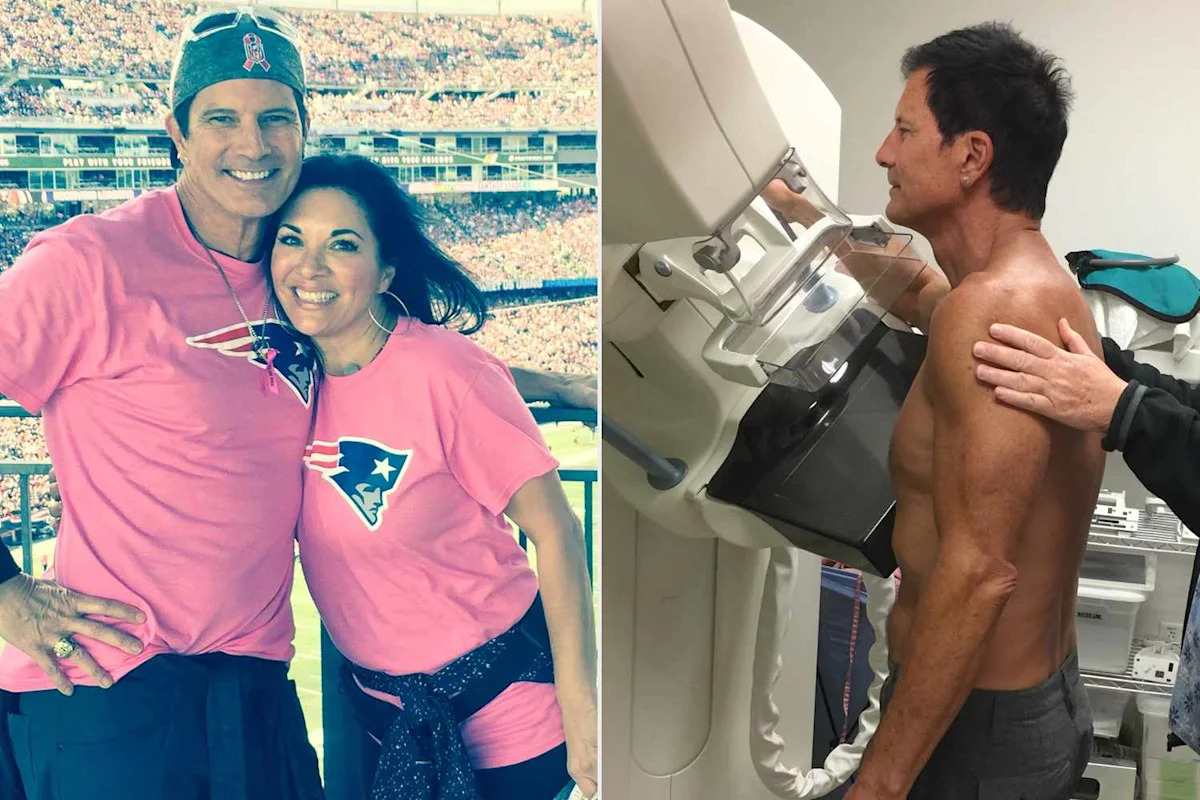
“I have more sympathy and a new respect for women trying to get a mammogram. I’m wondering how I’m going to get it into that machine. There’s nothing there!” he says with a laugh. “So it was an interesting test. But for a man to go through a female perceived procedure, there’s a lot of emotion and a lot of psychological things going on in your head.”
Following his mammogram, Paul also underwent a biopsy. He recalls realizing how rare male breast cancer was because he was suddenly surrounded by several doctors.
“Apparently they don’t see many of these very often. I’m just waiting for them to start selling popcorn at that point because I got a full room of people watching me get a biopsy,” he teases.

Paul Dombroski getting a mammogram
Credit: Courtesy Paul Dombroski
Although he was mentally preparing himself to hear the word cancer, getting his results a week later was still a devastating moment. Paul was diagnosed with stage 2 breast cancer.
“The surgeon called and said, ‘Paul, your worst fears are realized,’ ” he says, noting that he decided right then to not let it break him.
“So when that kind of delivery is given to you, there’s a couple ways you can take it,” he explains. “Mine was pretty much a punch in the gut initially, but then, because I played football my whole life, I kind of went into a mental mode of ‘Okay Doc, how do I get back on the field? How do we attack this?’ “
Meanwhile, Caron admits that she couldn’t help but feel scared initially.
“My thought, which I didn’t share with him, was: is he gonna die? What’s gonna happen? What’s the scar gonna look like? Those fearful things that everyone’s got in their head,” she says. “But we started discussing it, like, we can go after this. We can do this.”

Paul and Caron Dombroski at an NFL Crucial Catch event at Gillette Stadium to promote early detection
Credit: Courtesy Paul Dombroski
Within a month, Paul underwent a mastectomy and had four lymph nodes removed. After about five years taking Tamoxifen, monitoring his condition and keeping up with routine scans, he was officially declared cancer-free and has been healthy ever since.
“My doctor said pretty much the surgery was the cure,” he says. “Health-wise, I feel awesome. 70 is the new 40, that’s my saying.”
Paul and Caron have since been using their platform to educate others about male breast cancer and stress the importance of early detection.
“Early detection, especially on something like this, is really, really important,” Paul says. “And I think that’s why the mortality rate is much higher for men, because they don’t look for it or they’ll excuse it or they just push it aside.”
“You wait out of fear,” Caron continues. “You don’t wanna open the portal and know what the report says. You don’t wanna open the letter. I understand that all of us struggle with that, but early detection is gonna give you the best pathway. Don’t wait on stuff like that.”

Paul and Caron Dombroski
Credit: Courtesy Paul Dombroski
Never miss a story — sign up for PEOPLE’s free daily newsletter to stay up-to-date on the best of what PEOPLE has to offer, from celebrity news to compelling human interest stories.
Dr. Marisa Weiss, founder and chief medical officer of Breastcancer.org, says that’s why there’s so much value in people like Paul sharing their experience.
“Even though less than 1% of all breast cancers occur in men, any diagnosis of breast cancer hits hard on the individual and their family,” she explains. “No two breast cancers are alike, just like no two people are the same. This is why representation matters and we tell stories of all people impacted.”
Paul adds that he also feels a responsibility to share his cancer journey, and hopefully his transparency helps someone else.
“It could’ve ended worse for me, I understand that. I even said to Caron when I got that diagnosis, ‘If God takes me now, I have no regrets.’ But I think there is a purpose in what we go through,” he tells PEOPLE. “And over time, I realized that I can make an impact. If we save one life, I mean, who really has the power to do that? I’ve been put in this position to do something extraordinary, you know? It’s a privilege.”
Read the original article on People