
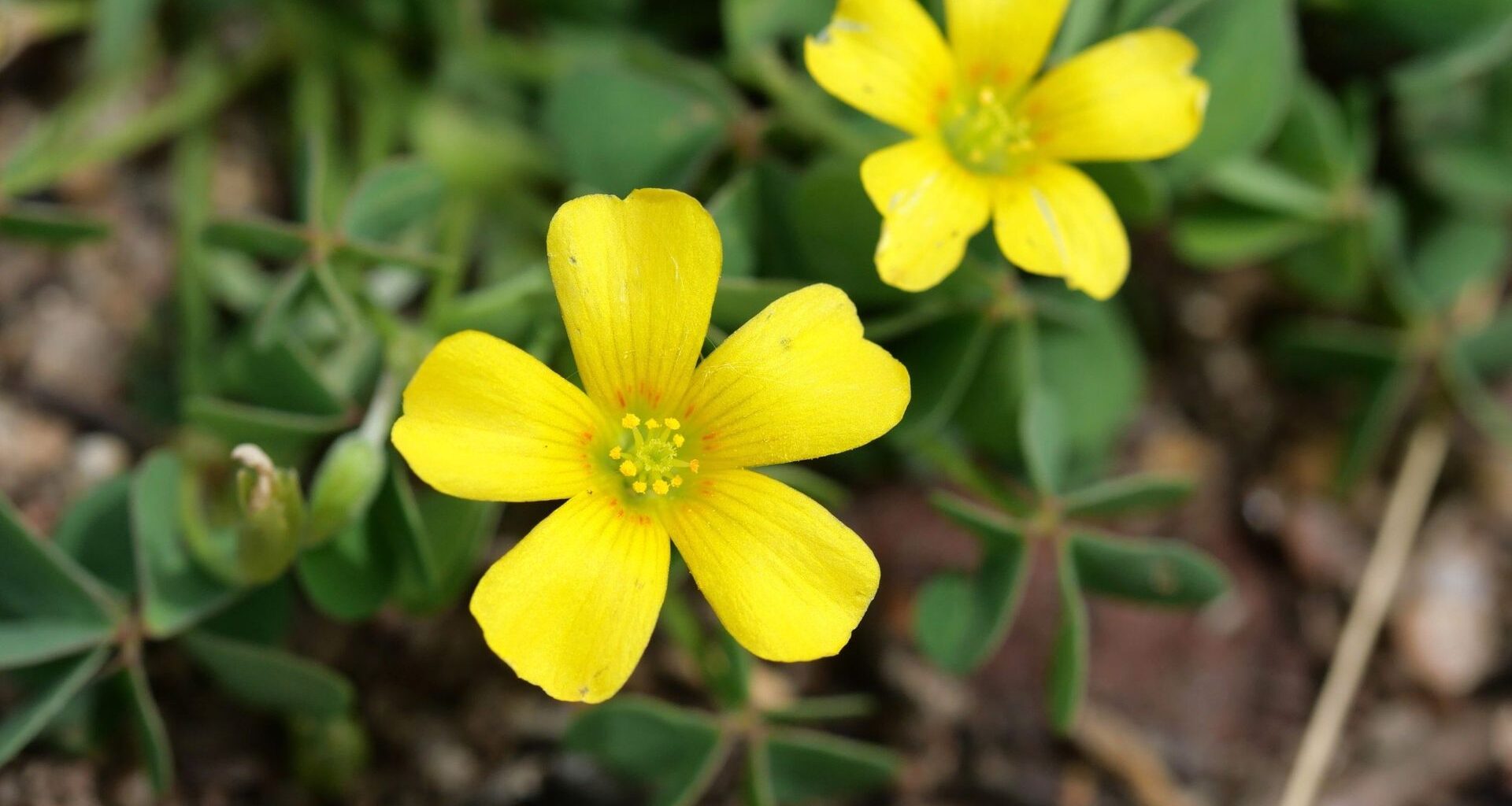
Researchers discovered that low doses of a common herbicide can increase flowering in weeds, with unexpected consequences for visiting insects.
Weedkiller is meant to stop weeds from growing. But what happens when only a little of it reaches a plant?
For yellow wood sorrel, a weed found in lawns and fields, the answer is complicated.
In a two-year experiment, plants exposed to a small amount of the herbicide dicamba produced more flowers than plants that weren’t sprayed. Their flowers were smaller, though, and insects visited each one less often.
The findings suggest that herbicide drift doesn’t always have the effect people expect. Even when it doesn’t kill a plant, it can change how that plant grows, flowers and attracts insects.
Regina Baucom is the senior author of the study and a professor at the University of Michigan.
“The general public uses herbicides in their lawn to kill weeds. They’re not using herbicides to make the weeds do better,” said Baucom.
“They probably don’t even know this is a potential side effect or something that can happen.”
When a small dose has a different effect
Dicamba is commonly used to control broadleaf weeds. It works by imitating auxin, a natural plant hormone that helps regulate growth. At a high enough dose, it disrupts development so badly that susceptible plants die.
But dicamba can also move beyond the area where it’s sprayed, carried in droplets or vapor. The U.S. Environmental Protection Agency identifies damage to nearby plants as a major ecological concern.
A tiny dose may do something quite different from a full-strength spray. Scientists call this hormesis: a low level of something harmful produces a boost in growth or another trait.
Researchers have seen similar effects with other herbicides, including glyphosate. Some studies have reported increases in plant growth or reproductive traits after low-dose exposure.
Anah Soble Botran and colleagues wanted to know whether that kind of response could also influence flowering and the insects that visit flowers.
Their subject was yellow wood sorrel (Oxalis stricta), a hardy plant that often survives attempts to remove it.
Earlier greenhouse research had already suggested that drift-level dicamba could extend its flowering season.
More flowers, but not necessarily more seeds
The researchers collected seeds from wild wood sorrel growing in Kentucky and Tennessee.
In 2022, they planted nearly 500 seeds representing 31 maternal families at the Matthaei Botanical Gardens in Ann Arbor, Michigan.
Half were sprayed with dicamba at roughly 0.7% of the recommended field dose. The rest received the same spray mixture without the herbicide.
The difference appeared quickly. Over three weeks, treated plants added leaves 44% faster.
They also flowered more. By the first hard frost in November, sprayed plants had produced an average of 139 flowers each, compared with 95 on the other plants.
In 2023, the team repeated the experiment with nearly 700 plants from 16 of the same families.
There was no clear growth boost in the second year. But the flowering effect returned.
During the first month after spraying, treated plants produced about 180 flowers on average, compared with 140 on untreated plants – roughly 29% more.
Across both summers, extra flowering was the clearest response to low-dose dicamba.
More flowers, however, don’t automatically mean more offspring.
In 2022, sprayed plants produced around 18% more seeds. Yet the counts varied so widely that the difference alone wasn’t statistically convincing.
Further analysis suggested the herbicide influenced seed production indirectly, by increasing the number of flowers.
In 2023, the extra flowers didn’t lead to an increase in fruit.
One possible explanation is timing. In 2022, only 17% of the plants had started flowering when they were sprayed. In 2023, 78% had already begun.
Plants exposed earlier in their development may respond differently, and weather conditions could also have played a role.
How did pollinators respond?
The researchers found another trade-off: sprayed plants grew more flowers, but those flowers were slightly smaller.
Measurements of 3,430 flowers in 2023 showed that treated flowers averaged 8.09 millimeters across, compared with 8.73 millimeters on untreated plants.
The team observed plants during September and October, recording insects entering flowers during 20-minute sessions.
Wood sorrel can largely pollinate itself, but hoverflies, honeybees and other insects still visit for pollen and nectar.
Insects visit flowers less
Individual flowers on treated plants received about one-third fewer visits than those on untreated plants.
Honeybees visited flowers on treated plants less frequently, while bumblebees visited them slightly more often. Hoverfly visits showed no meaningful difference.
But looking at visits per plant told a different story.
Plants with more flowers attracted more visits overall. In other words, insects weren’t necessarily avoiding treated plants; their attention was spread across a larger number of blooms.
That could affect pollen movement, although the study didn’t test whether it did.
Does this make weeds harder to control?
The results raise a question: could repeated exposure to drifting herbicides eventually help certain weeds thrive?
The study doesn’t establish that. The researchers found no evidence that families differed genetically in how much dicamba increased flower numbers.
Without that kind of inherited variation, there’s no clear basis for this particular response to become stronger through natural selection.
“We found no evidence of genetic variation,” Baucom said, describing the flowering increase as a response within one generation rather than evidence of evolution.
There was one exception: the amount by which flowers shrank differed across families, suggesting a genetic component to that trait.
The experiment also tested just one weed species and one low dose in a research garden. It doesn’t show that herbicide drift is increasing weed populations on farms.
Long-term effects remain unknown
Future research will need to examine other doses, plants and growing conditions, as well as whether smaller flowers provide enough food for visiting insects.
Tracking seedlings over several generations could also reveal whether extra flowers eventually translate into more weeds.
For now, the takeaway is simple but unexpected: a weedkiller doesn’t need to kill a plant to change its life.
Sometimes, at the edges of a sprayed field, it may even leave that plant with more flowers.
The study was published in New Phytologist.
—–
Like what you read? Subscribe to our newsletter for engaging articles, exclusive content, and the latest updates.
Check us out on EarthSnap, a free app brought to you by Eric Ralls and Earth.com.
—–