
Alia Karaman, the project director for Sydney’s long-awaited southwest metro extension, cannot say when the new train line will open but she can say when it won’t.
“It’s not going to be this weekend,” Karaman told the Guardian last Monday. “I can safely rule out that.”
At a news conference later in the week, the New South Wales transport minister, John Graham, says the opening of the latest section of what the state government touts as “Australia’s biggest public transport project” will be “a matter of weeks, not months”.
“We are very close,” he said.
Alia Karaman, the project director for the southwest metro extension, says ‘change is seen in a positive light’. Photograph: Jessica Hromas/The Guardian
The opening depends on a key final approval from the Office of the National Rail Safety Regulator (ONRSR) – Karaman submitted the final piece of safety data to the regulator this week. After regulator approval delayed the opening of the city metro section in 2024, the Minns government has been at pains not to commit to a date for the southwest expansion, despite media reports that it was aiming for launch on 18 October.
The former T3 heavy rail line was only originally estimated to be closed for 12 months when it ceased operations in September 2024. However, converting the historic stations on the 130-year-old line to be fit for the driverless, rapid transit system has proved challenging.
Mechanical “gap-fillers” have been added to fill the space between the train doors and curved platforms, as has anti-ibis infrastructure to keep the birds out of the rail corridor. They were frequently triggering a sensitive new hi-tech intrusion detection system, Karaman says. At four stations, particularly wide gaps will still mean that certain train doors will not open, while data is collected on the reliability of the gap-fillers.
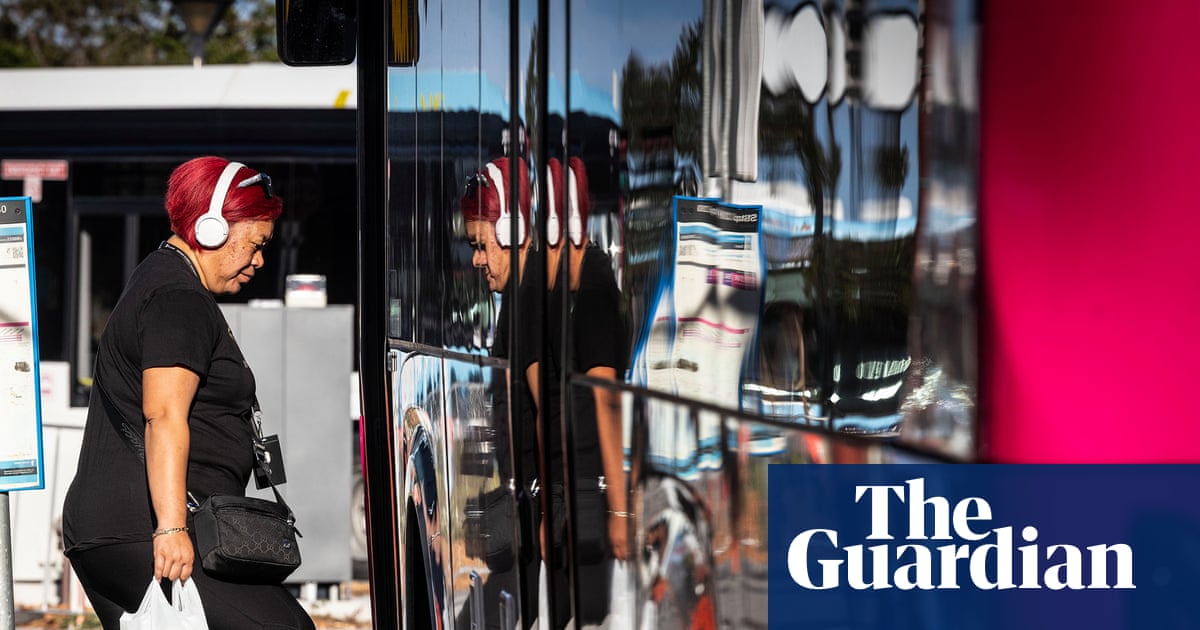
People at the bus stop on Chapel Road by the new Bankstown metro station. Photograph: Jessica Hromas/The Guardian
In Bankstown, at the end of the expanded line, locals and commuters are either unaware of the impending opening, or sceptical about the completion of a project first announced by the former Coalition government in 2014. Labor campaigned against it at the 2019 election but has supported the project under Chris Minns as premier. The city and southwest metro sections have cost more than $20bn combined.
But Sophie, who works in Bankstown but lives in Chatswood at the northern end of the metro city section that opened two years ago, says the southwest extension’s opening will be “life-changing”.
“It’s going to cut my commute down in half,” she says, before breaking off to run for a local bus.
Jason Tran, drinking an early morning coffee at a heaving cafe on Bankstown’s City Plaza, agrees. “I’ve had enough of the pink buses,” says the IT worker, whose commute to the city begins with a more than 40-minute replacement bus journey to Sydenham.
When the extension opens, the train will take 21 minutes from Bankstown to Sydenham, before rolling into the feted city metro, making parts of the Sydney suburbs within easier reach of the city’s centre than ever before.
Jo Haylen at the new Dulwich Hill metro station. Photograph: Jessica Hromas/The Guardian
The Labor MP for Summer Hill and Marrickville resident, Jo Haylen, has been catching the pink buses herself.
The former transport minister, who oversaw the closure of the T3 line, admits the pink bus is “not a train, but it’s been free and it’s been frequent”, even if “on a rainy day, it’s just not as much fun”.
“I do think we do need to remember what we had before,” Haylen says. What had been four trains an hour at smaller stations like Dulwich Hill will become a train every four minutes during the peak.
“It will be a totally different proposition about how people will choose to move … People will leave their private vehicles at home for the first time ever.”
Tran thinks more people will use the metro to explore Bankstown – “It’s multicultural, you have all your ethnic food” – but says he thinks the property prices will “skyrocket, for sure”.
skip past newsletter promotionFree newsletter |When needed
Sign up to Breaking News Australia
Get the most important news as it breaks

after newsletter promotion
An October 2025 analysis by Domain found houses within 400 metres of a station on the metro’s northwest section (which opened in 2019) sell for an average 16.6% more than comparable homes 2-3km away, and units 24.4% more.
A ‘Trojan horse for development’?
Some of the stations on the southwest extension are a focus of the NSW government’s transport-oriented development (Tod) housing strategy, which the government says will increase supply and affordability where it is most needed. The Tod zones allow six or seven-storey unit blocks within a 400m radius of train stations, and would see 7,800 homes built in the inner west council area within five years.
Heather Davie says development will mean ‘life is just not going to be as comfortable or pleasant’. Photograph: Jessica Hromas/The Guardian
The Labor-led Inner West council, which covers part of the area serviced by the expanded metro network, narrowly voted through its more ambitious housing plan last year, rezoning parts of Dulwich Hill and Marrickville to allow high-rises of up to 22 storeys. The state government has yet to approve the proposal.
Heather Davie, Marrickville resident of 40 years, and a member of the Better Future Coalition and Save Marrickville groups, says “we’ve always known that the metro was a Trojan horse for development”.
She walks down a street just south of the line, pointing out federation houses slated for demolition for multi-storey apartment buildings – one is a proposal for a block for between seven and 23 storeys.
“Life is just not going to be as comfortable or pleasant,” Davie says, adding that many of the new developments are “not built for families”, with minimal parking or outdoor space.
Federation houses in Byrnes Street, Marrickville. Photograph: Jessica Hromas/The Guardian
Karaman grew up in Bankstown. “I don’t live here any more, but my grandparents do, my mum does,” she says.
She says she hasn’t heard from people worried about rising property prices or gentrification. She says people are not even upset to have missed out on the stunning architecture that has defined the metro stations on the already established line.
“Change is seen in a positive light, as opportunities, as employment, prosperity, education,” she says. “It means that people are going to be knocking on the door to want to do work.”