
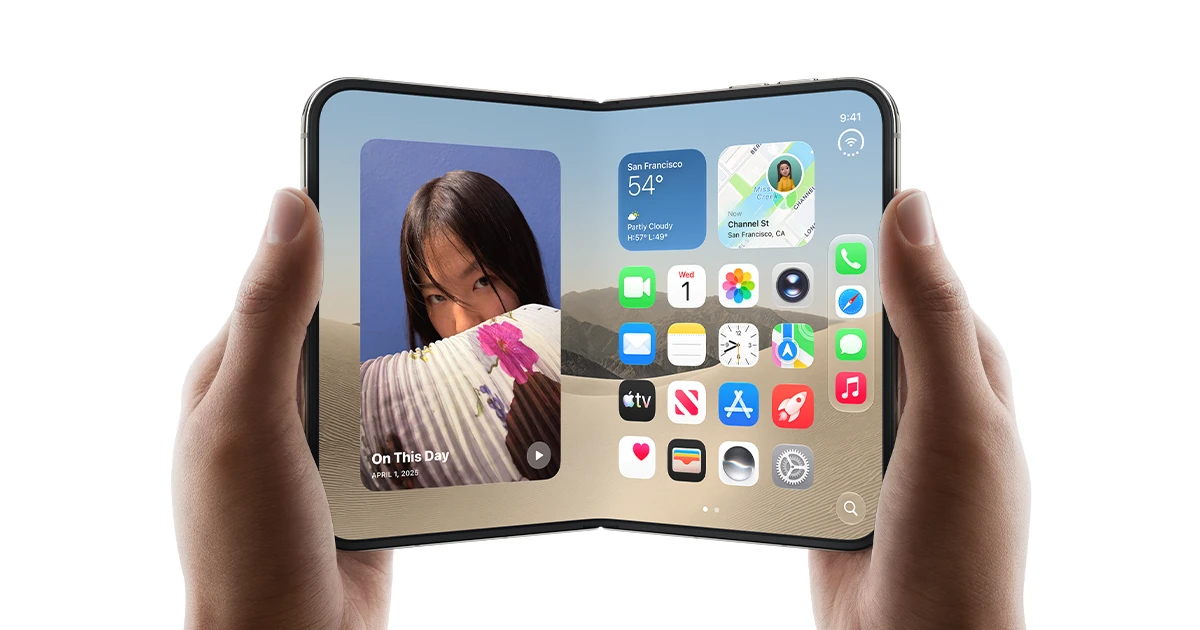
The supply shortage for Apple’s first foldable smartphone, the iPhone Duo, is showing signs of easing in some regions. With delivery dates for some pre-orders in Japan moved up from earlier estimates, observers are asking whether the scarcity caused by early production setbacks has passed its peak.
According to industry sources and foreign media reports on the 19th, many iPhone Duo orders in Japan that completed pre-orders last week have had their delivery dates moved up from the originally scheduled December to October 23, the official launch date. Apple-focused outlet 9to5Mac, citing screenshots of order pages from Japanese users, reported that multiple such delivery-date changes have been confirmed. The schedule adjustments are being seen on orders placed directly through Apple’s official channels. A later update to the same report noted cases of earlier delivery dates in the United States as well, but it has not been confirmed whether the change has spread to other countries or third-party retailers. Apple declined to comment on the delivery-date changes.
The shortened delivery times are being read as a signal that the iPhone Duo’s early supply crunch may ease faster than expected. The device drew record wait times in major markets worldwide immediately after pre-orders opened. In South Korea, delivery dates for all models were pushed to January 22 of next year just two days after pre-orders began at 9 p.m. on the 16th. In the United States, delivery dates slipped to January 25 of next year within 30 minutes of pre-orders opening. Buyers in Europe, India, the Middle East and Australia were also quoted January delivery, while Brazil saw dates pushed further to February.
The conditions in Japan, where the change was confirmed, are as follows. Apple began taking pre-orders in Japan at 9 p.m. local time on the 16th and will start sales on the 23rd. Japanese official prices are ¥364,800 (tax included) for the 256GB model, ¥399,800 for 512GB, ¥469,800 for 1TB and ¥574,800 for 2TB. It comes in two colors, Star White and Night Sky, and has a 5.4-inch display when folded and a 7.6-inch display when unfolded. Apple will begin sales on the 23rd in more than 70 countries and regions including Japan, with the remaining 28 countries starting on the 30th.
The issue is that the delivery delays cannot be explained by explosive demand alone. The prevailing analysis is that iPhone Duo production volumes were not ample to begin with. Assembly yields at Taiwan’s Foxconn stayed in the low 60% range, so mass-production speed fell short of expectations. Delays in stabilizing the processes for high-difficulty components such as the foldable display and hinge are also cited as supply constraints. The initial shipment volumes Apple gave to South Korean sales channels are also said to be lower than those for previous iPhone flagship models.
Production targets themselves were set low. According to a report by Chinese outlet Jiemian News on the 17th of last month, citing supply-chain sources, Apple set a global target of 6 million to 8 million iPhone Duo units for this year. That is less than a third of the typical 20 million to 30 million units for a single product cycle of a new Pro or Pro Max model. The same report said it could take another six months to a year for yields on Foxconn’s assembly lines to reach mature levels. A distribution-channel source said Apple’s sales guidance exceeds 5 million units. The foldable market itself is still small. According to market research firm Omdia, global foldable smartphone shipments in 2025 totaled 18.2 million units, only about 1.4% of the overall smartphone market.
Market attention is focused on whether the exceptional early demand will translate into actual sales. In a statement to the Financial Times, Apple said pre-order demand for the iPhone Duo was “exceptional” and that it is “working to get the product to customers quickly.” In China, more than 3 million people have registered interest on e-commerce platform JD.com, reflecting high market expectations. Interest registrations, however, may not lead to actual purchases, so they are hard to equate with sales.
RegionDelivery date right after pre-ordersNotesSouth KoreaJanuary 22, 2027All models and colors delayedUnited StatesJanuary 25, 2027Delayed within 30 minutes of pre-orders openingJapanJanuary 2027 (some December 2026)Some orders moved up to October 23BrazilFebruary 2027Relatively small allocationEurope, India, Middle East, AustraliaJanuary 2027—
Note: Based on Apple Online Store listings in each country and foreign media reports. Japan is the market where delivery-date adjustments have been confirmed.
The shortage is also producing unexpected side effects. On South Korean secondhand trading platforms, listings have appeared at prices above the retail price. One listing offered a 512GB model with a retail price of ₩3.59 million (approximately $2,700) for ₩4.5 million (approximately $3,400), while another post offered to sell a 1TB model for ₩4.59 million (approximately $3,400), 9.5% above list price. A resale market with a premium has formed even before the official launch.
In China, resellers who secured large quantities of early inventory are facing losses as prices fall. One vendor secured 50 units for about CNY 1 million (approximately $150,000), but after subcontract buyers cut their purchase prices twice in a single day, the vendor now expects a loss of CNY 25,000 (approximately $3,700). Stockpiling inventory to capture the early premium has backfired.
Thanks to the symbolism of being Apple’s first foldable product, the iPhone Duo drew concentrated demand from loyal customers despite a high starting price of ₩3.29 million (approximately $2,500). South Korea’s three major mobile carriers have rolled out measures to ease the burden on consumers, including trade-in compensation and device upgrade programs, but with early supply itself limited, it is unclear whether this will revive the number-porting market. Industry observers expect the scarcity to continue at least through the first quarter of next year. How quickly the shortened delivery times confirmed in Japan spread to other markets will be the gauge for normalizing supply going forward.