
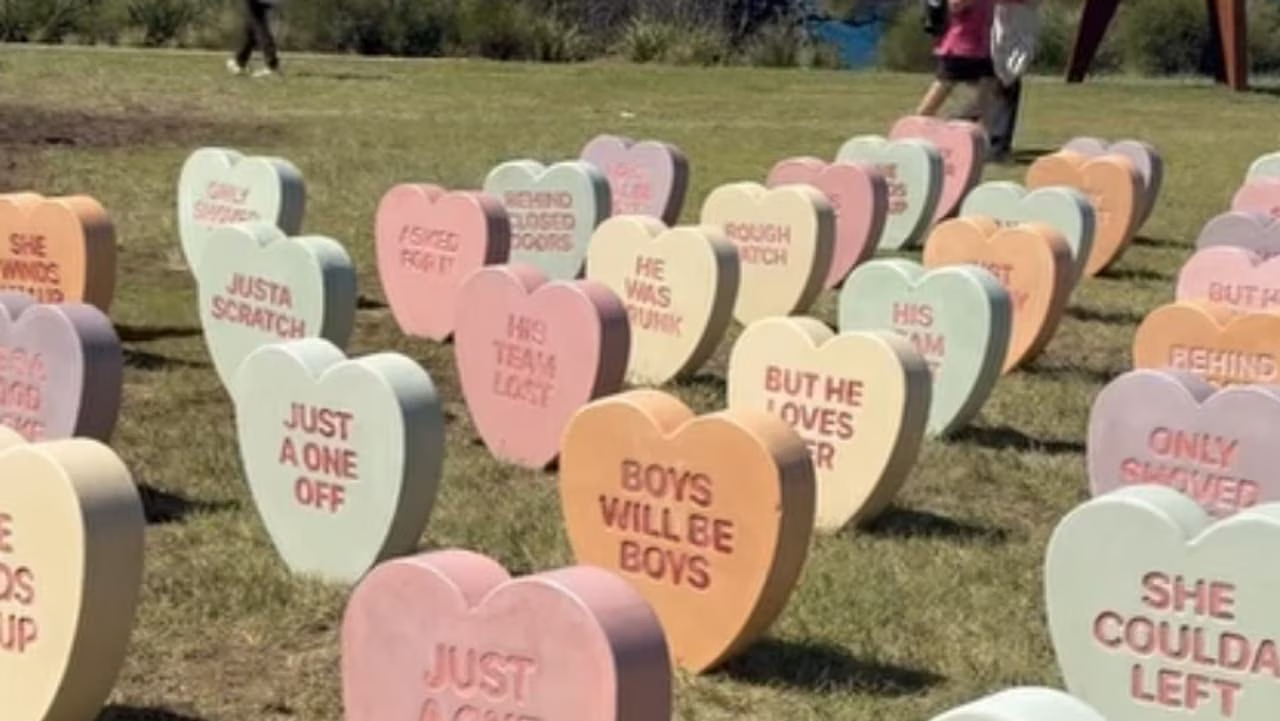
A chilling graveyard installation of pastel-coloured concrete hearts has appeared at Sydney’s iconic Marks Park between Bondi and Tamarama beaches, confronting Australia’s domestic violence crisis head-on.
Dozens of hand-polished concrete hearts transformed the scenic coastal headland into a sweetheart lolly graveyard as part of this year’s Sculpture by the Sea exhibition.
Want more local Australian news? Download our app and never miss a headline.

Plastered across the pastel sweets are common excuses used to minimise violence against women, creating a stark visual memorial for every Australian woman killed by a current or former partner this year.
Creators Philippa Lysaght and Omi McCurdie originally planned to make 52 hearts, reflecting the national average of 52 women killed each year in Australia.
However, as the death toll mounted during the project, the artists realised they had to expand the work so they would not under-represent the scale of the epidemic.
Lysaght noted that while 56 women had been killed in Australia when the piece was completed, the figure was on track to reach closer to 60 by the end of the exhibition, drawing on statistics tracked by Sherele Moody’s Australian Femicide Watch.
The eye-catching artwork, titled Sweethearts, is expected to be seen by nearly half a million visitors walking the famous coastal path over the course of the exhibition.
The heartbreaking visual serves as a permanent reminder that many of these victims were murdered by the very person who was supposed to be their “sweetheart”.
Lysaght said the purpose of using familiar phrases on the concrete lollies was to force passers-by to confront everyday language that quietly excuses abuse.
She explained to the ABC that seeing these phrases in a graveyard setting should “make you feel sick” when people recognise words they have either heard or spoken themselves.
Challenging traditional Aussie masculinity
Among the phrases hand-lettered onto the pastel hearts are everyday dismissals such as “boys will be boys”, “he was drunk”, “only words”, and “asked for it”.
Other concrete blocks display justifications like “two-way street”, “he’s a good bloke”, “she winds him up”, and “only shoved her”.
Lysaght said the installation aims to directly challenge traditional notions of Australian masculinity that underpin domestic violence.
She said that she was so appalled by the recent spate of domestic homicides that she wanted to create a piece targeting bystander inaction and actively calling out abuse.
By staging the confronting memorial at one of the country’s most photographed public art events, the creators hope to force a national conversation about how culture enables violence.
The stark stats behind the excuses
The statistics surrounding domestic abuse in Australia remain staggering, with current data showing that one in four Australian women experiences violence or abuse.
Each phrase featured on the concrete hearts reflects real-world excuses used by perpetrators and bystanders before tragedy strikes.
They’re disguised as harmless comments – phrases like “just a scratch” or “she coulda left” – and often buy abusers another day while leaving victims in real danger.
Research reveals that 60 per cent of Australians believe an intoxicated man is less responsible for sexual assault, reinforcing the prevalence of the “he was drunk” excuse.
Similarly, the narrative of “she could have left” ignores the reality that two in three women killed by a partner in NSW were killed by an ex-partner or while actively separating, making leaving the most dangerous period.
Sports culture and domestic stress are also closely tied to the crisis, with figures showing a 40.7 per cent surge in recorded domestic violence assaults in NSW on State of Origin nights alone.
Calling out bystander inaction
The installation serves as an urgent call to action for all Australians to stop letting subtle excuses slide in social settings, workplaces, and homes.
Advocates stress that when people hear phrases like “it’s not my business”, “he only pushed her”, or “she coulda left”, they must active call it out immediately.
Checking in on friends or relatives by asking if they are okay, listening without judgment, and providing support can save lives.
It’s equally important to directly confront men when they display abusive behaviour, refuse to excuse their actions, and encourage them to seek professional support.
Read related topics:Sydney