
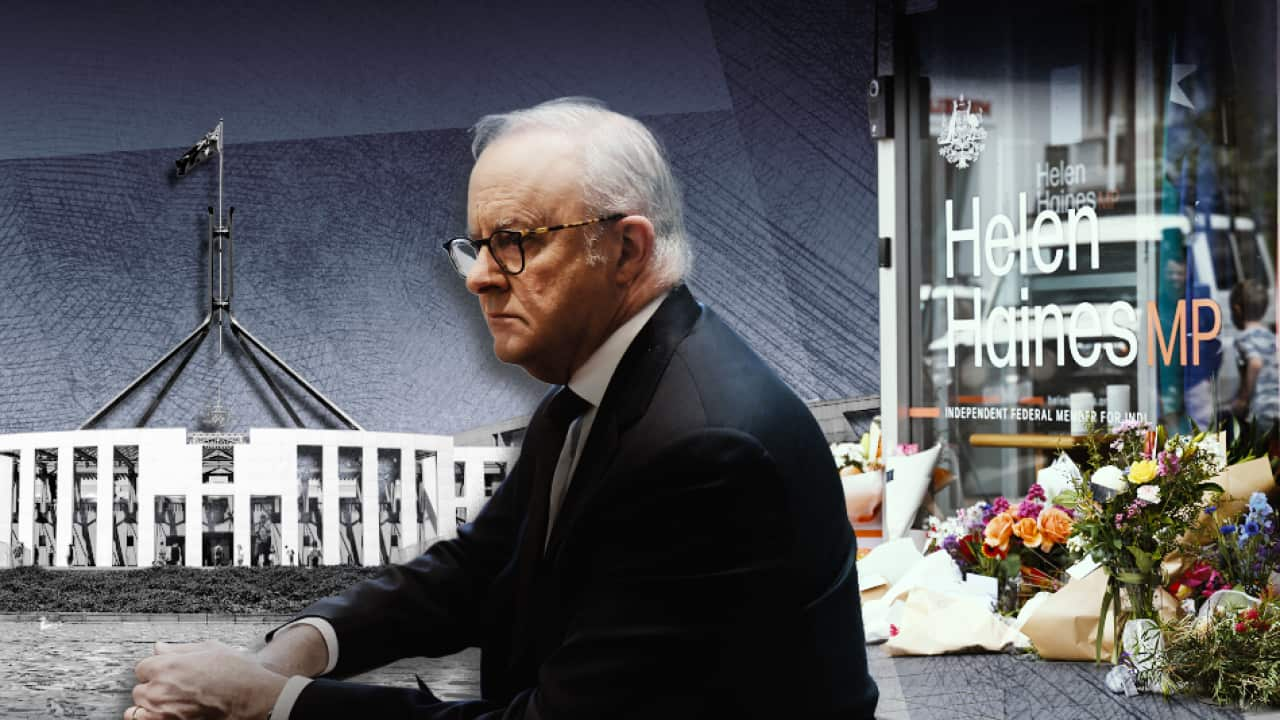
IN BRIEFThreats of violence received by members of parliament have increased significantly in recent years.Anthony Albanese said the political climate has become hostile and repeated a call for the “temperature” to be turned down.
After years of escalating threats against politicians, the attack on independent MP Helen Haines could signal a troubling new phase in Australia’s increasingly polarised political climate.
The independent member was rammed by a four-wheel drive outside her electorate office in Wangaratta in Victoria’s north Monday. She has reportedly lost a leg in the attack, with doctors working to save the other.
While authorities are yet to determine the motives of the suspect, the attack comes amid growing concerns about political violence in Australia, a country that has largely avoided the kind of attacks seen more frequently in the United States and United Kingdom.
‘Regular’ threats made against MPs
Threats of violence received by members of parliament have increased significantly in recent years, with the Australia Federal Police (AFP) receiving 1,067 reports of harassment or threats against politicians in 2025-26.
Your trusted source for staying up-to-date with the world around you. Get free daily news updates and analysis, straight to your inbox.
Over the past four years, that figure has climbed 63 per cent.
Since the AFP established National Security Investigations teams last October to focus on politically-motivated violence, 41 people have been charged for offences relating to threats against federal parliamentarians and high office holders, according to commissioner Krissy Barrett.
Earlier this month, a 54-year-old Tasmanian man was arrested and charged over alleged online threats directed toward a federal parliamentarian.
A day later, a Sydney man was sentenced to a two-year community corrections order and fined $1,000 for threatening a member of government.
In the wake of the attack on Haines, politicians have also spoken out about the particularly disturbing quantity and nature of threats they have received.
Social Services Minister Tanya Plibersek said rape and death threats were “regular” and Senator Bridget McKenzie told the ABC “it seems female MPs in particular are fair game, with sexually violent threatening commentary”.
Speaking to the ABC, independent senator David Pocock said that while he receives threats, including phone calls, emails and comments, female politicians receive a “ridiculous amount of threats and abuse”.
READ MORE
“As Australians, we need to stand up and say this is not okay, this is not what we want as a country. And we all have a role to play in actually not just calling that out, but changing the way that we engage in politics,” Pocock said.
Online environment ‘festering’
Political sociologist Dr Josh Roose told SBS News that while there have been rare examples of political violence in Australia, including the 1994 assassination of NSW Labor MP John Newman, the attack on Haines marked a new lowpoint.
“Australia hasn’t seen anything like this in terms of — not only the targeting of a politician in the street — but also the sheer aggression and violence enacted on that politician,” he said.
The Australian Security Intelligence Organisation (ASIO) warned in its 2025 annual threat assessment that politically motivated violence — which could include violent acts or threats intended to achieve a political objective — was becoming more common.
A government report published this year said political violence poses a “significant threat to democracy by reducing political participation, eroding public trust and deepening social polarisation”.
The report also said social media was a “key catalyst” for this form of violence.
Roose said a confluence of political polarisation driven by social media, as well as large-scale social changes caused by the COVID-19 lockdowns and economic shocks in recent years have led to a lot of “raw political emotions of anger, frustration and resentment”.
“The online environment can’t be allowed to continue to fester the way it is,” he said.
While the Albanese government recently introduced its Digital Duty of Care bill that could compel platforms to take action to protect Australians from harmful material and content online, Roose said there has been no “serious effort” so far to crack down on people spreading online hate in Australia “because it’s just too difficult and because of the volume of it”.
Alarms about politically motivated violence are also ringing globally.
There have been multiple politically motivated murders and attacks in the US and UK in recent years, including the killing of Democratic former Minnesota House of Representatives speaker Melissa Hortman and her husband in June last year.
In July, former UK Conservative Party MP Ann Widdicombe was found dead in her home outside London. A man has been charged with her alleged murder.
The Inter-Parliamentary Union, a global organisation of national parliaments with 184 member parliaments including Australia said in a recent report that parliamentarians “around the world are facing growing levels of intimidation, harassment and violence from members of the public”.
The union said that while disagreement and protest are essential elements of democracies, it is seeing a “shift towards behaviour that seeks to threaten, silence or punish MPs”.
Albanese calls for ‘temperature’ to be lowered
Albanese said Australia’s political climate has become increasingly hostile and repeated a call he has made several times for the “temperature” of political discourse to be lowered.
“We’ve seen a significant increase in the number of people who’ve been charged with making threats, and we need to make sure that these things aren’t normalised — that the way people conduct themselves — you can have disagreements, but do it respectfully,” he told the ABC on Tuesday morning.
“What unites us is far more than any divisions that are there and any disagreements which are there as well.”
Other party leaders have spoken out against political violence in Australia and called for preservation of a calm political environment, including Opposition leader Angus Taylor.
“No act of violence or political violence is acceptable in this country. Acts of political violence are un-Australian and unacceptable. Our nation can not become a place where these kinds of acts are normalised,” Taylor said.
Taylor said Australians have long been able to resolve differences through debate and voting and said it is one of the “great things about our nation” that should be cherished and protected.
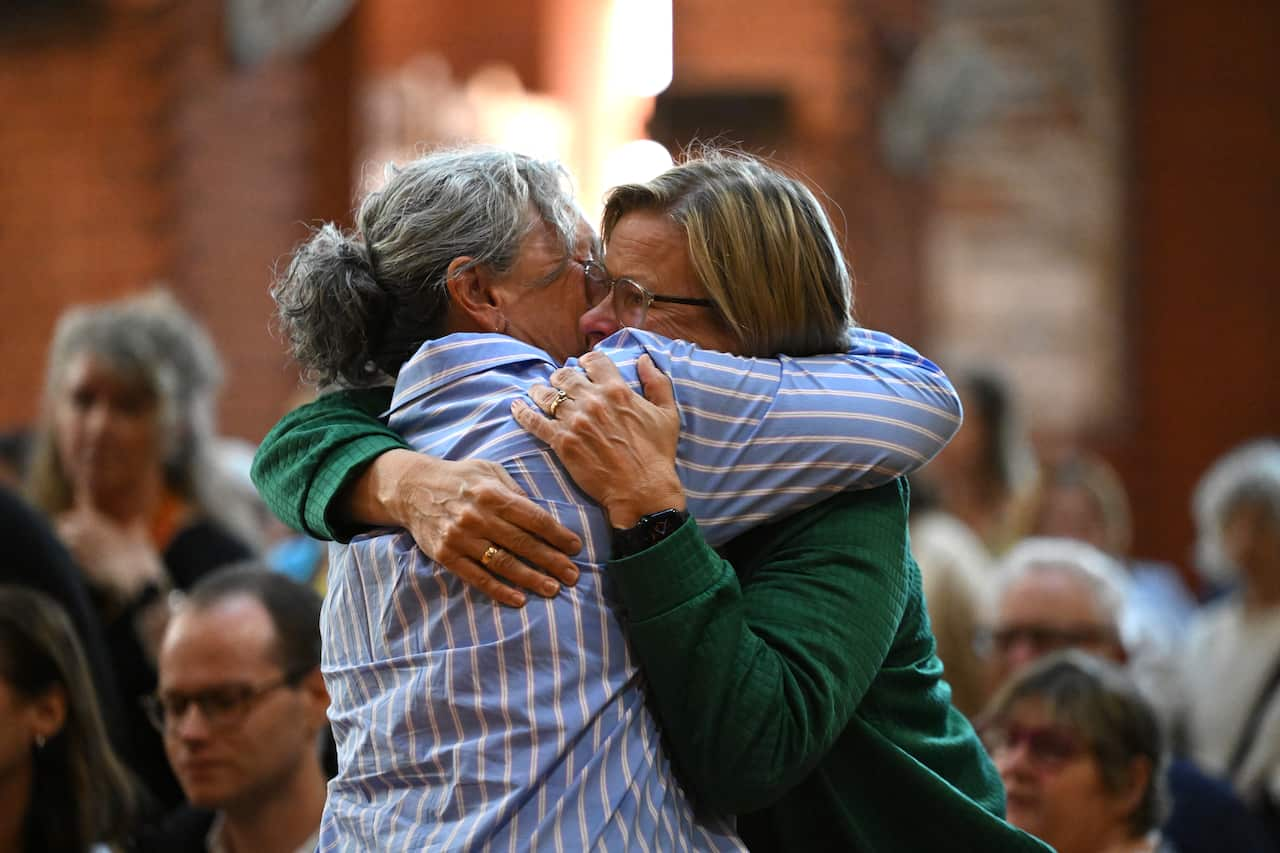 People gathered for a vigil for Helen Haines at the Holy Trinity Anglican Cathedral in Wangaratta on Tuesday. Source: AAP / James Ross
Professor Dominic O’Sullivan, a political scientist from Charles Sturt University, told SBS News the level of civility in parliamentary discussions and online is likely “something that every member of parliament is thinking about at this moment”.
Last week, Labor MP Anne Aly posted a video to her Instagram page responding to a call made by Gold Coast Liberal National MP Angie Bell in the House of Representatives to “stone” the small business minister.
Aly said the rhetoric stood “against our Australian values” and reported she had received 19 death threats over social media that week alone.
Sullivan said the threat of political violence risks reshaping how Australia’s democracy functions at large, particularly when it comes to interactions with the community.
“[Members of parliament] need to be able to represent their constituents, they need to be accessible to their constituents. And if people are anxious about what might be behind everybody who attempts to have a conversation with them, then that means that the quality of representation that we get is going to diminish.
“And when the quality of representation diminishes, then the quality of the whole system is undermined.”
— With reporting by the Australian Associated Press.
For the latest from SBS News, download our app and subscribe to our newsletter.