
To us mortals, the flow of time goes one way.
Yesterday is gone, tomorrow is yet to come, and no matter how precisely and faithfully a clock marks the passing seconds, we can never return to a moment that has passed.
But for a time crystal, things are very different.
The constituent ranks of this mysterious state of matter – be they atoms, sound waves, or topological defects – are strictly regimented in time, a repeating pattern of beats that could be snipped from a recording at regular intervals and perfectly superimposed, one over another.
Once thought impossible, time crystals have been observed in systems from physical atomic lattices to levitating styrofoam.
Now, physicists have discovered a strange new way for a time crystal to emerge – not through the imposition of an external rhythm, but through a spontaneous process in which competing vibrations gradually fall into step – order gradually emerging from chaos.
Using a 3D-printed two-dimensional metamaterial, an international team of physicists led by Jonas Veenstra of the University of Amsterdam in the Netherlands observed small, rapid vibrations giving way to progressively larger, slower waves, until the entire structure was moving in synchrony.
The researchers call this process “wave coarsening”, and it could reveal a new way for matter to organize itself into persistent patterns in time.
 frameborder=”0″ allow=”accelerometer; autoplay; clipboard-write; encrypted-media; gyroscope; picture-in-picture; web-share” referrerpolicy=”strict-origin-when-cross-origin” allowfullscreen>
One of the biggest challenges to time crystal research is how devastatingly fragile these systems can be.
When you’re trying to keep something in very precise step, even a slight disturbance can send it tumbling into disorder. In systems with only one or two spatial dimensions, those disturbances can be particularly destructive.
This makes the emergence of a stable, synchronized rhythm in a two-dimensional material especially intriguing.
One possible route to such order lies in the way different parts of a material interact with each other.
Veenstra and his colleagues wanted to observe what happens to waves in a system when the influence of one part of the system on another isn’t necessarily reciprocated.
These are known as non-reciprocal interactions, and they can produce some peculiar dynamics. Under the right conditions, rather than settling into a jumble of competing oscillations, waves can gradually reorganize, with longer, slower patterns taking over from shorter, faster ones.
Eventually, a single coherent rhythm can emerge across the entire system.
To show that this can happen mathematically is one thing – but manifesting it in a real material is a bit trickier.
For this, the researchers built an unusual metamaterial – one whose properties emerge from its structure, rather than its composition.
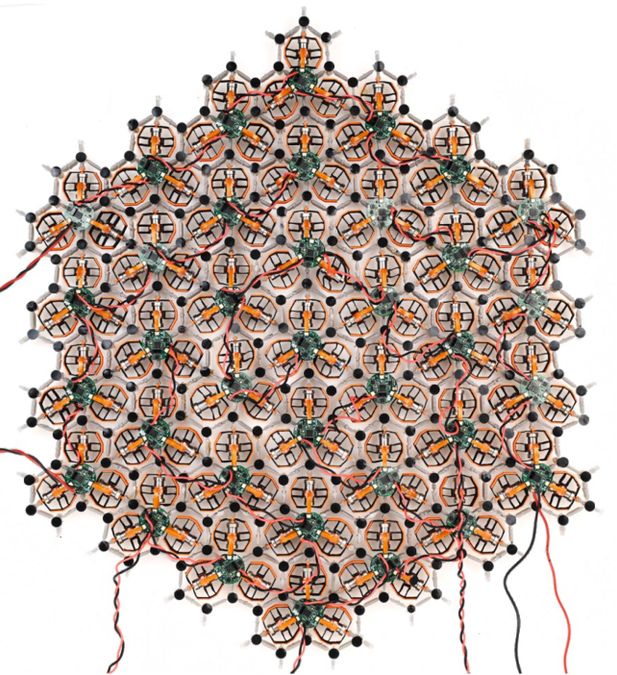 The 3D-printed honeycomb metamaterial used in the experiment consisted of 37 interconnected units equipped with sensors, actuators, and electronic controllers. (Veenstra et al., Nature, 2026)
It consisted of 37 units arranged in a honeycomb-like lattice, each made from three elastic hexagons fitted with sensors, actuators, and a tiny electronic controller.
The components were programmed to respond to one another in a very particular way. When one hexagon was compressed, its clockwise neighbor compressed too, while its counterclockwise neighbor expanded.
This asymmetrical response allowed the researchers to engineer the non-reciprocal interactions they wanted to study.
Then, they set the material in motion.
They gave the honeycomb a nudge, introducing small, random disturbances into the structure, and watched what happened.
At first, the individual units began vibrating rapidly, at around 30 times per second. But gradually, larger waves emerged, traveling around the material’s edge, overwhelming the smaller oscillations.
Then, as the waves grew longer, their oscillations slowed until the entire honeycomb was moving together in a single, synchronized rhythm.
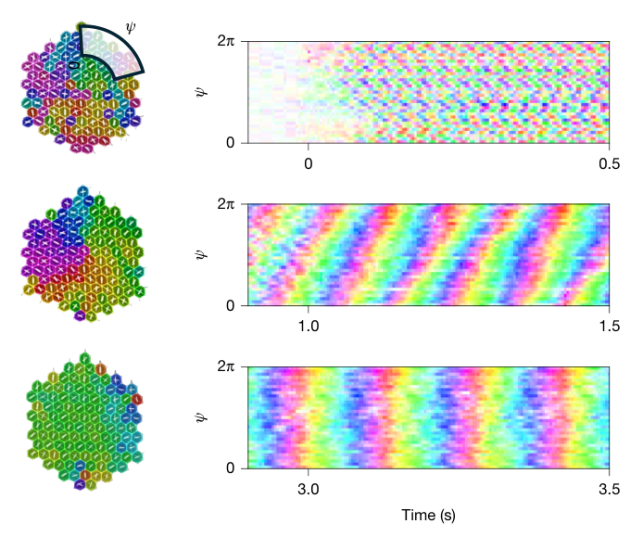 The vibrations of the honeycomb metamaterial become increasingly organized over time, progressing from chaotic, small-scale oscillations (top) to larger waves (middle) and finally a synchronized rhythm across the structure (bottom). Colors indicate the phase of the oscillations. (Veenstra et al., Nature, 2026)
Anyone can make a wave, though. The next part is demonstrating that the wave is a time crystal.
For that, the researchers needed to establish that the synchronized oscillations weren’t just a fleeting phenomenon, but a form of order that could persist even when jostled by random disturbances.
They turned to mathematical analysis and computer simulations, introducing noise into their model to see whether it would destroy the synchronized rhythm.
It didn’t. Their results showed that the oscillations could remain coherent despite the disturbances, even as the system approached an effectively infinite size.
The honeycomb wasn’t the end of the experiments, either. The researchers wanted to know if the effect could emerge in a system with a different architecture – so they built a donut for waves to ride, like an extraordinarily weird mechanical bull crossed with air hockey.
It consisted of a single elastic ring fitted with 24 motors, programmed to produce non-reciprocal interactions between neighboring sections. They placed it on an air table, allowing it to float with minimal friction.
When they activated the motors and disturbed the ring, waves began to travel around its circumference, deforming it into a succession of shifting polygonal shapes.
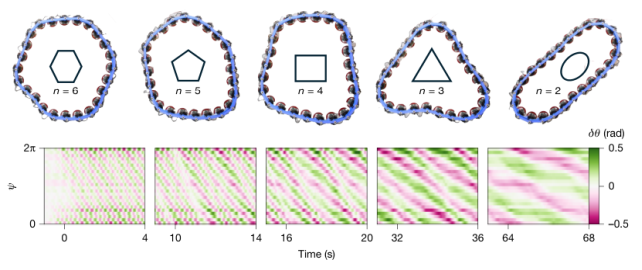 Wave coarsening in an elastic ring fitted with 24 motors. As the vibrations evolve, the ring forms progressively simpler polygonal shapes, showing how shorter waves give way to longer ones. (Veenstra et al., Nature, 2026)
As the waves grew longer and slower, the polygons developed fewer sides, until the ring’s motion was dominated by a single large-scale pattern.
The researchers did not separately establish that this system also formed a time crystal, but it did reveal something important about wave coarsening.
Their mathematical analysis showed that, as the waves grow in amplitude, they change the dynamics of the system, increasingly favoring waves with longer wavelengths. Those larger waves then grow stronger, further shifting the balance in their favor.
This creates a feedback loop in which the dominant waves become progressively larger and slower, until they reach the limits imposed by the size of the material itself.
Rather than having to impose a synchronized rhythm from outside, the researchers found a way for the material to organize its own vibrations.
Finally, there was one more surprise. The researchers also found that the process could be interrupted.
In their mathematical model, adding friction changed which waves were able to grow. The longest waves were suppressed, preventing the vibrations from continuing to reorganize into ever-larger patterns.
Instead of the entire material falling into step, the system could settle into a different kind of order – persistent waves traveling in one direction along its edge.
This suggests that the same underlying physics could produce different kinds of organized motion, depending on the conditions. By understanding how to control those conditions, researchers may eventually find new ways to guide vibrations through engineered materials.
The discovery could have implications for fields ranging from acoustics to soft robotics, although practical applications remain some way off.
But perhaps the most exciting part is that the researchers didn’t need to induce and guide the rhythm of the material’s vibrations. By engineering how its components interacted, they created conditions in which the vibrations could organize themselves.
Their results suggest that this self-organization could offer a new route to the robust, long-lasting temporal order that has proved so difficult to achieve in time crystals.
“We anticipate that wave coarsening represents an exemplary route towards time-crystallization in systems with additional symmetries and associated Goldstone modes,” they write, “which can be leveraged as a control strategy for shape changes and directed motion in fields such as robotics, active matter and optomechanics with non-reciprocal phase transitions.”
Well, obviously.
The research has been published in Nature.
This article was fact-checked by Fiona MacDonald and edited by Fiona MacDonald. While we pride ourselves on our process, we are only human. If you spot a mistake, please let us know.