
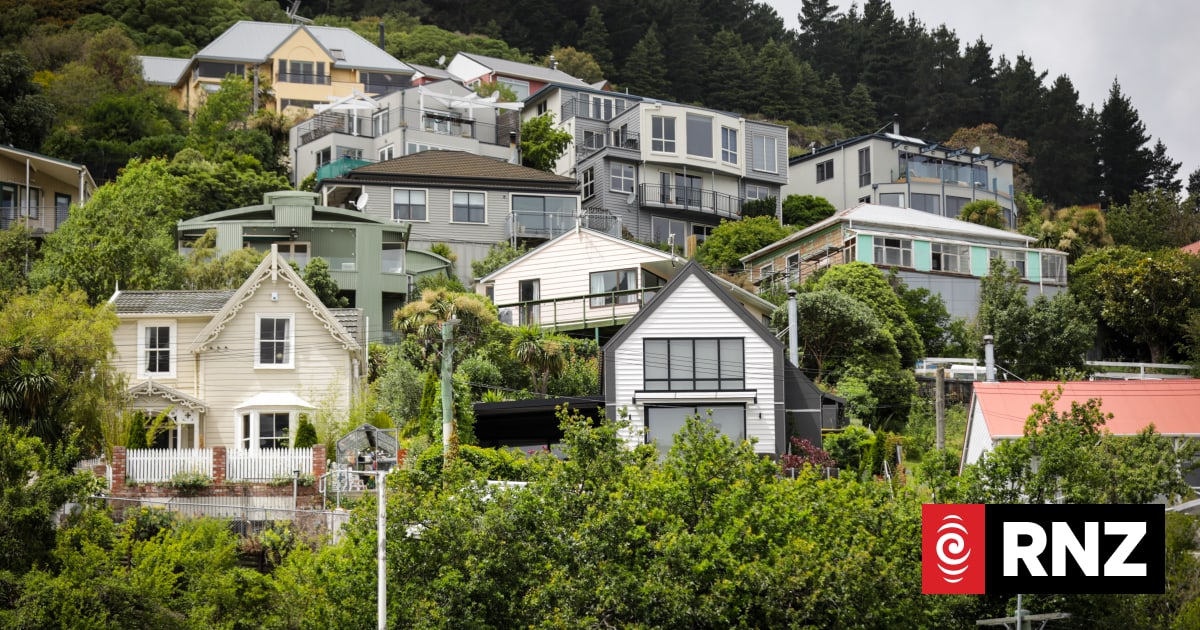
House prices may have a little further to fall, but most of the New Zealand housing bubble has now been deflated, ANZ economists say.
They have looked at how house prices compare to a set of long-run fundamentals.
That includes the house-price-to-income ratio, which increased from a level where prices were about four times household income before 2002 to a peak of nearly nine in 2021.
They said that measure had since corrected back to six as house prices declined and incomes rose with inflation.
“The big question: where might the house-price-to-income ratio gravitate back to in the long term? This is really hard to know,” they said.
“Prior to the 2000s, a ratio of around three to four was typical and regarded as ‘affordable’. While a return to such levels would be great for housing affordability for first-home buyers, we are doubtful New Zealand’s ratio will get all the way back there. New Zealand’s ratio hasn’t been below five since 2004, and several structural changes mean the equilibrium ratio is likely to be higher than it was before the 2000s.”
Senior economist Matthew Galt said interest rates were lower than they were in the 1980s and 1990s and likely to remain that way, which would keep the price of well-located land higher compared to incomes.
Population growth would probably also put pressure on the ratio, and the availability of credit had increased since the 180s.
The quality of housing had also improved since the typical ratio was lower, he said, so it was not an “apples with apples” comparison.
“An analysis of 96 cities across English-speaking countries found that while house-price-to-income ratios around three were typical around 1990, there are now no cities with a ratio below three and the median city has a ratio around five.”
The Reserve Bank’s sustainable house price indicator was another fundamental considered, and Galt acknowledged it was still showing some concern.
“The RBNZ estimates the sustainable range by comparing the long-term benefits and costs of owning a home. The benefits are measured by rents and expected long-term inflation in rents and house prices. The costs are measured by estimated long-term interest rates and other costs such as council rates and maintenance.”
He said, in September, the Reserve Bank had said house prices were still a little above the sustainable range, although the central bank’s estimate of this range was very sensitive to the neutral interest rate, which was difficult to pin down in real time. The neutral interest rate is the rate at which there is no impact on the economy.
“The estimated sustainable range for real house prices has declined since 2021 as the estimated neutral interest rate has increased.”
He said home ownership costs were also elevated compared to renting, and that was not likely to change in the next few years.
“That implies that the financial incentive to buy houses is lower than average, and that house prices are going to stay under downward pressure for a while yet. This framing shows the trade-off for people tossing up renting or buying a home to live in, but the maths would be the same for investors weighing up the potential running costs of owning property against the rental income they would receive.”
But he noted the house-price-to-build cost ratio was the lowest it had been in a long time.
“The most recent data puts the ratio at 1.54 as of June 2025, compared to its high of 2.1 in 2021 and a low of 1.4 in 2011. However, the latest published estimate is now over a year old, and the ratio has probably declined further since then, given rising construction costs and falling house prices.”
Galt said when house prices were above the cost of building it indicated that new supply could be profitably delivered and the additional supply was likely to limit further house price inflation in the long run.
He said there had been a lot of progress towards fundamentals since 2021.
“Particularly if we look at house prices compared to the cost to build, that’s converged a lot and that suggests that there’s only limited further downside from here in how far house prices can fall before construction drops away and that puts something of floor under prices.”
The economy was stronger for having had prices fall, he said.
“Enormous progress has been made in restoring house prices to a more sensible level after the Covid-era bubble, and while it has undeniably been painful, it has been achieved without any financial stability wobbles house prices still a bit above where the fundamentals indicate.”
It was hard to predict some of the drivers of fundamentals such as where interest rates would go, he said.
“We’re expecting interest rates to stay higher than they were through the 2010s. However, if interest rates start trending lower than we and financial markets expect, current house prices may prove to be more sustainable. On the other hand, if long-term interest rates start trending higher than we and financial markets expect, house prices could come under further downward pressure.
“It might seem surprising that house prices are still above fundamentals, given how large the correction in house prices has been. Average nationwide house prices are down 16 percent from the 2021 peak, and more than 30 percent after adjusting for inflation. In part, this shows how extreme house prices had become by 2021, and unwinding that bubble has been no mean feat. However, it also shows how dramatically house prices can change when long-term interest rate expectations change. Much higher house prices could be rationalised five to 10 years ago when interest rates were expected to stay low for a long time.”
Galt said if house prices were a bit above the level suggested by fundamentals, they would likely drift sideways or slightly down for a while long.
“After prices reach fundamentals, they are likely to trend up over the long term with household incomes and construction costs – perhaps at a rate of around 4 percent per year. However, there will undoubtedly be large house price cycles around this long-run trend: housing upturns in periods when the economy is strong or long-term interest rates fall, and housing downturns in periods when the economy is weak or long-term interest rates rise.”
Sign up for Money with Susan Edmunds, a weekly newsletter covering all the things that affect how we make and spend money