
Real-world wearable and health data
To ground our agent evaluation with real-world validity, we evaluated the applicability and robustness of the framework against the WEAR-ME study, a large-scale (n = 1,165) effort to investigate metabolic health43. The overall study design is outlined in Extended Data Fig. 9a. As part of WEAR-ME, consented participants were asked to link their Fitbit account to Google Health Studies, authorizing the collection of their wearable data for the duration of the study and for up to 3 months before they joined. Once enrolled, participants were asked to (1) complete questionnaires covering demographics, health history and personal health insights, (2) schedule a blood draw with a quest patient service centre, and (3) wear their Fitbit or Pixel Watch throughout the day and night (for at least 3 out of every 4 days). In total, WEAR-ME contains multimodal data from each participant on their questionnaire answers, Fitbit records and blood test results. More details of the dataset are described in Supplementary Section B.2. The WEAR-ME study was conducted in full compliance with privacy regulations, with the study approved by the Advarra Institutional Review Board (IRB; #Pro 00074093). All participants provided informed e-consent for their data to be used in research and publications.
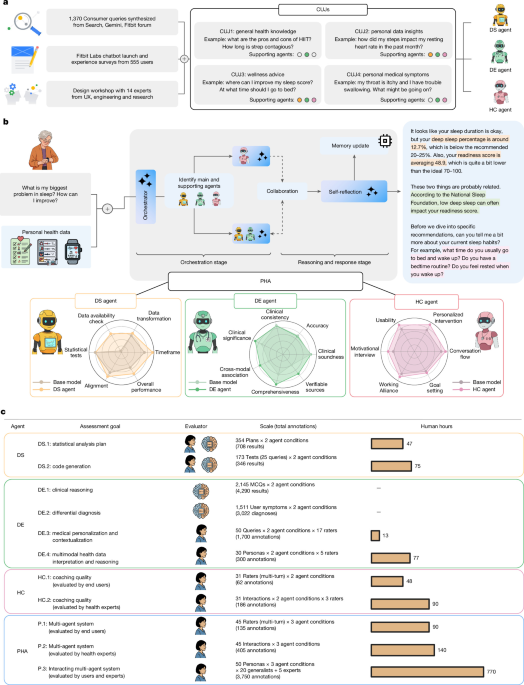
Throughout our evaluation, we leveraged the WEAR-ME dataset for various evaluation tasks (see tasks DS.1, DE.3, DE.4, HC.1, HC.2, P.1, P.2 and P.3 in Fig. 1c). As introduced later in this section, we contextualized our end-user and expert evaluations on a subset cohort of WEAR-ME for real-world validity. Working with clinicians, we identified the ten most common health profiles among the participants and then randomly selected five individuals representing each of those conditions (see the specific ten profiles and persona examples in Supplementary Section B.2). These 50 user personas were used to prepare evaluation samples for our agents’ multiple evaluation tasks (for example, task 3 and task 4 for the DE agent, and task 1, task 2 and task 3 for the PHA). The construction of the evaluation cohort is depicted in Extended Data Fig. 9b.
Choice of base language model
We used the Gemini 2 family (Flash/Pro) of models44 for our experiments. Gemini has demonstrated strong performance on medical tasks8,45,46. To demonstrate that our method is model agnostic, we further evaluated our agent architecture on other LLM families across OpenAI’s GPT and Anthropic’s Claude (see result tables in Supplementary Data). In this work, our focus was not to train a new LLM but rather to design and construct the agentic system around a given base LLM. By selecting Gemini as the base model, we could ensure that (1) there was no training data contamination, and (2) no health data from real participants would be logged by the model and used for training future models. Although existing contamination was not a main concern, as a majority of our analyses involve novel datasets that are unlikely to be part of any LLM training dataset, choosing Gemini allowed us to verify that any testing of the models did not lead to data entering a future training set. We note that our design of sub-agents and the agent teams are agnostic to the base LLM. We expect that our proposed solutions will be generalizable to other LLMs.
User-centred design of the PHA
We adopted a user-centred approach to identify and categorize the needs of end users for a PHA. Our process integrated insights from three layers of complementary data collection: real-world user queries, targeted survey responses and expert synthesis. Together, these layers form a coherent pipeline: we began by capturing broad, naturalistic user intent through consumer health queries; we then deepened this understanding through structured survey data that elicited the goals and satisfaction of users. Finally, we conducted expert workshops to distill and organize these findings into actionable requirements.
Consumer health queries
We compiled and analysed consumer health queries from Google Search, Gemini and the Fitbit community forum, from January 2024 to February 2025. In addition, in October 2024 through February 2025, we launched Insights Explorer through Fitbit Labs49. Participation was entirely voluntary and required users to explicitly opt-in and provide in-app consent for their data to be used for research and development. As part of this consented experience, participants were able to ask health queries and receive responses from a prototype generative artificial intelligence (AI) conversational agent. We composed a set of 1,370 de-identified user queries that represent a wide range of questions regarding daily health and wellness from real-world users. Supplementary Table 1 lists some examples of these queries.
Fitbit Labs survey data
To enrich the query data, we also collected survey data from participants (n = 555) in the Insights Explorer Fitbit Labs to ask about their personal health goals and sentiments when interacting with the agent. Specifically, the survey includes questions about user needs (for example, ‘what are you hoping to achieve by using [the prototype]?’, ‘which of the following aspects of health and wellness, if any, did you explore in [the prototype]?’), user experience and satisfaction (for example, ‘indicate any aspects of [the prototype] that have/have not met your expectations’), engagement and retention (for example, ‘what was the main functionality or benefits that you continued using [the prototype] for?’) and other user characteristics (for example, previous experience with wearable sensing, AI and conversational agents). Supplementary Table 1 lists the details of these laboratory surveys.
Expert workshop
To complement users’ perspective, we further conducted a 1-h critical user journey workshop with experts across user experience, product, research and engineering (n = 14) to categorize the data collected. The workshop procedure focused on summarizing the user journey goals and the specific associated tasks. After collecting multiple experts’ perspectives, we adopted a standard thematic analysis process50. Two researchers independently coded the same subset of these queries and all survey data to jointly develop a codebook of hierarchical user journeys (categories and sub-categories). The same researchers then categorized the rest of the user queries into these categories and expanded the codebook as needed.
Our analysis of user needs identified four CUJs, spanning data interpretation, knowledge seeking, wellness advice and symptom assessment (see results). Satisfying these diverse requirements demands more than a single monolithic system and calls for a set of specialized, complementary capabilities.
Our agent development approach is therefore grounded in both the cognitive theory of modular cognition51, which posits that the mind uses specialized subsystems for different tasks, and the empirical success of human health teams, in which experts with complementary skills collaborate. Inspired by this, we deconstructed the problem space and propose a multi-agent personal health assistant that brings together three core roles, each embodied by a specialized sub-agent: data analysis, health domain expertise and behavioural coaching, working in concert to emulate a professional health support team.
DS agent development
This agent mainly focuses on addressing user queries about personal data. Existing research has explored the ability of LLMs to answer data science questions2,28,29,30,31,32,33,34,35, but their capacity to interpret open-ended, personalized data inquiries and perform statistically sound data analyses remains unclear, and there is a lack of open benchmarks assessing their reliability in this area. We developed the first personal open-ended data science agent capable of analysing both personal and population-level time-series wearable data to provide numerical health insights. Our agent enables users to ask diverse, open-ended and personalized questions about their health data and provide meaningful, data-driven responses, filling a critical gap in personalized data analysis. We also open-sourced an evaluation benchmark for these capabilities. Example conversations between a user and the DS agent are shown in Supplementary Fig. 1.
We focused on a set of capabilities for the DS agent that are useful, yet tractable to evaluate2,30,34. These capabilities are informed by the types of user interactions and data that are expected in the context of the CUJs (presented in the results). Broadly, we define the capability of the DS agent to address queries that involve analysis of numerical data (for example, wearable streams and medical records), with the goal as obtaining statistical outcomes that align with the query intent and context surrounding those statistics, such as timeframe, type of statistics, assumptions, among others. Specifically, the capabilities of the agent are as follows.
Decompose an open-ended query into a structured analysis plan
For broad or ambiguous queries often posed by end users without data science expertise, the DS agent should translate them into appropriately specific, unambiguous, tractable queries and analysis plans by:
(1)
Identifying conceptual variables52, which recognizes the concepts in the question that can and should be represented in the data (for example, representing fitness as average daily steps and resting heart rate for a query such as ‘have I gotten more fit over the past few months?’).
(2)
Formulating the correct and exact data transformation steps to operationalize the variables across multiple tables of user data and population-level data tables. This involves the following optional steps:
(a)
Filtering relevant subsets of data (for example, filter for activities in the past 3 months)
(b)
Cleaning messy data (for example, handling missing or misrecorded wearable data)
(c)
Joining multiple tables (for example, joining the activities data table with the daily summary data table on the same day)
(d)
Aggregating data (for example, getting average steps and resting heart rate grouped by month)
(3)
Recognizing, highlighting or addressing missing or insufficient data to prevent unreliable conclusions.
(4)
Applying appropriate statistical tests and calculations on the basis of the intent of the user.
Note that given the open-ended nature of user queries, multiple interpretations and answers may be valid. Accordingly, in one single interaction, our DS agent is designed to provide at least one appropriate response, rather than an exhaustive enumeration of all possibilities. Users can have follow-up conversations to explore other options with the agent. In the case in which the data in user queries are not available, the agent might check the availability of the data with users and request data from users, if needed.
Compute accurate numerical results through code generation, execution and feedback
On the basis of a precisely specified analysis plan (that is, one without any ambiguity for alternative methods and models53), the agent should be able to generate, execute and debug code that follows the exact specifications of the analysis plan, such that it can execute bug-free code and compute accurate results.
On the basis of the delineated capabilities, the architecture of the DS agent is designed as a modular, two-stage pipeline: (1) analysis plan generation and (2) code generation with iterative execution54. This decomposition is critical for mitigating the risk of factual inaccuracies and logical errors common in end-to-end generation for complex data tasks55. It separates the semantic reasoning of ‘what to do’ from the syntactic task of ‘how to do it’.
The first stage translates an open-ended natural language query into a precise, structured analysis plan. To ground its reasoning, the planner is provided with a rich contextual summary of the available data, including table schemas, column descriptions with data types and semantic tags, and summary statistics56. The output is a structured natural language paragraph that explicitly outlines the conceptual variables, required data transformations (for example, filters, joins and aggregations), and the chosen statistical model, directly instantiating the components listed above.
The second stage receives this structured plan and is tasked with generating executable code. This focus on a well-defined specification allows the LLM to leverage its strong code generation capabilities55. The generated code is then executed in a sandboxed environment. We used an iterative refinement loop: if execution fails due to syntactic errors or runtime exceptions, the agent re-invokes the stage with the original query, plan and the error message as feedback. This self-correction cycle, which has been shown to improve robustness57, continues until bug-free execution is achieved and a numerical result is produced.
Figure 2a illustrates the architecture enabling these functions in the DS agent. The details of agent prompt and architecture are included in Supplementary Section C.2.
DE agent development
This agent aims to answer any queries that are related to medical knowledge or daily symptoms. Although previous work has evaluated the medical knowledge of LLMs36,37,38, many essential skills of an ideal domain health expert are underexplored, such as interpreting data within contexts, for example, population and environmental factors, and performing summarization and reasoning across data modalities from wearables and medical records. We built a DE agent equipped with a suite of tools to address these challenges. The agent integrates the wearable data of users, medical records and contextual data to generate accurate, relevant responses to complex health inquiries. It advances the state-of-the-art LLMs by providing nuanced multi-modal interpretations that consider the broader context of personal health. Example conversations with the DE agent are shown in Supplementary Fig. 2.
We designed the DE agent to function as a specialized cognitive layer for health applications. Its purpose is not merely to retrieve information, but to synthesize, contextualize and validate it against authoritative sources and patient-specific data. By acting as a focused and reliable source of medical expertise, the DE agent aims to minimize misinformation risk and translate complex data into clear, actionable insights, serving as a critical foundation for our multi-agent design. (These capabilities were investigated in a controlled, academic context; they do not indicate real-world products that require an evaluation of complex regulatory landscapes.)
To fulfil this role, the DE agent needs to move beyond the simple query–response behaviour of standard LLMs. It should be equipped with a set of distinct yet interconnected skills that mirror the reasoning of a human clinician. This involves not only accessing factual knowledge but also applying it within the context of the specific health status and history of an individual. To formalize this multifaceted expertise, we defined and evaluated the core competencies of the agent across four foundational capabilities:
(1)
Accuracy of health information. The DE agent should provide accurate and reliable medical knowledge spanning diverse personal health and clinical domains, ensuring that information is consistent with expert-level understanding.
(2)
Diagnostic reasoning acumen. The agent can perform differential diagnostic reasoning by generating and ranking plausible diagnoses on the basis of the symptoms and relevant medical history of the user conveyed through natural conversations.
(3)
Contextualization and personalization efficacy. The agent should contextualize and personalize health information and advice, tailoring outputs to the specific demographic profile, pre-existing conditions and health goals of a user to ensure relevance, clarity and safety.
(4)
Multimodal data synthesis and reasoning. The DE agent should synthesize and reason over heterogeneous data sources, generating coherent and informative summaries from complex real-world inputs that integrate wearable data (for example, simple statistics or complex outcomes computed by the DS agent) with medical records (for example, laboratory results and medical history).
The DE agent uses a multi-step planning, reasoning and acting architecture58, as shown in Fig. 3a. The agent receives a user query, wearable data and medical records as input. The agent processes the query and chooses actions from a set of tools that include querying: Web Search (https://www.google.com), the NCBI (https://www.ncbi.nlm.nih.gov) application programming interface (API) and the DataCommons API (https://datacommons.org). A Python Sandbox is also available for executing APIs.
The multi-step reasoning framework enables the agent to address complex queries by interleaving reasoning with tool use. For any given query, the agent follows a reason–investigate–examine cycle: it begins with a reasoning and thinking stage, in which the agent decomposes the health query posed by the user into a series of verifiable steps, such as establishing a clinical baseline for a vital sign, finding literature to connect symptoms or planning to analyse trends in personal data. On the basis of the reasoning from the previous step, the agent chooses the most suitable investigations by selecting the appropriate tool to execute its plan—for example, querying DataCommons for population statistics or NCBI for medical studies. The agent then examines the results of the previous steps, which informs the next cycle. This iterative cycle continues until the agent has synthesized sufficient evidence to construct a comprehensive answer.
This dynamic, iterative process creates a transparent and auditable reasoning trace. By synthesizing facts from authoritative sources with the personal health data of the user, the agent ensures its final answer is not a black-box output but is instead a grounded, evidence-based conclusion. This architecture is therefore essential for fulfilling the core capabilities of the agent: providing accurate, personalized and reliable health insights. Supplementary Section D.1 details the prompt setup for the DE agent.
HC agent development
The HC agent aims to provide personalized health and wellness advice, and to help users set up goals and motivations via conversations. Although previous studies have initiated explorations into the application of AI in personal coaching39,40,41, to our knowledge, our agent is the first to support open-ended coaching conversations across a wide range of general wellness topics. Building on coaching expert insights, we considerably enhanced the coaching skills of the agent, including motivational interviewing and personalized health recommendations. This agent adopts a modular structure to optimize the conversation flow, balancing information gathering, active listening and recommendation delivery to support a smooth and effective coaching experience. Example multi-turn conversations with the HC agent can be found in Extended Data Figs. 3 and 4.
To inform the design of our HC agent, we conducted a formative interview study with 11 health experts (6 male individuals and 5 female individuals, 24–45 years of age). Experts were selected from various domains, such as sleep, fitness and life coaching. These experts hold advanced degrees in their respective fields (with at least 5 years of professional experience) and had a deep understanding of best practices in health coaching. The semi-structured interviews, each lasting approximately 1 h, focused on eliciting expert insights regarding the critical elements of effective health coaching, particularly focusing on the interplay of conversational substances and styles. Two authors conducted thematic analysis and independently developed theme codebooks and iterated until convergence. This qualitative data provided a foundational understanding of nuanced coaching expertise, leading to the following core HC agent capabilities.
For goal and purpose identification, the HC agent needs to understand the goal and the motivation behind the goal of the user, maintain a goal-oriented conversation, and bring the user back to the main goal when they are deviating off the topic.
For active listening, the agent should provide occasional summary and paraphrasing of the state of conversation to circle back to users and ensure correct understanding and goal alignment.
For context clarification, our HC agent should collect and understand the constraints, preferences and previously attempted solutions of users.
For user empowerment, the HC agent needs to empower the user by building trust, guiding them to navigate their own paths when exploring potential solutions, and providing supportive reinforcement when they make positive progress towards their goals.
for personalized and concrete coaching recommendations, the HC agent should provide high-quality customized recommendations that are specific, measurable, attainable, relevant and time-bound (SMART), helping the user to create an actionable plan59.
For user feedback incorporation, the agent should be able to provide initial recommendations mid-conversation, while explicitly leaving space for user input, and subsequently updating its suggestions on the basis of that feedback.
Conventional single-prompt architectures often fail to simultaneously address the diverse coaching capabilities (HC1–HC6), struggling in particular with the demands of mixed-initiative dialogue. To overcome these limitations, we designed a modular architecture for the HC agent that embodies expert coaching principles. As illustrated in Fig. 4a, this design enables the agent to dynamically adapt its conversational flow on the basis of user input and to strategically time its recommendations.
At its core, the HC agent is designed to emulate a professional coach. To this end, we developed the personalized coaching module grounded in the principles inspired by motivational interviewing60, a client-centred approach that enhances motivation by exploring and resolving ambivalence. This module operationalizes key coaching behaviours, such as active listening (HC2) and user empowerment (HC4), to foster engagement. It also establishes a structured, proactive line of questioning that instructs the agent to first identify the goals of the user (HC1), then explore their context and constraints (HC3), and finally solicit feedback (HC6) before providing a recommendation (HC5).
Conversation flow modules: recommendation module and conclusion module
Although a single prompt can include all these aspects, our pilot testing revealed that such a prompt-based approach struggles to maintain conversational balance. Such agents tended to either offer premature recommendations before sufficient context was gathered, or become fixated on questioning, failing to transition to actionable advice. To address these failure cases, we introduce two specialized modules to manage the conversational state: the recommendation module dynamically determines the opportune moment to provide advice. It is responsible for keeping the conversation on track (HC1) and explicitly confirms with the user if enough context has been gathered before transitioning to a recommendation (HC3, HC6). Meanwhile, the conclusion module identifies when a conversation has reached a natural end point and ends the interaction gracefully with a summary, reinforcing the key takeaways (HC5).
The final architecture of the HC agent is a combination of the personalized coaching module to steer the coaching process with personalized information, and the two conversation flow modules for appropriate recommendations and conclusion to align the flow of the interaction with the queries inputs and goals of a user. More prompting details are described in Supplementary Section E.1. Overall, this modular architecture ensures that the agent robustly expresses the full range of expert coaching themes (HC1–HC6) in a dynamic, user-adaptive manner.
PHA development: multi-agent collaboration
The three sub-agents have complementary skill sets and often need to collaborate together to provide appropriate support regarding a query by a user. A central orchestrator manages this collaboration. It receives the initial query by the user, parses it and determines which agent (or agents) is best suited to respond. It decomposes the query into sub-tasks, routes them to the appropriate sub-agents, synthesizes the responses into a cohesive, user-friendly answer, and then reflects and iterates on it before responding to users42. Extended Data Figs. 5–8 demonstrate a multi-turn conversation example with PHA.
Our design is grounded in both cognitive theory and empirical evidence from human collaboration. Theoretically, we drew from the concept of modular cognition, which posits that the mind comprises specialized, independent subsystems for different cognitive functions51. We applied this by treating each agent as a distinct cognitive module with its own knowledge and processing capabilities. Empirically, this mirrors the structure of effective human expert teams, in which members with complementary expertise collaborate to achieve a more robust outcome than any individual could alone. This modular approach not only enables a more holistic response to complex health questions but also enhances explainability. By tracing outputs back to the specific function of each agent, the decision-making of the system becomes more transparent and interpretable, an essential requirement in sensitive health contexts.
To further instantiate our design, we propose a set of four principles across capability, user experience and architecture to guide the design of our PHA.
(1)
Address comprehensive user needs. Our user-centred analysis has revealed the wide range of health and wellness needs of users. This calls for a comprehensive set of agent capabilities to fulfil these needs. Single-agent systems, even with rich capabilities (for example, see a previous study2), may not be able to cover all cases.
(2)
Adaptive support. We have previously identified that user queries may require different combinations of the three agents (Supplementary Table 1). A multi-agent system needs to dynamically assign agents to be adaptive towards the needs of users. This suggests that static multi-agent architectures, such as voting23 and debating26, may not fulfil the need.
(3)
Low user burden. When a system has access to the wearable data and medical records of users, asking users what can already be inferred from the data would not only increase user burden but also impact user trust of the intelligence of the system. For example, the system should avoid asking questions such as ‘how long did you sleep last week?’ (a typical question from the HC agent when it acts without the DS agent) when it can easily compute the data from the wearable data record (via the DS agent). The system needs to have a chain of agents for deeper reflection rather than simply a set of parallel agents for straight response, for example, voting24,61, to fully leverage and potentially follow up on the output from each agent.
(4)
Simplicity. When the capabilities of an agent are similar, simpler architecture has advantages of lower latency, less computation cost, as well as an easier pathway of maintenance and extension62. Although more complex, hierarchical structures can be effective for specific goals such as ensuring clinical safety63 or mimicking interdisciplinary care teams27, they may represent unnecessary complexity (for example, leading to unappealing long inference times).
These four guidelines indicate the limitations of existing multi-agent architectures and guide the implementation of the multi-agent collaboration framework of PHA.
Following theoretical foundations and empirical evidence, together with the design principles, we present our multi-agent framework of PHA, as illustrated in Fig. 5a. It consists of an orchestrator (Gemini based) that manages a sequential and iterative workflow between the three specialists agents: the DS agent for data science analysis, the DE agent for domain expertise, and the HC agent for health coaching (improved on progress tracking based on the results in the HC agent evaluation). This collaborative process involves four key steps. The implementation details can be found in Supplementary Section F.1.
(1)
User need understanding (PHA.1 and PHA.2). When a user query arrives, the orchestrator first performs the crucial step of user need understanding. It analyses the semantics of the query and infers the primary goal of the user. This classification aligns with the four CUJs (for example, seeking data insights and wellness advice). This ensures that the system can select the most appropriate agent (or agents) for the need of the user, addressing the principles of covering comprehensive user needs (PHA.1) and providing adaptive support (PHA.2).
(2)
Agent orchestration and task assignment (PHA.2 and PHA.4). On the basis of the inferred user need (or needs), the orchestrator dynamically assigns a ‘main agent’ (one of the three agents) to take the primary responsibility for the query. It then determines whether any ‘supporting agents’ are required to provide supplementary information. For instance, a query such as, ‘how can I improve my sleep based on last week’s data?’ would assign the HC agent as the main agent, supported by the DS agent to first analyse the sleep data. The orchestrator decomposes the main query into specific, targeted sub-queries for each assigned agent. Moreover, to facilitate the task assignment, we built on the four CUJs and developed a set of collaboration examples that denote agent assignment for each sub-category (see Supplementary Table 1). These examples are provided to the orchestrator for reference. This dynamic needs-based assignment fulfils the principle of adaptive support (PHA.2) while maintaining architectural simplicity (PHA.4) by avoiding a complex hierarchy.
(3)
Query reflection (PHA.3). Unlike parallel architectures in which agents work in isolation, PHA uses an iterative process that allows for reflection. Outputs from the main agent and the supporting agents are not sent directly to the user. Before finalizing the response, the main agent performs a ‘self-query reflection’ step. Inspired by iterative self-refinement frameworks24,64,65, this internal check assesses the synthesized information for coherence, completeness and accuracy, ensuring that all available data from the health data of the user is leveraged. By preventing the system from asking for data it already has (for example, ‘how many hours did you sleep?’ or ‘when did you wake up?’), this process upholds the principle of low user burden (PHA.3).
(4)
Memory update (PHA.1, PHA.2 and PHA.3). After each interaction turn is completed and a response is presented to the user, the orchestrator updates a persistent memory module. This memory logs key entities from the conversation, including generated insights from each agent, user-stated goals, identified barriers and preferences. This running context enables the system to maintain conversational coherence over multiple turns and personalize future interactions more effectively. The memory module supports the agent team in addressing comprehensive needs (PHA.1) over time, providing adaptive support (PHA.2) as goals evolve, and ensuring low user burden (PHA.3) by retaining context across sessions.
Agent evaluation framework
To systematically evaluate our agent framework and identify the strengths and gaps in the design of each component, we created the evaluation framework shown in Fig. 1b. We took a mixed-methods approach and conducted a set of studies that examine a comprehensive set of factors:
(1)
Interaction turn: single and multi-turn interaction.
(2)
Data modalities: agent processing with both single-modality and multi-modality data.
(3)
Evaluation setup: automatic and human evaluations of conversations.
(4)
Human perspective: perspectives of health experts and end users on multi-turn conversations.
This multi-faceted approach provides a holistic understanding of the performance of the AI agent and is the most comprehensive evaluation of a consumer AI health agent thus far.
Specifically, our framework delineates and assesses the core capabilities of each component. The DS agent is evaluated on its two-stage process of (DS.1) generating robust analysis plans and (DS.2) translating them into accurate, executable code. The DE agent is assessed across four key competencies: (DE.1) answering common health questions, (DE.2) handling diagnostic conversations, (DE.3) personalizing answers to medical questions on the basis of context and information about the user, and (DE.4) interpreting and reasoning with multi-modal health data (wearables, laboratory results, demographics and health surveys). The capability of the HC agent for providing a personalized coaching experience is evaluated from (HC.1) its effectiveness from the perspective of the end user, and (HC.2) its fidelity to human expert coaching principles. After connecting all three sub-agents, the final multi-agent PHA system has the comprehensive set of skills to support various end-user health queries at a human health expert level. It is assessed on its holistic conversational performance from complementary viewpoints of both (P.1) end users and (P.2) experts.
DS agent evaluation
To ensure that our DS agent produces statistically robust and numerically accurate answers, we independently evaluated the two core components in two tasks.
Task 1: analysis plan generation
Given an open-ended query involving data analysis (for example, ‘am I getting more fit recently?’), we measured the ability of the agent to decompose and/or expand the query into a precise and robust statistical analysis plan. The plan should align with the intent of the query and appropriately involve the analysis of personal health data.
In this paper, we focused on the data analysis on the wearable data from the WEAR-ME dataset43. In particular, the DS agent was given access to the following data tables for each individual user: (1) a daily summary table with daily activity and sleep wearable data, (2) an activities table in which each row represents a recorded physical activity (for example, running, biking, swimming, among others), and (3) a population summary table that provides daily wearable percentiles stratified by gender and age group. We have included the full data schema of all tables used by the DS agent in Supplementary Section C.1.
An analysis plan involves many decisions that contribute to the robustness of the final result, such as handling missing data, choosing a statistical model and operationalizing constructs53,66,67. Evaluating these decisions with human experts is prohibitively expensive. To scalably evaluate a wide range of analysis approaches, we developed another LLM as an autorater68,69 tested against human expert raters to ensure its reliability.
Evaluation rubrics and point-detection metrics. To enable this, we first developed a detailed analysis plan rubric in consultation with a panel of four data science experts. The rubric is designed for objective assessment across six key dimensions:
(1)
Timeframe: does the analysis consider a specific timeframe (for example, past month, past 6 months) when it helps to personalize and align with user intent?
(2)
Data transforms: does the approach correctly reference existing columns and apply any necessary data transformations, without logical errors, in a way that others can reliably reproduce?
(3)
Data sufficiency: does the approach reasonably and clearly assess whether there is enough data, both in terms of available rows and non-missing cells within columns, to support the intended transformations, calculations and statistical analyses?
(4)
Summary statistics: does the approach appropriately calculate summary statistics where helpful, and are the chosen statistics reasonable given the context and question being answered?
(5)
Statistical tests: does the approach appropriately apply statistical tests when helpful, with clear, reproducible methods, reasonable test choices and proper consideration of distributional assumptions?
(6)
Overall alignment: finally, given the evaluation of the above dimensions, does the approach align with the intent of the user?
Our final rubric consists of 26 items arranged in a conditional hierarchy. This structure means some items only apply if a preceding one is satisfied; for example, we only assessed the appropriateness of a statistical test if the initial hypotheses are sound. To quantify quality, we used a point-deduction system in which errors or omissions lower the final score. Because of this hierarchy, a maximum of 16 points can be deducted in any single evaluation. The detailed rubric development process and point system are provided in Supplementary Section C.3.1.
Query–analysis plan benchmark. Evaluating the quality of generated analysis plans and developing a scalable autorater requires a reliable benchmark. To this end, we created an expert-rated dataset of 141 unique query–analysis plan pairs. These pairs were generated using various LLMs (Gemini 1.5–2.0 and GPT-4o) across 100 distinct health queries (sampled from the end-user health query set collected in the user-centred design study). Ten expert data scientists (eight male individuals and two female individuals, 25–45 years of age, all with PhDs in computer science and with 5–20 years of experience) spent 47 h in total and provided 354 approach annotations based on the rubrics defined above (each query–analysis plan pair was annotated by 2–4 experts), leading to a total of 6,157 rubric item annotations. This expert-rated dataset demonstrated a moderate level of inter-rater reliability, with an average agreement of 80.2% and a Bennett’s S of 0.622 (ref. 70). Detailed statistics can be found in Supplementary Table 4.
Development of a reliable LLM autorater. Using this human-rated dataset, we developed and validated an autorater based on Gemini 2.0 and 2.5 Flash. The dataset was split into development and test sets, with the test set comprising 96 evaluations of 25 unique queries. The development set with 75 queries was then used to train the autorater (the specific process is detailed in Supplementary Section C.4). Our final autorater achieved an intraclass correlation coefficient(3,1) of 0.838 when compared with the scores assigned by human experts, indicating high reliability for scaled evaluation68.
We then assess the quality of the DS agent-generated analysis plans using this developed autorater, and compared them to the baseline Gemini 2.0 Flash model. The plan generation prompt templates for both the DS agent and the baseline are listed in Supplementary Section C.2.
Task 2: code generation and execution
Given a precisely specified analysis plan from task 1, this task evaluates the ability of the agent to translate that plan into code that is not merely executable but also functionally correct and robust. The primary goal is to measure the fidelity of the implementation to the plan and the numerical accuracy of its results, especially its ability to handle key data science challenges. This includes managing edge cases (for example, limited data and complex data transformations) and provide a correct answer to the question posed by the user.
To objectively evaluate the code, we manually converted the analysis plan into a precise function header and doc string to the agent following previous work71. The code was written in Python in a sandbox environment with libraries such as numpy, pandas and scipy. The details of the implementation are included in the Supplementary Section C.2.
In particular, a group of seven data scientists (five male individuals and two female individuals, 22–45 years of age, with 5–10 years of experience) were recruited for the code generation evaluation task. They were provided with 25 query–approach pairs with high ratings sampled from task 1 and were asked to formulate each of them as a coding problem with a function header and doc string (clear return output structure). Next, experts were asked to write the function implementation and associated test cases as unit tests. Going beyond simply checking for executable code, these unit tests were designed to rigorously assess the correctness and robustness of the underlying logic. They evaluated the ability of the system to handle key analysis cases, including managing limited data, performing complex data transformations, applying appropriate statistical methods and, ultimately, providing an accurate answer to the question posed by the user. In total, we collected code detailing comprehensive test cases for 173 unit tests from these 25 query–approach pairs, with the number of tests per pair varying on the basis of the complexity of the query (75 h of human effort). Examples of unit tests are shown in Supplementary Section C.3.2. Our DS agent and the base Gemini 2.0 Flash model were assessed for their code generation capabilities using these 25 test suites.
The pass rate was determined by calculating the ratio of successful test cases (across all 173 tests in 25 suites) to the total number of test cases. If code execution fails, the model will receive error messages and retry up to five times.
Model-agnostic check across LLMs
To probe whether the performance gains attributable to our agentic architecture are contingent on the Gemini backbone or generalizable across base LLMs, we conducted an additional ablation in which the same DS agent architecture and prompts were instantiated on top of state-of-the-art LLMs (GPT and Claude family of models). We evaluated each configuration on both DS task 1 (analysis plan generation) and DS task 2 (code generation and execution) using identical queries, rubrics, autoraters and unit-test suites as in the main experiments. For each SOTA base LLM, we have reported both (1) the base model without our agentic scaffold, and (2) the base model wrapped by our DS agent architecture. The purpose of this analysis is not to claim a new peak result on either LLM, but to demonstrate that our proposed architecture is model-agnostic and generalizes beyond the Gemini family. Detailed results are reported in the Supplementary Section C.5.3.
DE agent evaluation
We conducted a systematic evaluation process to evaluate the four capabilities of the DE agent in four independent tasks.
Task 1: health knowledge and factuality
We evaluated the ability of the agent to accurately answer nuanced medical and wellness questions (DE1). The evaluation consists of a comprehensive suite of expert-level multiple-choice questions covering personal health and medical knowledge domains.
Guided by clinical relevance and our user study, we selected endocrinology, cardiology, fitness and sleep medicine as the main domains to evaluate for this task. These domains map directly to real-world daily health needs, including both high-prevalence chronic conditions (endocrinology and cardiology) and high-interest preventative wellness topics (fitness and sleep). Furthermore, they provide a scientifically robust testing ground; their complexity requires deep reasoning over case vignettes, allowing us to assess performance beyond simple fact retrieval. Although a broad medical knowledge base is essential, the foundational language model of the agent has already demonstrated strong performance on general medical benchmarks (for example, see previous articles36,45). Our evaluation is therefore specifically designed to assess the ability of the DE agent to apply this foundational knowledge in challenging, specialist-level domains that are of high interest to the public, rather than re-validating the established capabilities of the base model.
To this end, using board certification and coaching examination questions provides a standardized and quantitative metric for evaluating the ability of the DE agent to use its medical knowledge to reason over case studies mirroring real-world scenarios. Specifically, we took four curated multiple-choice question datasets totalling more than 2,000 test questions to assess knowledge and capabilities at answering expert-level health questions:
Endocrinology examination: leveraging StatPearls’ ‘American Board of Internal Medicine: Endocrinology, Diabetes, & Metabolism Exam’ preparatory quizzes72, we selected 570 questions at random from all available levels of difficulty (173 ‘expert’, 198 ‘difficult’ and 199 ‘moderate and easy’ questions).
Cardiology examination: we created a list of 399 Cardiology Board Certification questions using BoardVital’s ABIM-based preparatory question bank73. We randomly selected questions from all difficulty levels (100 ‘hard’, 199 ‘moderate’ and 100 ‘easy’ questions).
Fitness ‘coaching’ certification examination: compilation of 542 questions by Khasentino et al.8 from multiple question banks that emulate examination content for the Certified Strength and Conditioning Specialists.
Sleep medicine examination: a curated dataset of 634 multiple-choice questions from BoardVitals sleep medicine Maintenance of Certification board review question banks by Khasentino et al.8.
We compared our DE agent against the same backbone model, which acted as the baseline without the agentic framework.
Task 2: diagnostic conversations
This task evaluates the ability of the agent to perform differential diagnosis through conversational reasoning (DE2). Unlike previous work that often dealt with complex case studies4,74,75, we focused on the performance of the agent when presented with common symptoms that a user would typically self-report. The goal is to assess the quality and accuracy of the generated differential diagnosis on the basis of these realistic scenarios.
We conducted a large retrospective observational study to collect health case self-reports from consumers (n = 2,000, 18–65 years of age, IRB-approved #GH-SCD-001). The collected data were de-identified and utilized to evaluate the performance of the DE agent. Participants had experienced symptoms in one of 39 pre-defined categories (see Supplementary Section D.3.2 for the full list) within the 3 months. Participants completed an online survey detailing their previous health events, their symptom descriptions in natural language, any online information-seeking behaviour they engaged in and the ultimate diagnosis they received.
We compared our DE agent against a baseline that we re-implemented: a Gemini-based state-of-the-art DDx agent4. To generate predictions, we inputed all self-reported symptom descriptions into each model and prompted for the top ten most likely diagnoses (refer to Supplementary Section D.1.4 for the exact prompts). To evaluate the performance, we leveraged a separate Gemini 2.5 Pro as an autorater (prompt details in Supplementary Section D.1.4) that systematically compared the ground truth against the texts of predictions ranked by the models.
Model-agnostic check across LLMs
Similar to the DS agent evaluation, we also evaluated the DE agent architecture with other SOTA LLMs, GPT and Claude models, on task 1 and task 2. Detailed results are reported in the Supplementary Section D.3.3. Our results show that our agentic framework provides additional domain expertise and reasoning, resulting in better performance on diagnostic conversations and medical examinations, agnostic of the backbone LLM in use.
Task 3: contextualized and personalized health responses
Generic medical advice, although potentially accurate in isolation, can be inappropriate or even harmful if it fails to account for the unique health profile of an individual. For instance, encouraging a vigorous exercise plan could be beneficial for most people but may pose major risks to someone with certain cardiovascular conditions. Therefore, a critical capability of a reliable health agent is its ability to tailor responses to user-specific queries, integrating contextual information to provide personalized, trustworthy and actionable guidance. This evaluation assesses the ability of the DE agent to personalize responses to health queries involving key contextual information (DE3).
We curated a set of 50 health-related questions that are modified from the query set and designed to elicit personalized responses. To test the contextual reasoning of the models, each query was augmented with specific personal information falling into two categories:
Demographic differences: queries included details such as age, biological sex and race or ethnicity, which critically influence health risks, disease presentation and preventative care recommendations (for example, screening schedules and risk stratification).
Existing health conditions: queries were framed within the context of prevalent chronic conditions, including diabetes, cardiovascular disease, and impaired kidney, thyroid or liver function. Providing safe and relevant advice in these scenarios requires the agent to reason about potential contraindications and comorbidities.
We generated responses to these contextualized queries from both our DE agent and the base Gemini 2.0 Pro model. To mitigate presentation bias, all responses were programmatically normalized to a standard format. A cohort of 17 end users (25–50 years of age) were recruited and evaluated the model responses in a randomized order in which they were blinded to the model condition. In total, end users spent 13 h on the evaluation. Inspired by a previous article76, our evaluations used precise Boolean rubric questions, as well as side-by-side comparisons to assess dimensions of ‘personalization’, ‘relevance’, ‘credibility’ and ‘trustworthiness’. See Supplementary Table 9 for the specific evaluation rubric.
Task 4: multimodal personal health data reasoning
This task evaluates the ability of the agent to synthesize and reason over diverse, multimodal personal health data (wearable data and medical records) to generate comprehensive health summaries (DE4). Unlike simple information retrieval, this task demands a higher level of cognitive synthesis that mimics the ability of a clinician to connect disparate data points, identify trends and highlight potential concerns. The objective is to produce a concise and actionable overview of the health status of an individual proactively, without a specific user query or chief complaint.
To evaluate the capabilities of the agent for this task, we leveraged the following data modalities from participants from the WEAR-ME data:
Unstructured text: for each participant, we combined all contextual and background information collected during onboarding survey as one string.
Structured tables: this included tabular data representing wearable-derived digital measures, such as resting heart rate, heart rate variability, among other measures.
Laboratory result documents (PDFs): given that most users will have access to an electronic document of their laboratory tests, we converted the laboratory results of real participants to PDF documents for input to the compared models.
We sampled 30 participants from our persona pools with an equal distribution across 10 health profiles. We then prompted our DE agent and the baseline Gemini model to generate a comprehensive health summary for each participant on the basis of their complete data profile. A panel of five expert clinicians (MDs, two female individuals and three male individuals, 30–60 years of age) then independently evaluated the quality of these generated summaries in a side-by-side, blinded comparison, with a total of 77 h of human effort. The clinicians used a detailed rubric to assess dimensions such as clinical relevance, accuracy of interpretation and the actionability of the summary (see Supplementary Table 10 for the full rubric).
HC agent evaluation
To assess the capabilities of the HC agent, we conducted a comprehensive evaluation centred on real-world user interactions across various health and wellness topics. For a holistic assessment, our evaluation incorporates perspectives from both end users and coaching experts.
Task 1: coaching capabilities from end-user perspectives
The practical success of an LLM-based health coach hinges on the experience of the end user. An agent is effective only if users perceive it as engaging, competent and preferable to alternatives. This evaluation, therefore, investigates user sentiment and perception of the HC agent versus a baseline. We measured overall preference and engagement via agent rankings, satisfaction scores and conversation outcomes (that is, natural versus forced endings). To understand the drivers of these preferences, we also assessed user perceptions of specific coaching capabilities, conversational style and the actionability of the guidance of the agent.
We recruited 31 participants (25 male individuals and 6 female individuals, 18–64 years of age) for a 1.5-h session each (48 h of human effort total). Participants interacted with multiple conversational agents in a blinded, counterbalanced order using a Latin square design. This paper focuses on the comparison between our HC agent and a baseline agent built on the same Gemini model, prompted with a general instruction to act as a helpful personal coach. No significant difference in response time was observed between agent conditions.
To guide the interactions, we curated a set of open-ended scenarios reflecting common health concerns (see Supplementary Table 20). Participants selected the scenario that best aligned with their own personal interests to ensure a realistic coaching use case. They were instructed to treat each agent interaction as a new consultation, providing consistent background information each time (see Supplementary Section E.2.2 for detailed evaluation instructions). Each interaction began with the same initial sentence from the chosen scenario, after which participants conversed freely until reaching either a natural resolution or an ending forced by users (if the conversation was deemed unproductive).
Participants assessed each agent post-interaction and provided a final ranking at the end of the study. We adopted established metrics from psychology and agent usability, including subsets of the CUQ77, the WAI78, the CEMI79 and SMART goal-setting evaluations59. These metrics provide a comprehensive view of usability, collaborative bond, motivational techniques and goal formulation, echoing the expert-identified coaching themes (see Supplementary Table 21 for raw questions and Supplementary Table 23 for detailed aspects of these metrics). By allowing user choice in scenarios and enabling open-ended interactions, this setup is designed to capture realistic user experiences that surpass the limitations of automated evaluations.
Task 2: expert validation of coach design
Although end users are well-equipped to judge their personal satisfaction and engagement (task 1), they may not be able to recognize whether an agent is correctly applying evidence-based coaching techniques. A comprehensive evaluation should also validate the methodological rigour of the agent. Therefore, an expert-led validation is essential to assess the fidelity of the design of the HC agent. The primary goal of this task is to verify that the conversational behaviours of the agent are not just subjectively engaging but also objectively aligned with the intended expert-defined coaching capabilities (HC1–HC6).
We recruited three of the health experts from our formative study to evaluate the conversation transcripts collected from task 1. The experts, blind to the agent conditions, rated each conversation according to the six coaching themes (HC1–HC6), as well as the same set of CUQ, WAI, CEMI and SMART questions. We also incorporated a specialized set of AICM developed by our health coach experts, covering conversation tones (supportiveness and friendliness), style (clarification) and strategy (rapport development, information gathering for key assessment, personalized intervention and appropriate summary; see Supplementary Section E.2.3 for detailed evaluation instructions and questions). Finally, experts provided comparative rankings of the agents on motivational interviewing skills, recommendation quality and credibility.
PHA evaluation
For a comprehensive evaluation, we compared our PHA against two baseline agent setups (with the same Gemini backbone) to demonstrate the value of our collaborative architecture.
Baseline 1: a single-agent PHIA system. Previous work has revealed the promising capability of a single agent to conduct data analysis, generate personal health insights and provide health recommendations. We re-implemented the architecture from a previous article2 for a PHIA system that is capable of code generation, information retrieval, online search to analyse and interpret behavioural personal health data. This system covers the key capabilities that we have identified for the three specialist agents. Note that although this is a single-agent system, its ReAct framework can still trigger multiple LLM calls58. Although this design embodies architectural simplicity (+PHA.4), it may struggle to cohesively integrate the distinct skills of data science, domain expertise and health coaching within a single agent (−PHA.1, −PHA.2 and −PHA.3).
Baseline 2: a parallel multi-agent system. For multi-agent baselines, we implemented a static architecture that adopts a voting-like strategy24,61: each of the three agents will respond to a query from a user in parallel, and an orchestrator will combine the responses and respond to the query. This setup leverages the capabilities of each agent (+PHA.1) and ensures a short response time with a simpler structure than PHA (+PHA.4). However, different agents are working independently with a static structure, which may not be flexible enough to handle diverse needs of users (−PHA.2). It can miss the opportunity to fully unlock the synergies among three agents and lead to a less useful response (−PHA.3).
Task 1: end-user multi-agent experience
After combining the three single agents into a multi-agent system, our first evaluation is to assess the ability of the PHA to conduct broad, multi-turn health-related conversations from the perspective of an end user. We aimed to measure the perceived quality of the interaction, focusing on metrics such as helpfulness, coherence, empathy and how well the agent integrates data analysis, domain knowledge and health coaching.
To ensure ecological validity, we conducted a live interactive evaluation in which end users engaged in real-time, multi-turn conversations with each of the three systems while role-playing as specific WEAR-ME personas. The role-playing ensures that the evaluation is based on real-world data collected in WEAR-ME, while keeping the natural conversation setup to measure the open-ended conversational capability of the agent.
Persona setup. We sampled a set of 50 representative user personas from the WEAR-ME dataset, covering ten common health profiles (five personas each), ranging from healthy individuals training for a goal to individuals managing chronic conditions such as hypertension or diabetes (examples in Supplementary Section B.2.1). Working with primary-care physicians, we developed detailed background stories and specific health needs for each persona that are aligned with their health data, so that each persona carried a coherent data profile, life context and presenting health concerns that an end user could plausibly inhabit during a live session. All three systems (the single-agent PHIA baseline, the parallel multi-agent baseline and the PHA) had access to the same persona data, ensuring that any differences in performance reflect the agentic architecture rather than data access.
Live conversation protocol. We recruited n = 45 end users (17 female participants, 25 male participants and 3 other participants (who did not identify themselves as ‘male’ or ‘female’), 21–67 years of age) across a wide range of health conditions. Each participant was mapped to 1 of the 50 WEAR-ME personas that closely matches their health profile. Participants were sampled stratified by diverse health conditions to ensure that all ten health profiles were covered. Supplementary Table 35 lists the detailed break down of the health conditions of the 45 participants across 10 profiles. Before the study, they familiarized themselves with the data profile, background story and health goals of the assigned persona, and then conducted real-time, multi-turn conversations with each of the three systems about the health situation of that persona. During the study, we intentionally inserted random response delays in the systems to control the impact of the system latency. Meanwhile, participants were explicitly instructed to exclude system latency from the evaluation consideration. Systems were presented in a counterbalanced order with a Latin square design, with participants blind to agent conditions. Each conversation continued until the participant determined the needs of the persona were addressed, or the conversation reached a natural end point, or the interaction time exceeded 15 min.
End-user evaluation. The evaluation process is close to the HC agent. After each conversation, participants completed a per-agent evaluation using the same rubric instruments for this task (see Supplementary Section F.2.1). The metrics include the overall quality and specific capabilities of the agent in data science, domain knowledge and health coaching (questions adopted from previous agent evaluation tasks), as well as the organic integration of these skills (see the specific questions in Supplementary Table 31 and rubrics in Supplementary Table 32). After interacting with all three systems, participants provided a comparative ranking of the three systems. Numeric end-user results are reported in the results section and in Supplementary Tables 36 and 37. This process resulted in 135 individual agent ratings (3 agents × 45 participants) and 45 comparative rankings. In total, 45 end users spent 90 h on the evaluation.
Task 2: expert multi-agent evaluation
Beyond the end-user perspective, this evaluation seeks to assess the technical and clinical validity of the agent’s conversations from the viewpoint of health experts. The goal is to evaluate the soundness of the data analysis, the accuracy of the health information provided, the appropriateness of the coaching strategies, the coordination across three agents, as well as the overall quality of the conversation.
Expert evaluation. For the expert evaluation, we used the live conversation logs produced in task 1. Three health coach experts (one female individual and two male individuals, 35–54 years of age) with professional backgrounds in health coaching and digital health (two specializing in fitness and one in sleep) reviewed these live conversations while being blind to agent conditions. Supplementary Section F.2.2 shows the detailed instruction for the expert evaluation. Although the evaluation metrics covered similar domains as the end-user task 1 (DS, DE and HC), the questions were framed from an expert standpoint, such as the clinical validity of the advice from the DE, the correctness of the analysis by the DS agent, and whether the HC agent applied evidence-based motivational interviewing appropriately and safely (see questions in Supplementary Table 33). Experts rated each agent per-conversation and, after reviewing all three systems for a given participant, provided a comparative ranking. Consistent with the live-study framing of task 1, this expert-driven evaluation provides another layer of validation for the quality and reliability of the responses from the agent under ecologically valid conditions. In total, the evaluation involves around 140 h of human effort, resulting in 405 individual agent ratings (135 scripts × 3 experts) and 135 comparative rankings (45 participants × 3 experts).
Task 3: scaled synthesized dialogues
The live evaluations in task 1 and task 2 are ecologically valid but bounded by participant time, which limits the breadth of personas, query types and rater coverage they can cover. To complement them with a larger-scale evaluation, we additionally synthesized conversations between persona-instructed user models and the three systems, and recruited a separate cohort of generalist end users and health experts to rate them. We used a base Gemini 2.5 Flash model, instructed with each WEAR-ME data, background and goals of the persona, to act as the user and engage in three independent multi-turn conversations with each of the three systems, yielding 150 conversation scripts (50 personas × 3 systems). Twenty end-user generalist evaluators (13 male individuals and 7 female individuals, 20–44 years of age) read the scripts and rated each agent using the same rubric instruments as in task 1, then provided comparative rankings (3,000 individual ratings, 1,000 comparative rankings and 500 h of human effort). Five health experts (four female individuals, one male individual, 25–64 years of age; three specializing in fitness, one in nutrition and one in sports) independently reviewed the same 150 scripts using the task 2 expert rubric, blind to agent conditions (750 individual ratings, 250 comparative rankings and 270 h of human effort). Detailed methodology and full numerical results are reported in Supplementary Section F.3.3.
Computational cost
Using the scaled-up, synthesized conversations in PHA task 3, we compared computational cost across the three systems by LLM call count and per-round response time. The single-agent PHIA had the lowest cost (average of 3.0 calls per round, response time of 36.4±1.6 s), followed by PHA (average of 6.5 calls per round, response time of 205.3±15.0 s) and the parallel multi-agent baseline (average of 7.0 calls per round, response time of 244.4±11.4 s). Despite the additional reflection stage, the dynamic agent task assignment by the PHA requires fewer LLM calls and responds faster than the parallel baseline.
Statistical analysis
For per-rubric three-or-more system comparisons (for example, PHA tasks), we fit a GLMM with a log link, treating system as a fixed effect and rater (and conversation script, where applicable) as random effects. Pairwise contrasts among the systems within each rubric were obtained with Tukey’s honest significance test adjustment. Each rubric was treated as a confirmatory test of a pre-specified, conceptually distinct quality dimension before any system comparison. To verify that this per-rubric framing did not understate the overall type I error, we additionally conducted an across-rubric Holm–Bonferroni robustness check80; the outcome of this check has been reported in the caption of each corresponding result table. For comparative rankings, we applied a Friedman (omnibus) test followed by post-hoc pairwise Wilcoxon signed-rank tests with Holm–Bonferroni correction. Effect sizes and confidence intervals are reported alongside P values, where applicable. All statistical tests were two-sided. Unless otherwise noted, the error bars represent the standard error of the mean, as detailed in the corresponding tables.
Ethics statement
The human participant research reported in this study was reviewed and approved under three protocols. The WEAR-ME study was approved by Advarra IRB #Pro 00074093. The retrospective study that collected self-reported symptom cases for the DE agent evaluation was approved by Advarra IRB #GH-SCD-001. The HC agent and PHA user studies were approved by WCG IRB #20244970. All research involving human participants was conducted in accordance with all relevant ethical guidelines and regulations, and informed consent was obtained from all participants before participation.
Reporting summary
Further information on research design is available in the Nature Portfolio Reporting Summary linked to this article.