
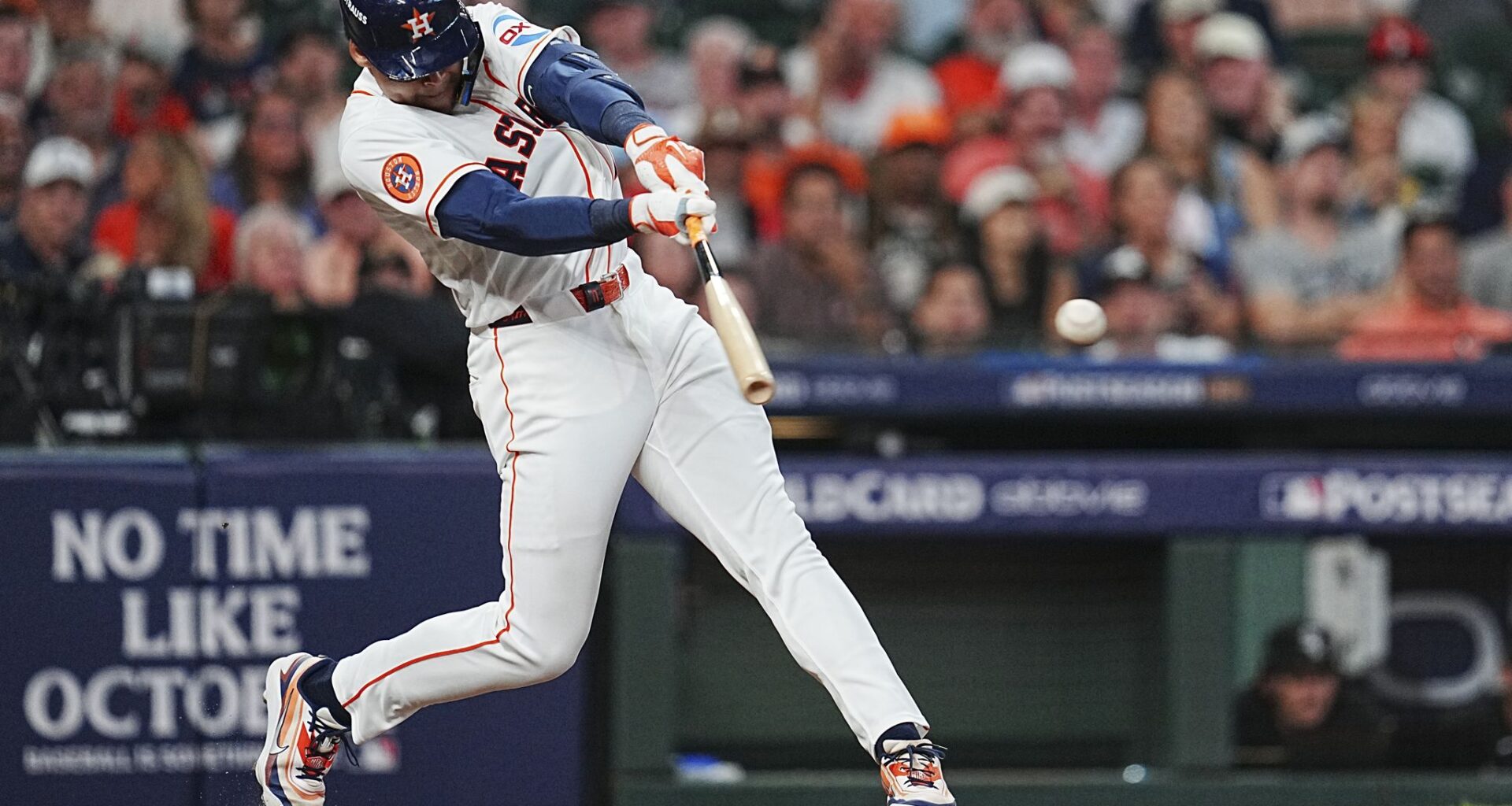
Houston Astros Cam Smith (11) hits a single in the third inning during Game 1 of an American League Wild Card Series in Houston, Tuesday, Sept. 29, 2026.
Jason Fochtman/Houston Chronicle
Ninth in a series on the Houston Astros‘ 2026 season, which ended with an AL West title but a sweep in the opening round of the playoffs.
Right field
After starring in a series in Philadelphia in late September, Cam Smith said candidly of the ups and downs of his second major-league season: “I guess I’m still trying to find my way.”
Article continues below this ad
For a second straight year, the Houston Astros asked Smith to navigate that process while serving as their primary right fielder. The 23-year-old started 139 games in right and thus was mostly responsible for both the Astros’ positive defensive marks and meager offense at the position.
A right field group that also included Taylor Trammell, LaMonte Wade Jr., Zach Cole, Joey Loperfido and Dustin Harris combined to post a .647 OPS, the Astros’ lowest at a position in 2026, and 0.8 wins above replacement per Baseball Reference, which ranked 17th of 30 major-league teams.
Smith, meanwhile, was named an American League Gold Glove finalist for a second straight year in right field, a position he had not played before the majors.
Houston right fielder Cam Smith (11) tries to field an RBI single by Atlanta Braves Ozzie Albies that tied the game 1-1 during the sixth inning of an MLB baseball game in Houston, Sunday, Sept. 20 2026.
Jason Fochtman/Houston Chronicle
What went right
While the Astros experienced heavy turnover in center and left field, Smith served as a fixture in right. He played the second-most innings among American League right fielders and rated among the sport’s best defenders there by publicly available metrics.
Article continues below this ad
The SABR Defensive Index, a factor in deciding Gold Glove winners, ranked Smith second among AL right fielders in its latest update in August. Statcast put Smith fourth in the majors in outs above average at the position this season, while Sports Info Solutions ranked him tied for 13th in runs saved in right. Smith drew high marks for his range and mixed ratings for throws.
Offensively, Smith hit for more power than in his rookie year. He slugged 21 home runs, compared to nine last season, with a .390 slugging percentage that was 32 points higher. His hard-hit rate rose by 2.7%, per Baseball Savant, while his barrel rate jumped from 6.9% to 11.2%. He became the sixth Astros player to produce a 20-home run season at age 23 or younger.
Houston Astros Cam Smith (11) reacts after striking out for the final out in the ninth inning during Game 2 of an American League Wild Card Series in Houston, Wednesday, Sept. 30, 2026.
Jason Fochtman/Houston Chronicle
What went wrong
Though the power and some underlying metrics were encouraging, Smith’s overall offensive numbers did not display the jump the Astros surely hoped to see in his second season. Bursts of production gave way to slumps, and the lack of consistency was reflected both in Smith’s season totals and Houston’s overall impact at his position.
Article continues below this ad
Smith’s batting average dropped 26 points from his rookie year and his on-base percentage by 33 points. Among qualified hitters, Smith posted the fourth-lowest OBP (.279) and sixth-lowest average (.210). His line-drive rate fell by 5.8%, per Baseball Savant, while his strikeout (26.1%) and whiff (29.1%) rates were among the highest quartile of major-league hitters.
A dearth of other options, along with Smith’s defense, still contributed to his starting 139 games in right field. All other Astros right fielders combined to take 85 plate appearances, in which they totaled a .182 average, a .250 OBP and three extra-base hits. As a result, Houston ranked 25th of 30 teams in OPS and offensive bWAR at the position.
Number to note
77.9 mph: Smith’s average bat speed in 2026.
Smith’s average bat speed in his rookie season was 74.5 mph, per Baseball Savant. His year-to-year jump of 3.4 mph this season was the largest of any qualified major-league hitter.
Article continues below this ad
Bat speed does not create results by itself, but there is correlation. Baseball Savant defines a “fast swing” as one with a bat speed of 75 mph or higher. This season, fast swings produced a .308 average and .613 slugging percentage on balls in play, per Savant; other swings yielded a .253 average and .385 slugging.
Smith’s fast-swing rate rose from 46.9% last season to 78% this year. It’s a promising metric that helped explain his 2.7% increase in hard-hit rate. Other numbers, though, suggested Smith did not get as much out of his ability to generate elite bat speed as other hitters with that strength.
The four qualified hitters with a higher fast swing rate than Smith this season were Jordan Walker, Junior Caminero, Garrett Mitchell and Nick Kurtz. All four had at least a 26.1% squared-up rate on contact, which Baseball Savant defines as generating at least 80% of the maximum possible exit velocity based on speed of the swing and pitch. Smith’s squared-up rate was 23.5% on contact.
Baseball Savant also deemed at least 21.5% of those four hitters’ contact to be “blasts,” or squared up and with high swing speed. Smith’s contact was 16% blasts, per the site. MLB-wide, contact qualifying as blasts this season produced a .568 average and 1.191 slugging. That Smith wields this kind of bat speed is auspicious; capitalizing on it fully seems key to his taking a next step.
Contract status
Smith has one more season before he becomes eligible for salary arbitration. (That is barring any changes to the arbitration process under a new collective bargaining agreement). Worth noting as well, Smith is set to be PPI-eligible for a third and final season in 2027, meaning the Astros would receive an extra draft pick if he were to finish in the top three in AL MVP voting next year.
Article continues below this ad
Of the Astros’ other right-field starters this season: Trammell is arbitration-eligible and projected by MLB Trade Rumors to earn $1.5 million in 2027. Houston may face a decision on whether to tender Trammell a contract. Wade is set to become a free agent. Cole and Loperfido are still in their pre-arbitration years and both finished the season on the Astros’ 40-man roster.
In the minors
Loperfido, Cole and Zach Dezenzo all ended the regular season at Triple-A Sugar Land. (Loperfido was added to Houston’s roster for the wild-card series but did not play). All have played in right field for the Astros and may be viewed as upper-level depth at this point. None posted an OPS over .641 in limited major-league time this year.
Ethan Frey, Anthony Huezo, Joseph Sullivan and Caden Powell are all ranked among the Astros’ top 30 prospects by MLB Pipeline and have played all three outfield positions in the minors. Sullivan has not played above Double-A, and the others have reached High-A. Kevin Alvarez and Logan Hughes, two of Houston’s top prospects still early in their development, have appeared in right field.
Key question
Can Smith break through in 2027?
Any assessment of Smith’s two major-league seasons must factor in his accelerated path there. Smith played in 32 minor-league games before the Astros named him their opening day right fielder in 2025. He still has never taken an at-bat at Triple-A. His development is ongoing and has taken place for two years at a level where results are required and every move is highly scrutinized.
Belief in Smith’s ability and makeup endures. The former showed in tantalizing flashes this season. Smith posted a .737 OPS in June and a .785 OPS in August. He propelled Houston to a series win in Philadelphia in September. Sustaining that level proved the issue. Smith had a .609 OPS in May and a .504 mark in July. After the Philadelphia series, he entered a 2-for-35 funk.
Unlike his rookie season, which featured a stark second-half dropoff, this one saw Smith’s numbers hover around the same level after April. In some situations, they regressed. Smith hit.270 with runners in scoring position and .250 with men on base as a rookie. This season, he hit .205 with runners in scoring position and .187 with men on base, while taking Houston’s fifth-most plate appearances in both scenarios.
Smith pared his strikeout rate by 1.7%, but it remained above MLB average. After accruing a minus-8 run value against sliders last season, per Baseball Savant, Smith posted a plus-3 run value this year. His batting average against sinkers fell from .315 to .230, though, and his minus-10 run value against sinkers tied for the third-lowest in the majors this season.
Falloff after the top of the Astros’ lineup encompassed far more than Smith. Yet his numbers illustrated the strides still required for Smith to become the “aircraft carrier” former general manager Dana Brown envisioned. Smith will enter his third season under a new GM and manager. Right field appears the least of the outfield questions they’ll inherit, but it would help if Smith makes a bigger jump than in year two.
Summary
Two seasons in which Smith owns an 88 OPS-plus have tempered expectations inherited upon his abrupt arrival with Houston. But Smith is still only 23 years old and among the top defensive right fielders in the sport. In weighing patience against production, the Astros have skewed toward the former with a player they believe can be a big part of their future. That balance may shift with time, but barring an unforeseen change this winter, Smith should have an opportunity to override it with improvement.