
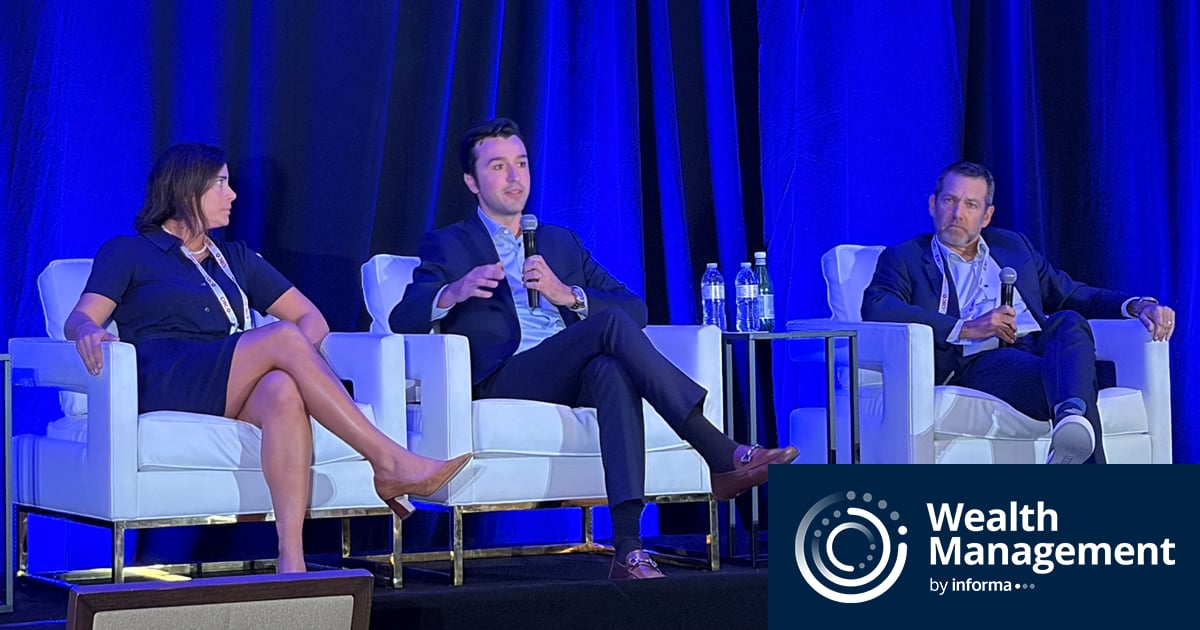
Even registered investment advisors with dedicated and active acquisition strategies say organic growth is the key—and arguably more valuable—focus area for a successful organization in the long run, according to three RIA leaders speaking at RIA Edge Orange County on Wednesday.
Brian Parker, co-founder of the acquisitive EP Wealth, said the industry should keep in mind that growing outside of acquisitions ultimately determines a firm’s value, not its asset or headcount metrics.
“Organic growth is really what all of these businesses are ultimately valued on,” said Parker, who has helped grow EP Wealth to a national firm overseeing more than $50 billion in assets. “It’s very difficult to get somebody to grow. It’s much easier to find somebody that is growing and enhance what they’re doing and build a culture around that.”
Parker, who started EP Wealth with Derek Holman in 1999, said he was cautious at first about building a larger firm because he didn’t want to lose a personal touch with clients.
“Any of these business models that are just about capturing EBITDA or additional business or even headcount—you kind of already lost,” he said. “This business is about sitting at the kitchen table with your sleeves rolled up, talking about retirement and college planning and helping people achieve their goals. What sadly seems to happen sometimes is people find pride in building a wirehouse … and that starts to become very cold.”
Alison Burkett, senior partner, executive vice president and head of enterprise development at Snowden Lane Partners, said her firm has deliberately focused on fostering organic growth to ensure it wasn’t subsumed by its very active recruiting and acquisition strategy. Burkett gave the metaphor of the firm as a body in which, if you only exercise one muscle, the other muscles will atrophy.
“What’s really important in how we think about organic growth or just growth as a firm, is making sure you’re not just exercising one or a few muscles, but all of them,” she said. “Growth is something that’s up to everyone in the firm.”
Burkett said Snowden Lane’s organic growth strategy is based on a “mantra, a method and a measure” that ties growth to better client services, rather than a straight sales approach.
“Organic growth can start to feel like a sales pitch, right?” she said to the audience of RIAs. “You don’t want to feel like an auto salesman. … If you remain curious about your clients and you’re asking the right questions, then you earn the opportunity to serve them better and serve them in more places or win a referral because you’re doing a great job.”
Bryce Black, director of corporate development at Bogart Wealth, noted that a new team’s desire to grow can often be evaluated even before they join a firm. Bogart Wealth, he explained, structures some offers with as much as 70% equity and only 30% cash specifically to filter out sellers who aren’t interested in long-term growth.
“Show me the incentives, and I’ll show you the results,” he said. “Someone that’s only interested in monetizing their business and cashing out isn’t going to be interested in the way that we structure the deal.”
The three firms, while in agreement on the importance of organic growth, noted different strategies for fostering and tracking success.
According to Black, Bogart Wealth runs a centralized business development team that handles email marketing, podcasts, webinars and dinner seminars, booking meetings directly on advisors’ calendars. He said his two favorite growth metrics are the number of new client meetings booked each month and overall lead flow, with the firm targeting roughly 30 introductory meetings per advisor per month, or about 360 annually.
Parker said EP’s biggest organic growth investment has gone into its direct-to-consumer marketing engine, which he described as highly measurable.
“If I put one dollar in, we know how it works and what our close rate is,” he said.
Snowden Lane, in the meantime, directs incremental dollars toward technology and back-office support that frees up advisors’ time with clients, including AI tools.
All three panelists agreed that the first 90 days after an acquisition or recruitment are critical for measuring how a new firm is meeting its organic growth goals.
Black said the goal of any deal is to be “additive,” with growth rates expected to at least return to pre-deal levels within two to three months and ideally exceed them. Parker said resourcing in that early window is paramount: “You just can’t have enough resources in those first 90 days,” he said.
Burkett noted that M&A isn’t the only growth lever post-deal—firms can also expand by adding complementary skill sets, such as next-gen advisors, CFPs or dedicated business development “finders,” to existing teams.
“We’re really encouraged if an acquisition or a recruit comes on and a year later, they want to expand their team,” she said. “That shows they want to grow their practice not just by the numbers, but through their services.”