
The snap was clean, but the catch was not.
U-M punter Blake O’Neill bobbled the ball, and MSU freshman safety Jalen Watts-Jackson pounced on it, returning the muffed punt for an unfathomable game-winning touchdown as time expired. A rivalry game that would be etched into MSU history — and college football history. Blaha was there to call it.
At 81, Blaha knows his career will eventually come to an end, but he isn’t ready to put a date on it. He said he expects to recognize when the time is right to step away, though he doesn’t believe that moment is here just yet.
After more than 50 years calling games, Blaha said time has passed so much faster than he could’ve ever imagined. What feels like 15 or 20 years to him has turned into a career spanning generations of Spartan players, coaches and fans.
“It’s not going to be next week. Probably not gonna be next year, but it’s not gonna be 10 years from now either,” Blaha told The State News.
For Blaha, who has spent five decades broadcasting Spartan football to listeners across the state, the 2015 “Trouble with the snap” game remains his favorite moment behind the microphone.
“You got to rank the block punt as number one,” Blaha said. “But I have a co-number one that you didn’t bring up.”
Fourteen years earlier, Blaha had a similar feeling during MSU’s 2001 victory over Michigan, a game that’s remembered as “Clockgate.” After the Spartans spiked the ball with one second remaining, quarterback Jeff Smoker had nowhere to go in the pocket and heaved the ball up into the end zone. Wide receiver T.J. Duckett came down with the football, securing the 26-24 win over the Wolverines.
“At that point in time, I couldn’t have been any more nervous,” Blaha said. “I feel sorry for T.J. Man, he’s got to catch this. And he did.”
The two calls represent entirely different eras of football in East Lansing, yet Blaha has approached his career the same: explaining to radio listeners what is happening on the field while sharing an experience with them every college football Saturday.
His career began in 1971, when he was 26, and WJIM handed him the play-by-play duties. Blaha’s first broadcast was a 10-0 Spartan win over Illinois, and he remembers studying defensive lineman Tab Bennett, one of the Illini’s top players.
The Detroit native recognizes the luck that put him in the booth 55 years ago. Blaha credits pure chance for giving him the opportunity to call MSU football early in his career, a job he fell in love with instantly.
“I think anybody who gets a job that’s prestigious has to be lucky, and I think I was fortunate,” Blaha said.
And his appreciation for calling the sport hasn’t wavered. He said he still feels the nerves before every single broadcast, whether it’s a football game at Spartan Stadium or a Detroit Pistons game at Little Caesars Arena. Blaha is devoted to his craft and always reminds himself to never take calling a game for granted.
“I think you should get nervous before every game,” Blaha said. “At least amped up and remind yourself how fortunate you are to be behind that mic, and that you need to have prepared and be ready to put your preparation into words and action.”
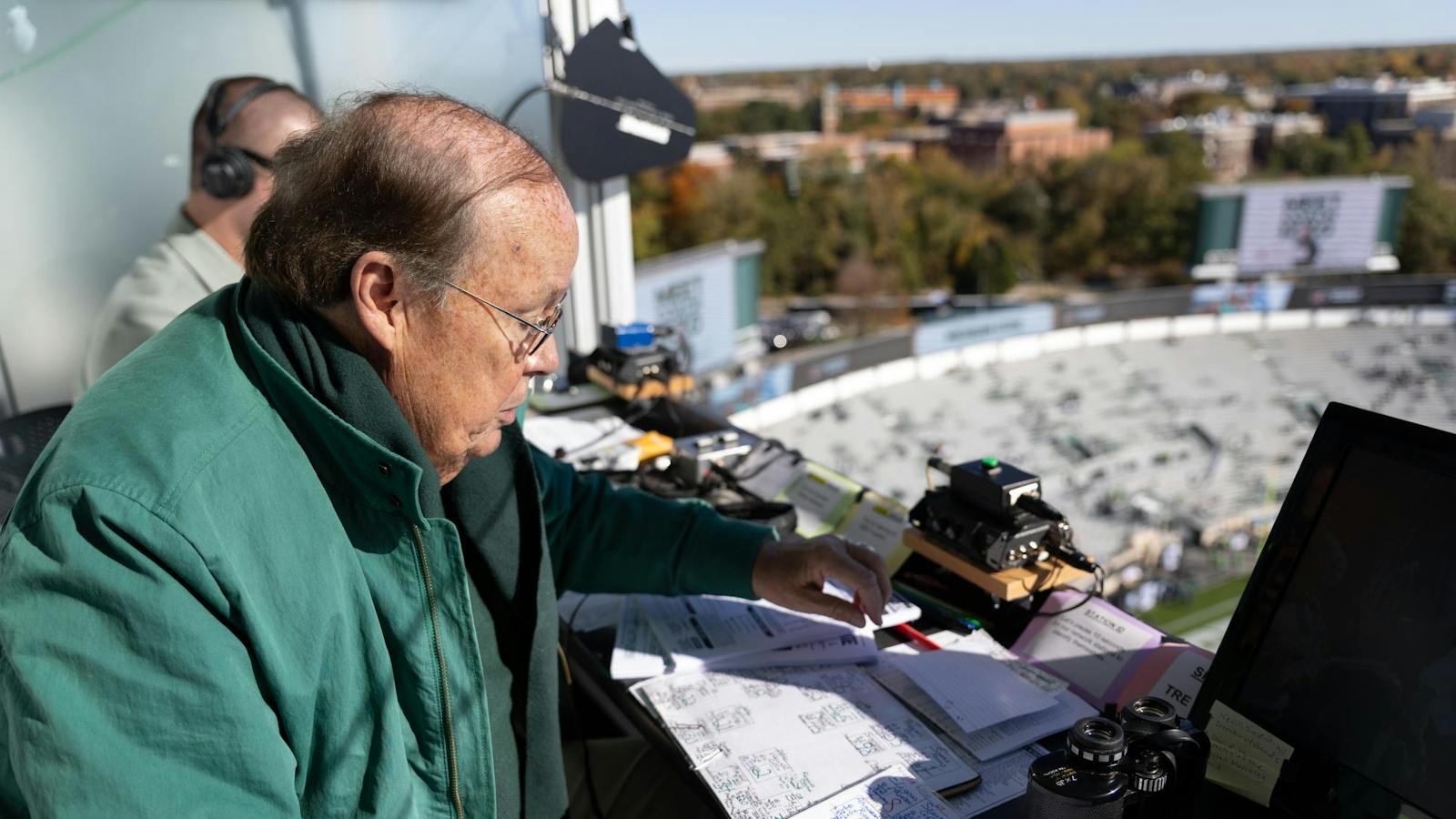
He said his preparation has kept him behind the microphone for so long. He learned it best from Van Patrick, a former Detroit Lions and Notre Dame football announcer, who taught him how to keep track of players and build a spotting board, a reference chart used by broadcasters to help identify players and stats.
Patrick had other employees build his board, but Blaha wasn’t in a position to let others do that work, so he did it himself. Since then, he’s continued to create them himself, while handwriting everything.
“I don’t want anybody doing those things for me; I want to do it myself,” Blaha said. “You learn more when you’re looking to try to find who’s on the two-deep, why he plays there, and when he plays there and all the rest.”
Support student media!
Please consider donating to The State News and help fund the future of journalism.
Blaha’s board construction has remained similar over 50 years, though players and coaches shift continuously. Few coaches impacted him as much as Duffy Daugherty, who led the Spartans from 1954 to 1972 and significantly helped integrate college football.
Daugherty drew a crowd wherever he went. Whether his jokes were funny or not, you laughed anyway. His personality was contagious, one of a kind — at least that’s how Blaha described him.
“Duffy was a magnanimous guy,” Blaha said. “He was nice to everybody, and people absolutely loved him.”
Blaha also developed lasting professional relationships with coaches who followed Daugherty, including Nick Saban, George Perles and Mark Dantonio.
Saban, whom Blaha considers one of the best college football coaches of the modern era, welcomed Blaha and his wife, Mary, into his circle. Blaha has appeared on Saban’s radio show and Sunday morning television program, and the two visit occasionally over coffee at Saban’s house.
Blaha said Perles supported him by giving him an opportunity to work on the network broadcast in the early 1990s. He remembers Dantonio for his ability to make the right decisions in close games, particularly in the final minutes.
It’s the relationships that keep him going at 81 years old. He’s not chasing any milestones, and the MSU football team hasn’t shown any success for five seasons, but Blaha loves what he does. He said the people around him make it so easy to keep going.
“Time flies when you’re having fun,” Blaha said. “It’s been a great ride.”
For now, he remains behind the microphone, preparing for each broadcast the same way he has since 1971 — knowing the names, understanding the game and making sure Spartan fans know what is happening on the field.
Discussion
Share and discuss “Exclusive: How George Blaha’s 50 years calling MSU football shaped MSU history” on social media.