
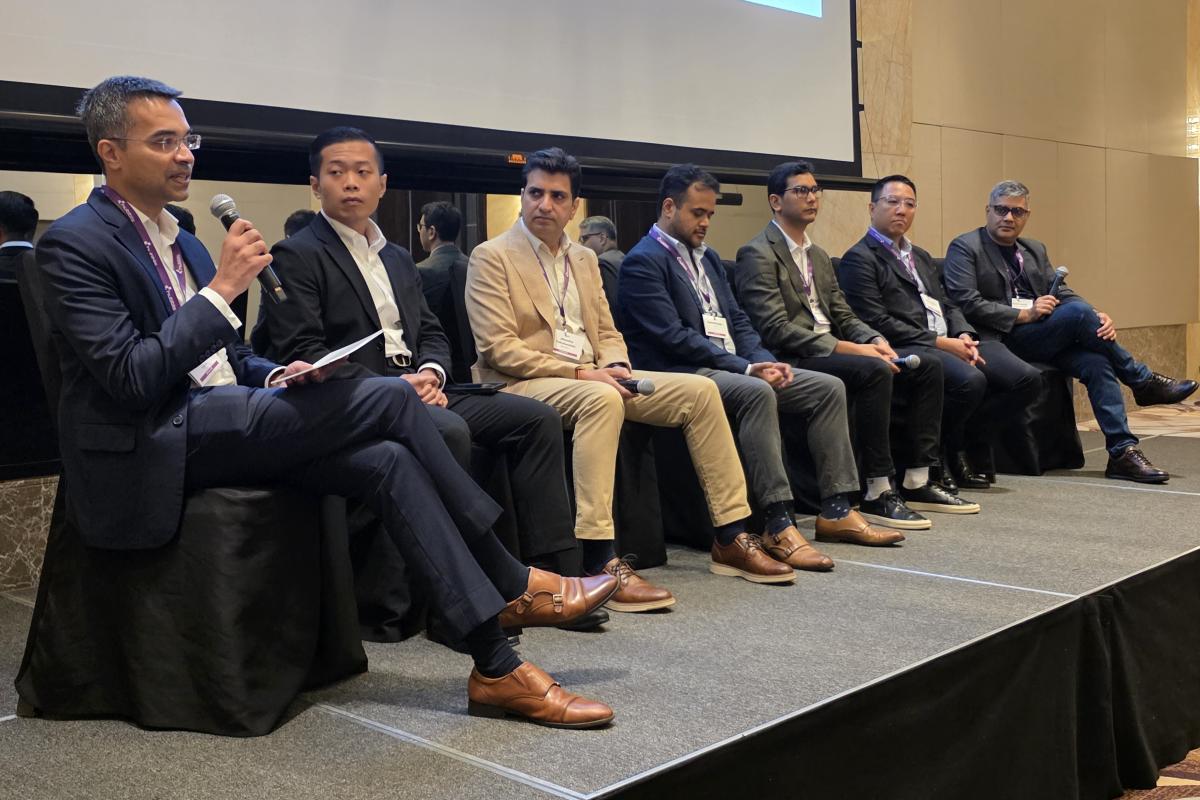
At the Hubbis Digital Wealth Forum in Singapore on 21 October 2026, the second panel examined what takes artificial intelligence (AI) beyond a pilot and into the everyday work of a wealth-management business. The discussion moved between established banks with complex legacy processes and a digital platform whose core operations were already substantially automated.
That contrast shaped the debate. Agentic AI could help advisers prepare for clients, improve access to investment knowledge or support a long-term financial plan. It did not follow that every process needed an agent capable of acting independently. The panellists returned to the business objective, the user’s workflow and the person accountable for the outcome. They also argued for a broader assessment of returns, including better client engagement, stronger assessment quality and reduced risk, rather than treating every productivity gain as a headcount reduction.
Chair: Prasanna Venkatesan, Senior Partner and Global Head of Private Banking & Wealth Management, Synpulse
Panellists
Jackson Ng, Chief Operating Officer, Chief Technology Officer (Singapore), and Head of Innovation (Asia), Azimut Group
Jitendra Tekchandani, Executive Director, Wealth Management, DBS Bank
Gourab Kundu, Head of Digital Growth and Wealth Continuum, Asia South, Citi
Deepak Sarda, Chief Technology Officer, Endowus
Kelvin Chiang, Head of Compliance Transformation, Group Compliance, OCBC Bank
Sushil Anand, Head – AI Chapter, Wealth & Retail Banking, Standard Chartered Bank
Key Takeaways
AI is more likely to be used when it is part of a defined business transformation and an existing workflow, with an accountable business owner.
Institutions can centralise reusable capabilities and governance while leaving the application of those tools and the final judgement close to the business.
An agent that executes tasks autonomously can add risk without much additional value where the underlying process is already well automated.
Preparing advice and taking responsibility for it are separate activities. The panel emphasised human review and stronger controls as systems approach consequential actions.
Compliance should help shape the design from the outset, including the policy, process, platform and organisational culture around it.
AI can extend guidance to clients who never had an adviser, but the handover to a person must preserve the context of the conversation.
Return on investment should include engagement, decision quality and risk reduction, with agreed measures and comparisons that establish the contribution of AI.
Client-owned agents may become another channel into financial services, but the panel saw accountability, risk appetite and control of autonomy as unresolved implementation questions.
Adoption Starts With the Work People Already Do
The opening contribution distinguished the proliferation of proof-of-concept projects from AI embedded in a business transformation. Trusted data and safeguards were necessary, but the speaker placed equal emphasis on users, adoption and clear business accountability.
“Users are not expecting a new AI tool,” said a panellist.
They need help within the platform and workflow they already use. A separate application may add another task to the day rather than remove one.
Client-engagement preparation illustrated a more integrated approach. The speaker described combining a client’s portfolio, risk profile and holdings with market information and house views to prepare personalised prompts for relationship managers. Human review remained in place before communications reached clients, with the objective of generating a fuller portfolio conversation.
Other examples included synthesising investment-office knowledge and making house views available in shorter formats for frontline teams. The speaker also described an agentic pilot for relationship managers covering product discovery, market views and portfolio preparation. That initiative was explicitly still a pilot, and was being developed within the advisers’ wider application rather than as a standalone project.
The examples suggested a useful test for any implementation: where, precisely, will the employee encounter the tool, and which part of the job will it improve?
Central Governance Can Support Local Decisions
The panel did not frame centralisation and decentralisation as mutually exclusive choices. A multinational institution needs consistent governance over agents and their outputs, but the use cases still have to reflect the needs of individual businesses.
One participant described a central governance engine that allows agents to be produced within common guardrails, while teams identify how to apply them. Another identified reusability, delivery speed and governance as functions that can be standardised, avoiding repeated work across departments.
The distinction became sharper at the point of judgement. Common controls and approved technical approaches do not remove the need for the business to decide how a capability should serve a client or support an employee.
This approach gives local teams room to use AI without requiring each of them to establish an entirely separate operating framework. It also makes governance part of the shared infrastructure, rather than a late review of unrelated experiments.
Existing Automation Changes Where Agents Create Value
A digital wealth participant challenged the assumption that agentic execution was necessarily the most attractive investment. Much of that firm’s onboarding, compliance and execution activity was already automated. Introducing agents to make autonomous decisions in those areas could add considerable risk for relatively little additional return.
The opportunity was stronger elsewhere: helping clients discover available solutions, understand their portfolios and relate their investments to short- and long-term needs. Internal tools could also improve adviser preparation.
The participant described a wealth-planning companion intended to be personalised, proactive and guided by the firm’s investment principles. Its purpose was to retain context around a client’s goals over time, rather than simply wait for the next isolated question.
The emphasis on principles was important. A system that agrees too readily with a user’s suggestion may be poorly suited to financial guidance. The speaker wanted the AI to reflect a consistent approach to asset allocation and matching assets to liabilities, including when that required challenging the client’s initial view.
The service was described as live since the middle of the year, with the speaker reporting additional investment activity and fewer support enquiries. Those were reported outcomes from that implementation, not evidence that autonomous execution would produce the same return elsewhere.
Map the Business Before Choosing the Agent
Another participant described a project that began by mapping the organisation’s workflows, converting them into cross-departmental value chains and assessing where the gaps were. Building agents came after that assessment.
The approach reversed the familiar question of what to do with the latest model. The starting point was “what is the business outcome that we want to achieve”, as the panellist put it.
That exercise also created space to decide that an agent was unnecessary. A workflow should not receive one simply because deployment has become easier.
The speaker described three pilots, including a front-office concept that would connect market developments to a wealth manager’s client list and provide relevant briefing material. As the work approached deployment, governance questions became more pressing. The response was to develop a controlled environment in which agents could operate, described as a form of virtual office.
The example exposed a practical tension. It is possible to make an agent perform an impressive task before resolving how it should operate safely inside the institution. The operating design has to catch up before that task becomes a dependable service.
Preparing Advice Does Not Transfer Accountability
The panel drew a clear boundary between assembling an advisory recommendation and taking responsibility for it.
AI can bring together holdings, market movements, client preferences and risk profiles, then help prepare ideas or rebalancing insights. It can also support suitability checks and explain the resulting recommendation in more accessible language. In the model described, the relationship manager still reviews the output and remains accountable for the advice.
The level of control has to increase as a system moves closer to action. A draft, an informational prompt, a payment and an executed transaction do not carry the same consequences. One participant described using more constrained, semi-autonomous arrangements and deterministic controls at the final step.
This was a limit on autonomy within the implementations being discussed, rather than a rejection of AI’s ability to support complex preparation. The aim was to give advisers a fuller, faster starting point without making responsibility ambiguous.
Compliance Belongs in the Design
The compliance perspective began with a question about whether the function is treated as a police officer or a partner. Bringing it in only when a project needs approval can make the path to production more difficult.
“Your AI should be compliant by design,” said a participant.
The speaker described four connected requirements: policy, process, the technology and data platform, and people and culture. Accountability and auditability were central, including identifying the human who would answer for an error.
A source-of-wealth tool illustrated why the language around a system matters. It was positioned as an assistant that helps prepare an assessment, not as a final approver. The speaker described changing its name from an adviser to an assistant after the earlier wording encouraged expectations of straight-through approval.
The broader objective was to make the institution’s experience available to bankers as they worked. A training course alone does not ensure that every employee can produce a clear, well-supported source-of-wealth assessment. An AI-assisted draft can provide a starting point and a continuing learning aid, while leaving the final assessment subject to review.
Better Assessment Quality Can Improve the Client Experience
The source-of-wealth example also challenged the tendency to report AI success chiefly in terms of time saved. The participant said the original objective was to improve assessment quality and strengthen the bank’s risk culture.
Poorly prepared assessments can lead to identification issues, further requests for evidence and remediation work. The speaker reported fewer source-of-wealth and source-of-funds identification issues after implementation, with fewer repeated approaches to clients for documentation.
That connected compliance quality with service quality. A client benefits when the institution asks for the right information earlier and avoids unnecessary iterations. Faster processing is useful, but so is reducing the likelihood that the work must be repeated.
The panel’s discussion placed consumer protection, avoiding mis-selling and accurate representation alongside productivity as design objectives. An implementation that improves those outcomes can have value even where the main gain is not a visible reduction in staffing cost.
The Handover to a Human Is Part of the Product
In the mass-affluent segment, another panellist questioned the language of replacing advisers. Some digital services are reaching clients who never had an adviser in the first place.
AI can support awareness, education and an understanding of what is relevant to the customer, then help them move towards an action. Where judgement is needed, a human wealth professional remains available.
The difficult part is the transition. If the digital interaction cannot pass its context to the adviser, the conversation breaks and the client has to begin again. A joined-up handover is therefore part of the service itself, not an incidental technical feature.
The sequence also depends on the segment. In the model discussed for mass-affluent clients, AI may be the first point of contact. In private banking, the person may remain at the front of the relationship, with AI helping that adviser make better decisions. Neither arrangement can be assessed without considering the clients it is intended to serve.
Measure What the Released Capacity Produces
On returns, one participant argued that the value of an adviser knowledge tool should not be judged solely by whether expenses fall.
“Productivity is not an expense cut,” the panellist said of that implementation.
Time released from cumbersome processes can be used to serve clients more effectively and support revenue growth. That differs from a programme designed to reduce frontline headcount, even where both are described as productivity initiatives.
Another participant focused on measurement discipline. The assessment covered better decisions, employee productivity, risk avoidance and greater client participation. AI could help advisers identify whom to contact and provide a useful reason for the conversation, extending engagement beyond the clients they could previously reach.
The measures were agreed with business owners, and control groups were used to compare outcomes with and without AI. That provided a basis for assessing the difference attributable to the technology rather than simply counting activity.
The discussion did not reduce success to one universal metric. It called for the intended outcome to be explicit, then for the institution to test whether that outcome had actually improved.
Client Agents Will Require a Further Layer of Control
The closing exchanges considered a different form of interaction: a client’s own AI agent communicating with the financial institution.
Several panellists expected this to become more common, comparing it with the arrival of other channels that clients eventually take for granted. They also acknowledged that the risk boundaries were not yet fully understood.
One participant, explicitly offering a personal view, distinguished an agent that provides information or identifies intent from an agent authorised to act for the client or adviser. Others focused on managing levels of autonomy, agreeing accountability and working within the institution’s risk appetite. Cooperation between financial firms, technology providers and regulators was seen as necessary as expectations develop.
For current implementations, the panel’s priorities were more immediate. Put the tool inside a useful workflow, establish who owns the decision, design the controls before deployment and measure the effect on the business and client. Those requirements remain relevant whether the institution is introducing its first adviser assistant or preparing for agents to interact across its boundaries.
**
Disclaimer: This article is for general information only and does not constitute investment, legal or other professional advice. Readers should seek independent advice relevant to their circumstances. To the extent permitted by law, Hubbis and the contributors accept no liability for any loss arising from reliance on this content, including any action taken or decision not to act.