
Summary of the day so far…
It has just gone past 3pm in Tel Aviv and 1pm in London, where we are currently blogging from. Here is a summary of where things stand:
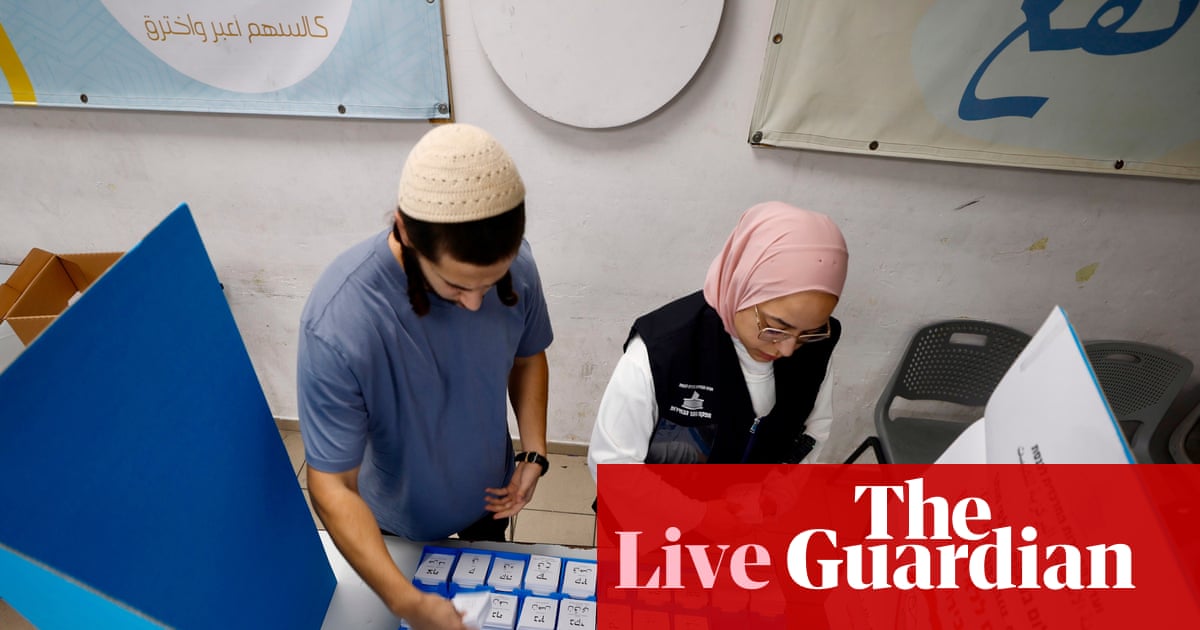
Turnout is at its highest so far in decades as Israelis vote in what is widely considered to be one of the most consequential elections in the country’s history.
Polls have opened in the first election since the Hamas-led attacks of 7 October 2023, Israel’s subsequent destruction of Gaza, and the launch of its war with the US against Iran.
Tens of thousands of Israelis living abroad have flown in for the elections, according to Aid Coalition.
Exit polls are released at 10pm Israeli time (8pm GMT), and the first indication of actual voting counts usually emerges in the early hours of the morning.
Israeli prime minister Benjamin Netanyahu’s main rival is Gadi Eisenkot, a former head of the Israeli military and relative political newcomer.
A consistent majority of Israeli polls show Netanyahu’s coalition bloc with the ultra-Orthodox and the far right will fall below the threshold of 61 seats needed to form a government.
But even though there is a clear anti-Netanyahu majority, polls indicate that the Jewish Israeli opposition bloc will also fall short of the required seats, meaning weeks or even months of political wrangling may be in store as parties make deals and trade concessions.
There was a suspected attempted stabbing of the leader of the Democrats party, Yair Golan, at HaMesila park in Tel Aviv, earlier today, the party said. The security guards “subdued” the suspect before he could do anything, the party said in a statement. The suspect was subsequently arrested.
The Central Elections Committee told reporters earlier that there had been no indication of widespread irregularities.
Updated at 09.05 EDT
Key events
Israeli prime minister, Benjamin Netanyahu, has continued to urge right-wing voters to go out and vote, claiming that if they don’t then a new government will be formed with parties representing Palestinian citizens of Israel.
“Buses are heading to the polling stations, and huge lines are being reported in the Arab settlements,” he wrote in a social media post that appears as if it is part of a scare campaign.
“If we don’t go out to vote now, we’ll find ourselves with a government of the Arab parties. We must not stay home. Every vote counts!”
The Central Elections Committee told journalists earlier today that there had been no indication of widespread irregularities.
In an earlier post, we mentioned that, as of 10am local time, turnout in the Israeli general election was at its highest point at that stage of voting since 1981.
We now have some more figures from the Central Elections Committee, which appear to confirm the trend, with the new data showing that 31.5% of Israelis voted by noon, the highest voter turnout by midday since 1977.
Share Emma Graham-Harrison
In the settlement of Efrat near Jerusalem, Shani, 19, had come to the polling station with her parents, to cast her vote for the far-right party of finance minister Bezalel Smotrich.
She is part of a large cohort of first-time voters who are more rightwing than older generations, and may help bolster support for Benjamin Netanyahu and his far-right coalition partners.
More than 500,000 Israelis have reached voting age since the last election in 2022, and three-quarters of first-time Jewish voters define themselves as right or centre-right, a recent poll for Channel 12 television found (it did not survey Palestinian citizens of Israel).
People arrive to vote at a polling station in the settlement of Efrat in the West Bank. Photograph: Quique Kierszenbaum/The Guardian
Shani said she chose Smotrich, a settler himself, for his promises to expand Israel’s footprint in occupied Palestine. “Smotrich is pushing forward with settlement expansion and improving security,” she said.
Her mother, kindergarten teacher Rivka, also voted for Smotrich, and said her priority was to return Netanyahu’s coalition to office.
“The right must win, because otherwise there is a chance of a Palestinian state, which will be very bad for Jews,” she said. Her husband Motti, who runs a healthcare standup had voted directly for Netanyahu. “He’s a diplomat, he’s strong. He’s got whatever leadership should have.”
Bezalel Smotrich, leader of the Religious Zionist party, votes in the general election this morning. Photograph: Avi Ohayon/Reuters
Spiralling attacks by militant Israeli settlers on Palestinians, and the growing threat of sanctions on settlement goods and construction, were not a key election issue for voters in Efrat who spoke to the Guardian.
Software engineer, Yitzchak Schwarz, 36 is an activist for far-right libertarian Moshe Feiglin, running on a joint slate with Smotrich for this election. “If there are sanctions, it’s going to hurt a bit, but we have to think about our own survival and our own national rights,” he said.
Yitzchak Schwarz carries a flag for the ultra right wing party Zehut, lead by Moshe Feiglin, in a polling station in Efrat. Photograph: Quique Kierszenbaum/The Guardian
Sue and Tom Rosenfelt, who have lived in Efrat for over 30 years and have three sons in the reserves, said national unity and the unequal burden of military service are their main concerns. “I think that at this point getting another foothold and another hilltop isn’t the thing that’s going to strengthen the country as a whole,” Tom said. “We need to work more on unity.”
In an election which many Israelis describe as critical, turnout was so high at their polling station at a school in Efrat that they had left the long lines, and planned to come back later.
Sue and Tom Rosenfelt have lived in Efrat for over 30 years. Photograph: Quique Kierszenbaum/The Guardian
Both plan to vote for the party of Naftali Bennett, a rightwing settler and tech multimillionaire, who joined forces with centrist Yair Lapid. “I feel like this is a time when we need to come together,” Sue Rosenfeld said. “You know, Bennett and Lapid are on different sides of the spectrum, but they’ve come together and that’s something I want to support.”
Updated at 08.57 EDT
Suspected stabbing attempt against Yair Golan foiled at Tel Aviv event, party saysEmma Graham-Harrison
There has been a suspected attempted stabbing of the leader of the Democrats party, Yair Golan, at HaMesila park in Tel Aviv, the party has said in a statement.
During a voter mobilisation tour, the party said “an unidentified man wearing a jacket” approached Golan in a “threatening manner”.
A statement from the party read:
double quotation markGolan’s security guards blocked the man, and as they moved toward him, a large knife slipped from beneath his clothing and fell to the ground.
The security guards immediately subdued him before he could do anything. Police were called to the scene and arrested the suspect.
In a statement, Golan said:
“Incitement and violence will not deter us. This is the direct result of the poison machine operated by Netanyahu and his Qatari agents. I call on everyone who cares about security and democracy to go out and vote now, so that we can ensure the country we love so dearly becomes a free and safe place once again.”
Golan fought a long legal battle to get security protection from the Shin Bet security service. They only resumed responsibility for his security on Monday, the day before the elections.
Yair Golan, 64, is a former general who leads the Democrats, a party that favours the establishment of a Palestinian state. Photograph: Noam Galai/Getty ImagesShare
Updated at 08.00 EDT
While the media attention has been focusing on the country’s parliamentary elections, Israel’s assault on Gaza has continued, a year after the signing of a so-called ‘ceasefire’ with Hamas.
A UN commission said yesterday that Israel was continuing to commit genocide in Gaza despite the signing of the US-brokered ceasefire last October.
The report by the UN Independent International Commission of Inquiry on the Occupied Palestinian Territory, including East Jerusalem, and Israel, rejected a claim in May by Donald Trump’s Board of Peace that the truce had “largely held”.
It said Israeli authorities had kept committing “genocidal acts with the genocidal intent to destroy, in whole or in part, the Palestinians in Gaza”. The report said:
double quotation markThe perception of Palestinians and a possible Palestinian state as a threat to Israel and the desire to reduce the Palestinian population contribute to a permissive military culture where Israeli soldiers, with or without directives from commanders, directly target Palestinians whether or not they pose a real or immediate threat.
Testimonies by Israeli soldiers in Gaza display a disregard for Palestinian lives and a military culture where Palestinians are dehumanized, equated with “terrorists”, trivializing the killing of civilians.
The aftermath of an Israeli airstrike in Nuseirat refugee camp in the central Gaza Strip. Photograph: Ramzi Abu Amer/JNA/ZUMA Press Wire/Shutterstock
The report noted that between the 10 October ceasefire in 2025 and 30 September 2026, Israeli attacks killed at least 1,431 Palestinian people in Gaza, including 300 children and 130 women.
In its latest update, Gaza’s health ministry said that 74,561 Palestinian people have been killed in Israeli attacks across Gaza since October 2023, when Isreal launched its assault on the territory following the Hamas-led attack on southern Israel on 7 October 2023, in which about 1,200 people were killed.
The report also accused Israeli forces of having committed crimes against humanity in the West Bank. It lists extermination, torture, rape and other forms of sexual violence. Israel has dismissed the findings of the report and has denied committing genocide in Gaza.
ShareNetanyahu casts his ballot and urges his supporters to vote, saying ‘this is an emergency hour’
Benjamin Netanyahu, who is fighting for his political survival, has just cast his ballot in Jerusalem.
In a post on X this morning, the Israeli prime minister wrote “right-wing voters, this is an emergency hour” as he urged them to get out and vote to counter any left electoral gains.
“Higher-than-usual turnout rates in the left’s strongholds. Right or Palestine, for real,” Netanyahu wrote.
Allow content provided by a third party?
This article includes content hosted on platform.x.com. We ask for your permission before anything is loaded, as the provider may be using cookies and other technologies. To view this content, click ‘Allow and continue’.
Updated at 07.49 EDT
Police believe the arrest of three people in southern Israel who are suspected of being involved in voting bribe attempts was a single incident and not part of a larger campaign, according to Dean Livne, acting director-general of the Elections Committee.
Updated at 06.26 EDT
Early voting figures show highest turnout in decades
Citing figures released by the Central Elections Committee, the Israeli newspaper Ynet is reporting that voter turnout in the election reached 16.68% by 10am local time (8am GMT), the highest level recorded at that hour since 1981.
Over 1.2m Israelis had cast their ballots by 10am, according to the data, a rise of 0.78 percentage points compared with the same stage of the previous election in 2022.
Updated at 06.19 EDT
 Julian Borger
In Sanhedria cemetery in north Jerusalem, ultra-orthodox voters came to the tombs of revered rabbis before they cast their ballots. There was no question of which way they were going to vote: for the parties representing Ashkenazi and Sephardic ultra-orthodox. But some at the Sanhedria cemetery, the young especially, made clear they only would do so reluctantly.
Yair Shuker, aged 19, said only one issue was important to him. “The election is about whether we will live by the Torah, or there will be no Torah. There will be a Jewish state or there will be no Jewish state,” he said.
Ultra-Orthodox voters gather at the grave of late spiritual leader Rabbi Obadiah Yossef. Photograph: The Guardian
And for him – as with almost all Israel’s ultra-orthodox (the Haredim) – the critical measure of the state’s level of observance is whether the Haredim would continue have exemption from military service.
“There are some who study the Torah, and some who stand and defend the land,” Shuker said.
The exemption for ultra-orthodox religious students dates back to the founding the state, but has long been a sort of tension among Israeli Jews, all the more so since the 7 October attack in 2023 and the start of the Gaza war. Israel’s supreme court ruled in 2024 that the blanket exemption for haredi men had no basis in law.
In return for their support in keeping him in power, Benjamin Netanyahu promised the ultra-orthodox parties (the Sephardic party Shas and the Ashkenazi United Torah Judaism) new legislation that would perpetuate the exemption, but has failed to deliver on that promise due to splits in his coalition. As a result both parties left the government, though Shas remained part of the coalition.
Whatever their feelings about Netanyahu, both would vote against a secular-led government led by the current opposition parties, which have pledged to end the exemption once and for all, and enforce military service if necessary.
Images for sale at the grave of late spiritual leader Rabbi Obadiah Yossef. Photograph: The Guardian
Shuker said he did not trust either coalition, but would vote because he had been told to. “The rabbi has asked us to vote for Shas, so I will vote,” he said. A 23-year-old Ashkenazi ultra-orthodox, who identified himself as Yaacov K, expressed the same sense of disillusion mixed with duty. He said:
double quotation markI’ll tell you the truth. To me and most of the people around me, we don’t believe in anyone.
If you’re asking me, I’ll never go and vote. But I have a rabbi and the rabbi told me listen, you have to go and vote. And if he says you have to go and vote, then that’s what I do. I don’t even start thinking if it’s worth it for me or not worth it for me.
The open distrust and contempt for Netanyahu, coupled with obedience and party discipline, could be one reason that the prime minister’s bloc has over-performed by a seat or two in past elections, compared to his poll numbers. That could be crucial if the pattern is repeated.
Azriel Zadok, a rabbi who had come for morning prayers at the Sanhedria cemetery, argued that the mass ultra-orthodox vote was essential to preserve Israel’s Jewish identity from “the left”.
“We have no problem with the secular. We pray for them, and we pray for the soldiers,” Zadok said. “Our problem is with the leftists we are trying to decide for us how we should live.” “They want us to go to the beach on Saturday and they want us to marry outside our faith. We want to remain Jews,” the rabbi added.
The centre left is only a small part of the opposition bloc, and it does not propose to change the ultra-orthodox lifestyle. But the bloc is united on the insistence that the Haredim should do their part in the defence of the nation. It is the most divisive issue among Israeli Jews voting today.
Updated at 08.53 EDT
According to Israel’s Hareetz newspaper, United Arab List (Ra’am), an Islamist party headed by Mansour Abbas, has filed a complaint to the Central Elections Committee, alleging that a systematic campaign has been launched to disrupt voting for the party.
In a statement, the party said police arrested several of its leading activists in southern Israel’s Negev region before dawn with no clear justification, according to Hareetz.
The party also said there is a widespread shortage of its Arabic-language ballot slips in several areas, including the cities of Nazareth and Shfaram in northern Israel. We have not yet been able to independently verify these claims.
Updated at 05.09 EDT
Emma Graham-Harrison
About 15 million people live in areas under Israeli control. Just over 7 million Jewish Israelis and 1.7 million Palestinian citizens of Israel live within the country’s pre-1967 borders, known as the “green line”, and have full voting rights.
In the occupied West Bank, more than 500,000 Israeli settlers can vote. They live among 3.1 million Palestinians who are subject to military rule and do not have the right to vote.
In occupied East Jerusalem more than 230,000 Israelis with voting rights live among 350,000 Palestinians who cannot vote.
Two million Palestinians in Gaza, who live under Israeli military occupation, according to the international court of justice, also have no vote.
ShareHow does the system work and when might we get results/a new government?Emma Graham-Harrison
The Knesset, the Israeli parliament, has 120 seats, with lawmakers voted in through a system of proportional representation. No single party has ever claimed a majority of 61 seats, so Israel has always been governed by coalitions.
When the results are in, the president invites the party with the largest number of seats to try to agree a governing coalition. Exit polls are released at 10pm Israeli time (8pm GMT), and the first indication of actual voting counts usually emerges in the early hours of the morning.
Getting full results could take much longer, with the outcome potentially hanging on the electoral fortunes of two small parties, which need to win 3.25% of the overall vote to take up seats in the Knesset. Polling puts both around this threshold. If they cross it, they each get four seats, which would have a significant impact on coalition building options.
Ofer Winter speaks during the National Youth Conference in Jerusalem on 11 October 2026. Photograph: Abir Sultan/EPA
The far-right Amcha Yisrael is led by the former general Ofer Winter, who has pledged to back Netanyahu for prime minister if he gets into the Knesset. The Reservists is a rightwing Zionist party focused on ensuring universal conscription whose leaders sit between the two blocs.
They have ruled out joining any government supported by either the ultra-Orthodox – key Netanyahu allies – or Palestinian parties whose backing Gadi Eisenkot is likely to need. If it goes down to the wire, counting could take more than a day.
No single party has ever won a majority in the Knesset, the 120-member Israeli parliament. Photograph: Ilan Rosenberg/ReutersShare
Updated at 04.48 EDT
Palestinians with Israeli citizenship constitute about a fifth of the population but are consistently under-represented in the parliament.
Benjamin Netanyahu and most of his chief rivals have said they won’t form a coalition with parties (broadly) representing Palestinian citizens of Israel – even if that means political gridlock.
But after the votes are counted these parties could hold a critical balance of power, as my colleagues Emma Graham-Harrison and Quique Kierszenbaum highlight in this story. Here is an extract from their report:
Palestinian citizens of Israel are forecast to secure between 12 and 15 seats, divided between the Islamist Ra’am and the Joint List alliance of three smaller parties, Hadash, Balad and Ta’al.
Yousef Jabareen, leader of the Joint List political alliance, casts his ballot to vote at a polling station in the town of Umm al-Fahm. Photograph: Ahmad Gharabli/AFP/Getty Images
The mathematics of power are clear, even though most of the Jewish Israeli opposition has ruled out a coalition with Arab politicians, and Netanyahu and his allies have been doing everything they can to make such an alliance politically toxic.
There is recent precedent for breaking promises not to work with Palestinians, however. The Ra’am leader, Mansour Abbas, in 2021 took his party into a historic coalition government with Naftali Bennett, now part of the opposition bloc, and Netanyahu himself had previously started coalition negotiations with Abbas.
Israeli lawmaker Mansour Abbas, leader of the Ra’am party, casts his ballot alongside his daughter in Maghar, Israel. Photograph: Mahmoud Illean/AP
One prospective voter, Mohammed, works at a hi-tech company, managing both Jewish and Arab employees, which he sees as a template for a different future for Israel.
Although disappointed that most Jewish Israeli opposition parties have ruled out a coalition with Palestinian parties, he understands the political logic, and he expects their position to shift once results are in.
“At the end of the day, everything is mathematics, right? One plus one is two. They cannot do anything without [those seats]. So they must do [some kind of deal] and they will do it.”
Updated at 04.37 EDT
Who are Netanayhu’s main opponents in the general election?
A consistent majority of Israeli polls show prime minister Benjamin Netanyahu’s current coalition bloc with the ultra-Orthodox and the far right will fall below the threshold of 61 seats needed to form a government.
But even though there is a clear anti-Netanyahu majority, polls indicate that the Jewish Israeli opposition bloc will also fall short of the required seats, meaning weeks or even months of political wrangling may be in store as parties make deals and trade concessions.
So who are Netanyahu’s leading rivals in the race?
As we have mentioned in a previous post, the man leading the field to potentially replace Netanyahu, Gadi Eisenkot, is a former head of the Israeli military who formulated the notorious Dahiya doctrine of using “disproportionate force” to cause damage and destruction.
Naftali Bennett is a former prime minister and former chair of the settler council, who supports annexing much of the West Bank.
Avigdor Lieberman wants to dismantle the Palestinian Authority and replace it with an Israeli-Jordanian confederation (though apparently he did not consult the Jordanians about this plan).
The Democrats, the only remaining political home for Israel’s Zionist left, are led by Yair Golan, a former general and deputy head of Israel’s military.