
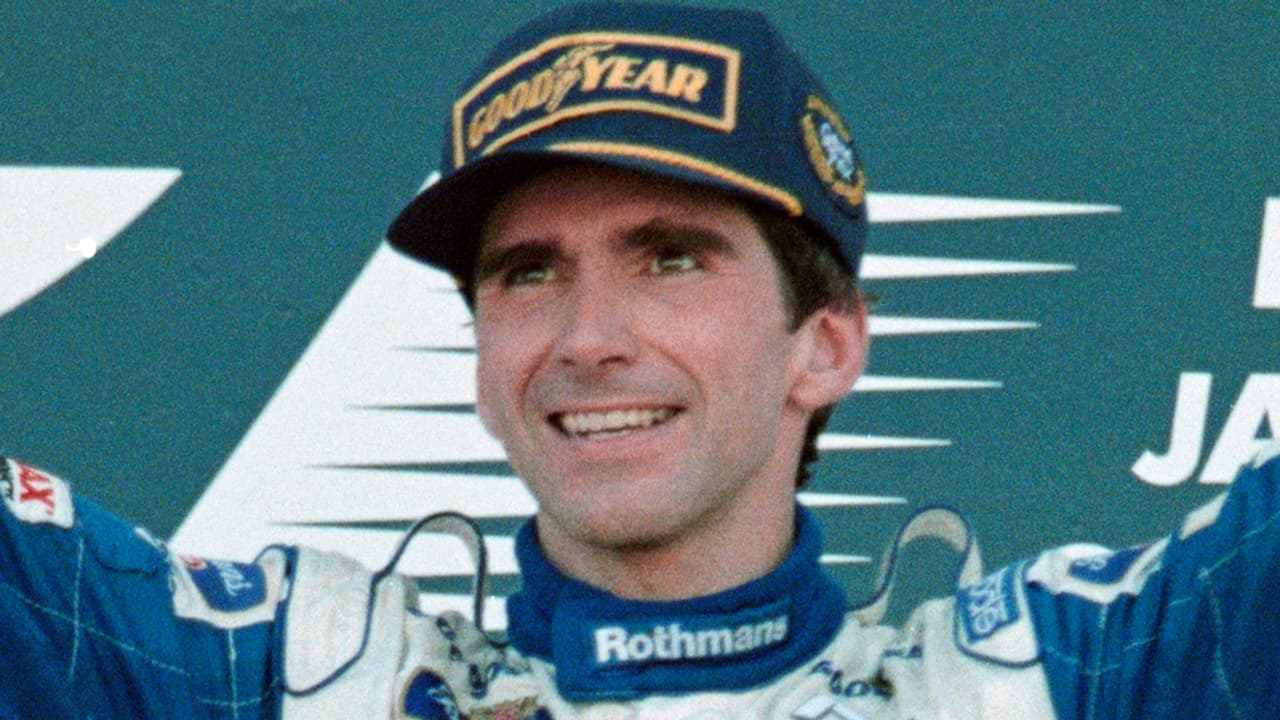
Somewhere ahead of him, through the rain and the spray, a red light was flashing.
Damon Hill knew he had to chase it.
The seemingly disembodied red light was the only thing tethering Hill to his dream of becoming a Formula 1 world champion.
Fox Sports, available on Kayo Sports, is the only place to watch every practice, qualifying session and race in the 2026 FIA Formula One World Championship™ LIVE in 4K | Get Kayo now.
The conditions couldn’t have been any tougher. A deluge had drenched Suzuka, one of the world’s most fearsome racing circuits, and the red light ahead was attached to the back of the Benetton of Michael Schumacher, who had even then already developed his regenmeister reputation as a wet-weather master.
Hill, in just his second season and in a Williams car that was ill at ease around the Japanese track’s fast sweeps, surely stood no chance — and defeat would mean he would head to the final round in Adelaide with only a theoretical shot at the title.
A red flag in the worsening conditions and an alternative fuel strategy for Schumacher shuffled Hill into the lead, but even then the Englishman was given no hope.
With 10 laps remaining Schumacher took three seconds out of his 14.6s deficit, and the margin was down to 2.4s with one lap left. Hill was struggling not just with traffic but with a heavily worn right-rear tyre that had been left on his car at his previous pit stop, giving him massive instability.
“I could see he was going to catch me at the last lap,” Hill recalls in his eponymous documentary Hill, premiering today in the British Film Festival.
“In my head I said, ‘Ayrton, if you’re up there, I could do with a hand’.”
PIT TALK PODCAST: Andrea Kimi Antonelli puts one hand and four fingers on the title trophy after dominating the United States Grand Prix. | Listen to Pit Talk here >
Ayrton Senna’s legacy hung as heavily over the 1994 season as the rain clouds at Suzuka that day. The Brazilian legend, a three-time champion, was killed in a high-speed crash in Imola four rounds into the campaign, and amid the devastation and grief, it fell to Hill, his inexperienced teammate, to lift the team and give it something to rally around.
He rose to the occasion with a superb title challenge. But now he needed Senna’s help.
“And something happened,” he recounted.
“My foot went to the floor. My arms are moving in a way that felt like it wasn’t my hands. Then I’m going around turn 2 and through the esses absolutely like a bat out of hell.
“I release from this conscious driving that I’ve been doing up until now. I’m absolutely committed to going as fast as possible.
“I just felt like I’d been visited by some sort of spirit.”
Hill won the race by 3.4s to shrink Schumacher’s title lead to just one point for the season finale.
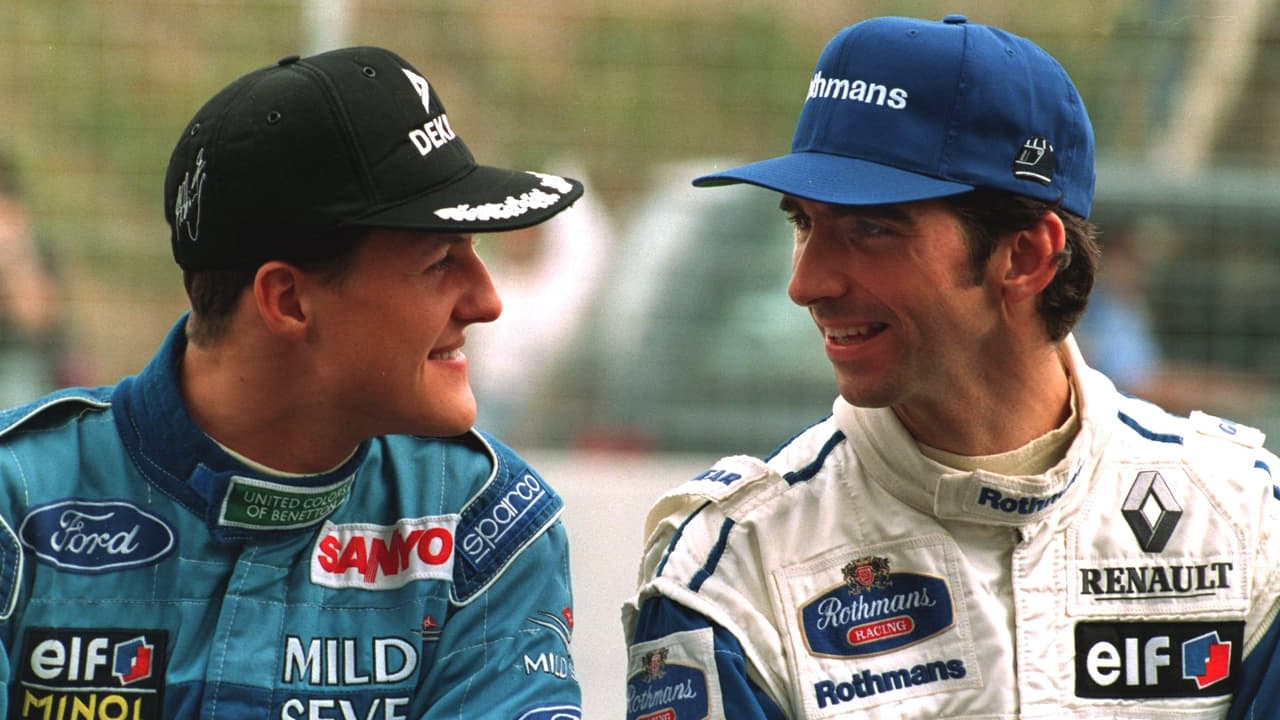 Michael Schumacher and Damon Hill duelled during the 1994 championship season (Mike Hewitt/ALLSPORT)Source: Getty Images
A sense of destiny and spirituality runs throughout the Hill documentary as a connective thread linking the entirety of the Englishman’s career, which began only after the death of his two-time title-winning father, Graham Hill.
“I believe that there is such a thing as a kind of journey that we all go on — everybody does in their own life — and there is some reason to it,” he tells Fox Sports ahead of today’s premiere. “It’s not just a kind of random meaningless experience.
“I think we are spiritual beings. If you think this is all just a waste of time, then that’s rather depressing.”
Before Graham’s death and in the years that followed, Damon showed no real inclination or interest in four-wheel motorsport. Motorcycling was his passion, and he was competitive, winning races and even a club championship.
It wasn’t until he was convinced by his mother to take up an offer to partake in the prestigious Winfield Racing School that he realised his destiny revealed itself.
“I was surprised when I had a go at car racing and I found I was quite good,” he says. “That was really the big surprise, because I just had no interest. My love was motorbikes, and I was doing quite well on bikes at that time.
“At that exact moment I was getting an opportunity to have a go at cars and see how I got on. I was quite surprised that I didn’t do too badly, so I kind of thought, ‘Well, maybe there’s a better career path here long term in car racing’.”
That was 1983. Hill was already 23 years old, but his course was set.
“If you’ve got a competitive spirit, you want to succeed at whatever you do, so I had to turn this opportunity into a success story.”
By 1991 he’d forced his way into the Williams team as a test driver, and after an abortive season with the collapsing Brabham team in 1992, he sensationally replaced reigning champion Nigel Mansell at Williams after his compatriot walked out on the sport over a contractual dispute.
He was immediately on the pace, winning three grands prix and finishing third in the championship, just four points behind runner-up Ayrton Senna as Prost marched to his fourth and final title before retiring.
“The probability of all that happening the way it happened is so bizarre and so remote,” Hill acknowledges. “That is kind of astonishing. I can hardly believe it myself sometimes, when I think about how it all unfolded.”
Damon Hill in 1996Source: News Corp Australia
By then he was 33 years old — past what even at the time was considered a driver’s peak age.
“If you were to say, okay, we’ve got [20-year-old] Kimi Antonelli, and we’re going to say to Kimi you’re not allowed to drive go karts or anything like that and you’ve got to have quite a few years in the junior formulae and you’re not allowed to get to Formula 1 until you’re 32 — that’s 12 years at least wasted.
“He’s been karting since he was five years old — as have all of them. They’ve all wanted to be racing drivers since they were babies almost.
“That wasn’t my story. How the hell it all happened, you’d have to say there’s a degree of luck, but then of course I was always in the background pushing it forward and wanting it to succeed. It didn’t just come to me.”
In 1994 he was partnered with Senna, but the challenge was to be more severe than simply measuring up to one of the all-time greats.
When Senna died, Hill had to rise to the leadership of what at the time was F1’s powerhouse team.
It put him directly into Schumacher’s path.
Schumacher, nine years Hill’s junior, was clearly a star on the rise, and even in the early years of his career was an astute psychological player, exerting pressure with every lever available to him. By the end of his career, he had redefined the role of a professional racing driver.
Their duel became a titanic rivalry that culminated in the race following that soaking-wet round in Suzuka.
Adelaide was a winner-takes-all affair, and in the early laps Hill stuck on Schumacher’s gearbox as they battled for first place.
On lap 36 Schumacher left the road at the left-hand bend at East Terrace and collided with the barriers.
Hill couldn’t see the accident around the close-in barriers, and as he rounded the corner he saw only Schumacher travelling slowly, and he instinctively went for a move down the inside line at the following right-hander.
Schumacher turned in, and the two made contact.
The Benetton was flung into the air and landed heavily, eliminated.
Hill limped back to pit lane, where front-left suspension damage was assessed as terminal, and he retired.
Schumacher won the title.
Michael Schumacher flung himself into the air after turning into Damon Hill at the 1994 Ausralian Grand Prix. (Reuters/Paul Dengate)Source: News Corp Australia
Hill refused to engage in the controversy at the time, and Williams refused to appeal.
“I didn’t win the championship in 94, but everyone remembers that race, and it was drama,” Hill reflects, insisting the climax of his Schumacher rivalry does not carry the same weight with him as it does for others.
“I didn’t let myself down, I don’t think, so I’m not disillusioned by that.”
For Hill, there are no regrets.
“I mean, you can look back and go, ‘If I’d done this or if this had happened, then it could have been different’. Well, you don’t know what could have happened.
“There’s all sorts of outcomes that are unforeseen.”
His 1995 campaign was poor, and he was comfortably beaten by Schumacher, who claimed his second consecutive title at a canter — enough to shake Williams’s faith in Hill as its leading man.
Remarkably, in late 1996 — despite leading the title ahead of new teammate Jacques Villeneuve and old foe Schumacher — he was told he would be dropped at the end of the season.
“They were the top team at the time. They were established as the best team in Formula 1. They were used to running at the front. A lot was expected of you. You had to come up to their standard and their status.
“It’s difficult when you start off as an understudy, a test driver, and then you’re trying to establish yourself as being the same calibre of drivers as Mansell, Prost and Senna. I’m not sure I achieved that.
“But I like the fact that they were tough. I like the fact that they were not going to give you any flannel.”
Despite the lack of faith from the team, Hill clinched the championship at the final race.
Damon Hill shares his championship podium with Michael Schumacher and Mika Hakkinen (Getty Images)Source: Getty Images
Fittingly, triumph arrived in Japan, this time in the dry, just 1.9s ahead of Schumacher, closing the loop on their ferocious rivalry.
“I approached racing from the point of view of I wanted to find out how far I could go and how good I could get or whether I was good enough,” he says. “You only find out by going up against the best opponents.
“Racing against Michael Schumacher, I found out what it was like to race against the best and one of the most talented ever and the fastest ever. I can feel proud that I managed to beat him, that I got a few notches on [my belt].
“I beat him a couple of times — not all the time and not regularly, but at least I raced up there with him sometimes, and I feel pretty impressed by that considering where I started and how long it took me to get there.”
But the journey he completed was about more than just about his own racing ambition or about closing the loop with Schumacher.
“There was no way of escaping the legacy of having been in Formula 1 when I was young with my dad racing and his career,” he says. “I was always an addition to his career, I think.
“Having won the world championship, being the first ever son of a previous world champion is my tagline; that’s what they described me as. There’s no way of being separate.
“I do think I carved my own path, but maybe it was a kind of homage.
“I dedicated my first ever race win to Hills past, present and future, and I really meant it, because after my dad’s accident, everything was destroyed in a way, so the phoenix rising thing was a concept I was aware of and then wanted other people to understand, maybe.”
He reflects on the film that the first wave of emotion that strikes him on the podium in Japan was the realisation of achieving his championship dream.
The second wave was how much he missed his father and how he would’ve liked him to have known what he had done — and the feeling that, somehow, he does know.
“There’s a whole backstory to my career, and the question I was asking all the time is why, after having felt like I had no interest in cars at all to start with — I didn’t show any inclination to become a racing driver — I suddenly decided I’d have a go,” he says.
“I was conscious of this bond, let’s say, that was being relived or created out of racing without him being there. I carried this legacy within myself of my father, through the racing career.”
Graham Hill with his Damon and daughter Brigitte in 1963. (Motor Racing Hill)Source: News Limited
Hill’s career was ultimately short, lasting just three more seasons in backmarker machinery that delivered him mostly disappointment bar one sparkling victory at the 1998 Belgian Grand Prix for Jordan, the team’s first triumph.
But by 1999 he realised he was enjoying the sport less and less and his motivation was therefore waning. He called it quits at the end of the season, declaring that his world title had satisfied his objective.
To retire a champion had in fact been beyond his expectations — he had, after all, been surprised that he had any aptitude for car racing in the first place and that his desire to pursue it had been so powerful once he got behind the wheel.
“I’m conscious that all these tests I put myself through were completely fabricated,” he says, reflecting on his journey 30 years since becoming a world champion.
“I didn’t have to do them; I could have just had a reasonably relaxed life.
“But I do think we get better by pushing ourselves, whatever that happens to be.
“The realisation of what you’re capable of can only be achieved through taking on ridiculous challenges, perhaps.
“Maybe that says a lot about the human spirit.”