
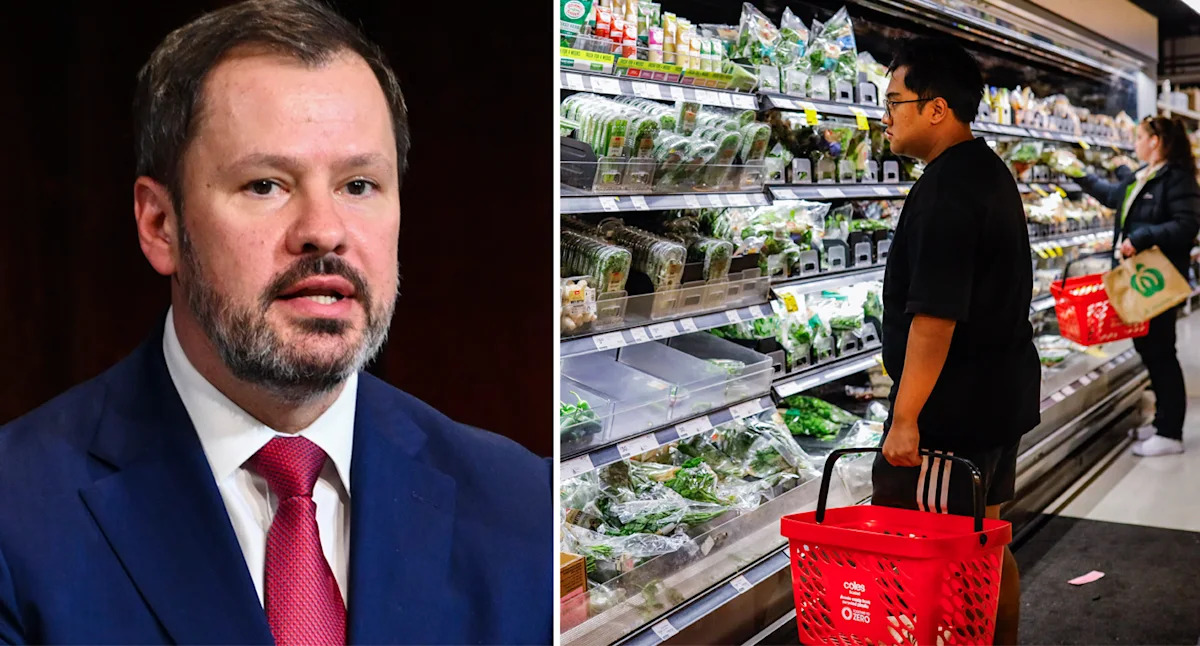
A senior member of the Albanese government has suggested it should consider capping the price of essential grocery items to help with the cost of living for Australians as inflation continues to rise. It would mean, theoretically, shoppers heading to Coles or Woolworths would know the price of basic items like milk, eggs and fruit would remain under a certain price level.
Ed Husic, the chair of the House Economics Committee, made the comments while appearing on the ABC’s Afternoon Briefing on Wednesday after inflation figures came in hotter than expected. He said such a measure to control prices at supermarkets could help people struggling to pay their living costs and should be seriously considered by his government.
“These companies cannot continue to profit and push people in the way that they have, and having price interventions or price caps on those basic groceries are some of the things I seriously think need to be entertained,” he said.
RELATED
“We cannot have Australians … having to make a choice between how do we pay the rent, how do we pay groceries, do I feed myself or do I feed my child going to school?”
The supermarket giants have been under scrutiny in recent years over accusations of price gouging with the government increasing penalties and oversight of pricing practices in the grocery sector.
“We just can’t have this profiteering in the system and not have any sort of action. So if we need to take action like price caps or price controls in terms of those basic groceries, then we should,” Husic said.
While noting he would receive a wave of criticism for proposing the idea, he added: “I believe that is the type of action we have to absolutely consider to give people some sense of comfort and relief”.
“The thing that gets me about the interest rate increases is it’s not wages that’s driving up inflation. It’s not people buying the essentials that’s driving up inflation,” he added.
Price controls are a very controversial idea among economists but Husic pointed to price caps imposed by his government on coal and gas in 2022 when Russia invaded Ukraine as an example of such a policy being temporarily implemented.
‘The evidence isn’t particularly favourable’
Deputy chief economist at AMP Diana Mousina pointed to the fact that price controls had been tried in the 1970s in Australia and largely proven not to be a workable solution.
“The evidence isn’t particularly favourable,” she told Yahoo Finance.
“It’s not a solution for the long-term. It’s basically just more intervention by the government in the market at a time when you should be allowing demand and supply to just work its way through the system.
“I’m not sure if it’s actually going to be a long-term solution, even though I sort of understand why people feel like it it may be helpful in the short-term.”
 AMP Deputy Chief Economist Diana Mousina says price controls a fraught with problems. · AMP
Instead, she said more targeted programs like food vouchers could address the situation of struggling households cited by Husic, but overall she thinks government subsidies are not what is needed at the moment.
“I don’t think we should be doing price caps, or starting new food assistance programs. I think the government just needs to cut its spending,” she said.
Rising inflation has been keenly felt at the grocery store. In the latest inflation data, a number of key supermarket items have been shown to be outpacing headline inflation over the past year.
Fruit has seen an annual cost increase above 10 per cent, breakfast cereals have risen 8.5 per cent over the past year, while beef and veal have risen 5.8 per cent and milk has increased 5.4 per cent.
Overall, the price of food and non-alcoholic beverages has risen 3.2 per cent in the past 12 months.
Assistant Treasurer responds to price caps idea
Previously, the RBA has explicitly ruled out price caps as a viable tool for fighting modern inflation. RBA Assistant Governor Sarah Hunter has also highlighted historical experiments with price controls which ultimately failed.
When asked about the comments from Husic on radio this morning, and whether that was a possible option, Assistant Treasurer Daniel Mulino threw cold water on the idea.
“Well, look, what I can point to is really strong measures that Assistant Minister [for Competition Andrew] Leigh and the Treasurer [Jim Chalmers] have championed when it comes to mandating the grocery code of conduct,” he said.
“There’s a lot of measures that have been taken to strengthen oversight of the grocery sector … the ACCC has stronger powers for oversight of a number of key sectors, including groceries. But also, importantly, the penalties for market manipulation and price gouging have gone up tenfold under this government.”
 The price of fruit has been rising faster than headline inflation. · SOPA Images
Liberal MP Andrew Hastie was also asked about the Husic thought bubble of grocery price controls on ABC radio this morning.
“That’s very interventionist, the best thing we can do is cut spending,” he said.
On Wednesday, Woolworths released its first quarter sales results, with the supermarket boss Amanda Bardwell saying Aussies struggling with higher prices and interest rates are increasingly turning to cheap mince when they do their grocery shopping.
“The amount of pressure on young families, particularly, and families more broadly is increasing,” she said.
Earlier this month, the Greens official think tank ripped a page out of the policy book of New York major Zohran Mamdani calling for public owned grocery stores to challenge the duopoly of Coles and Woolworths.
Get the latest Yahoo Finance news – follow us on Facebook, LinkedIn and Instagram.