
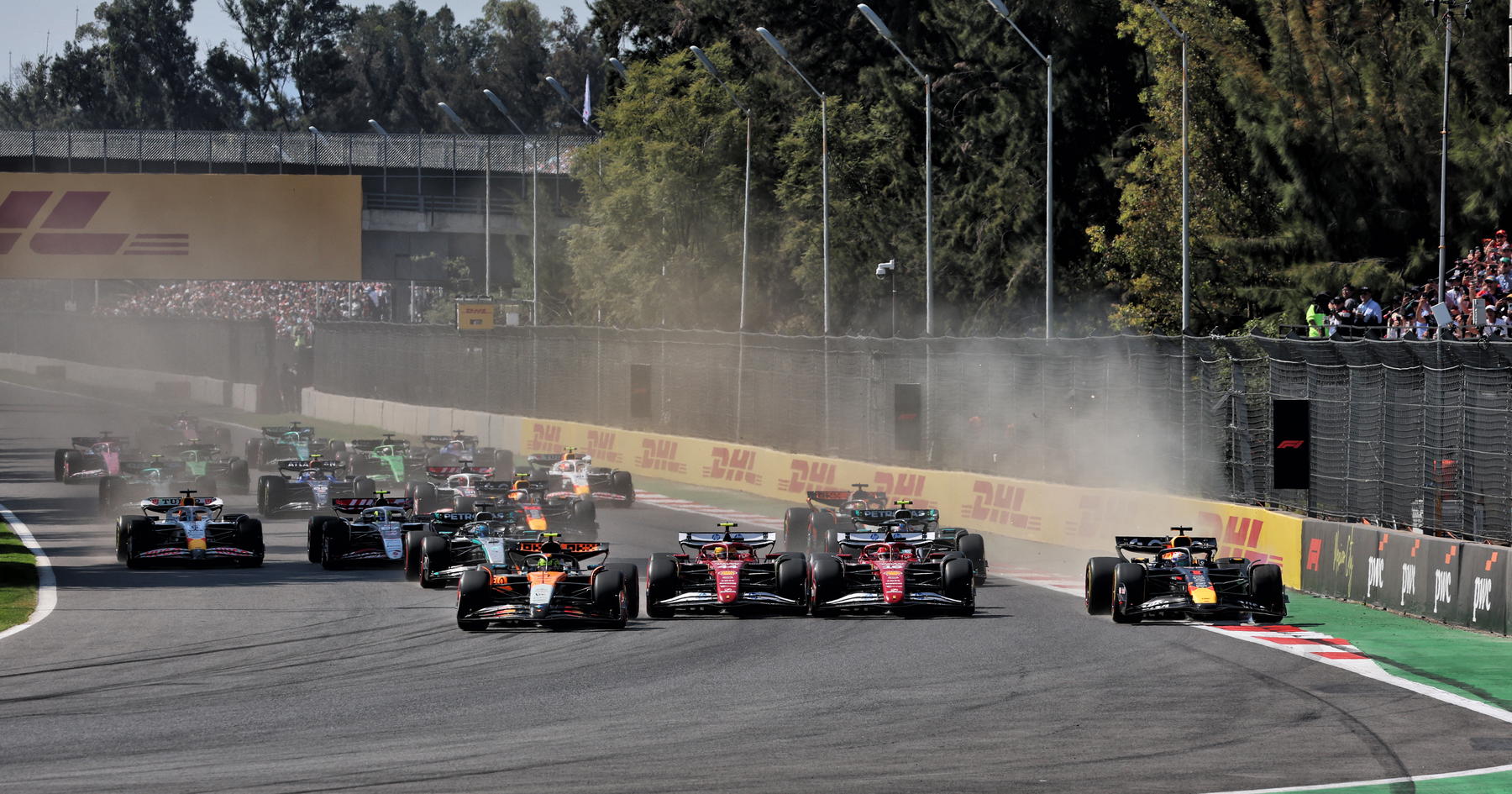
The Mexico City circuit has one characteristic that makes it fundamentally different from all the others: the thin air at an altitude of 2,240 metres above sea level.
At this altitude, air density is more than 25 per cent lower than Monaco and the effects on aerodynamics, among other areas, are particularly noticeable.
The lower density has a significant impact on the downforce generated. It is worth considering that, with the same aerodynamic configuration used in Monaco, only 60 per cent of the downforce generated in the Principality is achieved in Mexico.
However, the impact is not limited to reduced downforce as it also extends to the lower heat exchange provided by the less dense air, which necessitates larger bodywork gills and increased brake duct openings.
[Article continues below]
The impact on engines
But the teams and manufacturers need to consider much more than the aerodynamic changes.
The lower air density also significantly reduces ICE performance, particularly in power units where a smaller-diameter turbocharger has been adopted as a design choice, as is the case with Ferrari.
However, there are not only negative implications. The thinner air also means that drag is significantly reduced, consequently requiring less maximum power on the straights, or, in other words, less energy.
All these characteristics play a significant role in determining the best possible engine mode in terms of energy deployment and harvesting, as well as in establishing the cars’ setups. Every team has, of course, carried out extensive simulator work to replicate the conditions at this circuit.
It is therefore clear that, on the one hand, we will generally see bodywork featuring many more gills to ensure adequate heat exchange.
At the same time, it will be particularly interesting to assess the different aerodynamic configurations adopted in combination with engine maps and energy management strategies.
One team in particular will be looking to confirm the strong performance seen in Austin: Ferrari, which will nevertheless have to contend with the limitations of its power unit, further accentuated by the thinner air.
Red Bull, by contrast, should theoretically be the favourite, as its ICE is considered the best in terms of performance. It will be interesting to see, however, whether its aerodynamic package proves just as effective as it has in recent races.