
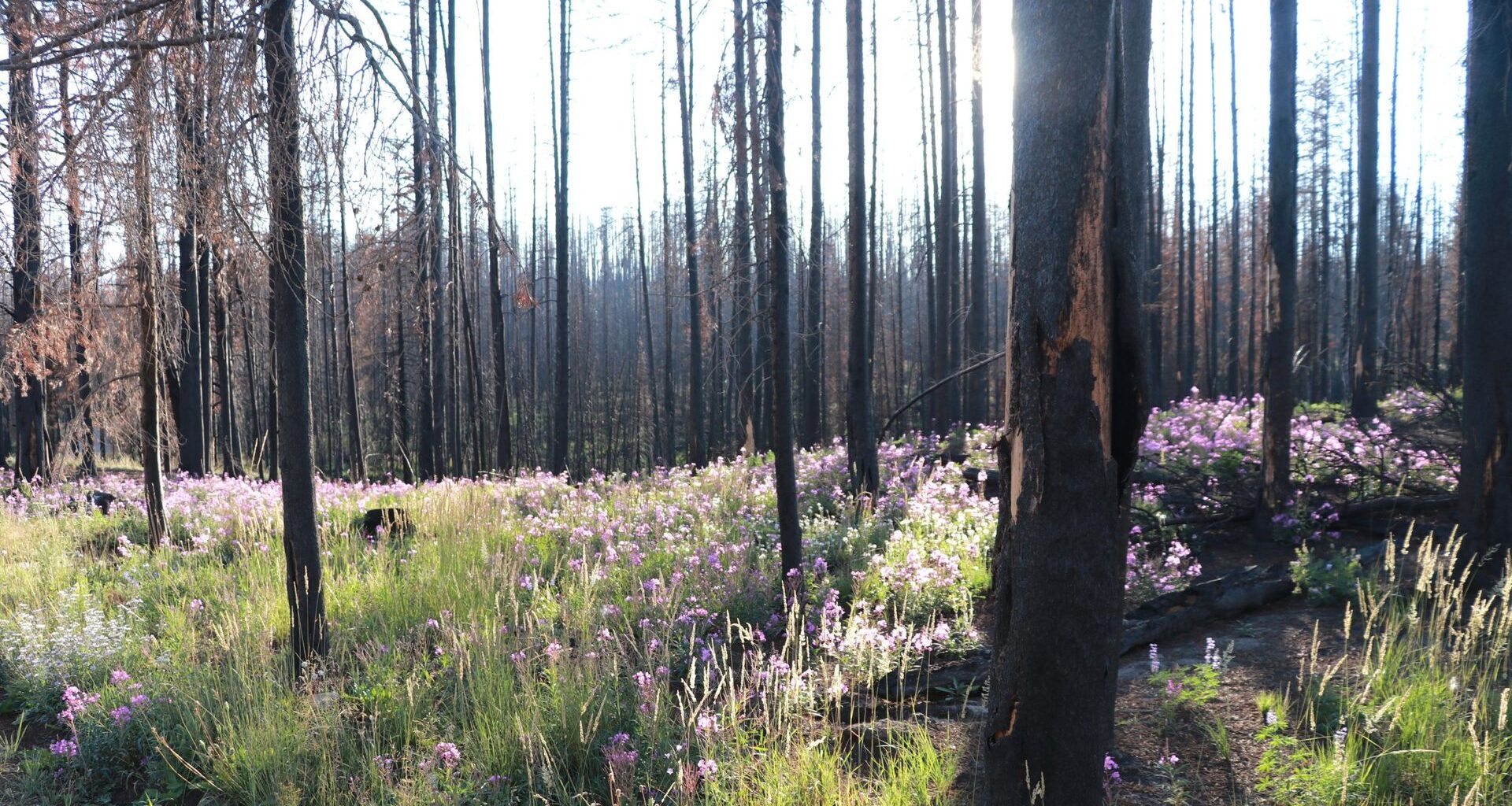
A global satellite study reveals how drought and wildfire together disrupt the relationship between rainfall, plant growth, and carbon absorption.
When drought and wildfire hit an ecosystem at the same time, something quietly breaks in the relationship between plants and water.
A global satellite study has found that vegetation hit by these compound events becomes markedly more sensitive to rainfall. Yet, it is simultaneously less efficient at turning that water into carbon gain.
The two processes, which normally move together, start to come apart. This finding’s implications for the health of the world’s forests are not reassuring.
The study was conducted by Huipeng Xi and Qunming Wang at Tongji University in Shanghai.
The carbon sink under pressure
Every year, vegetation absorbs enormous quantities of carbon dioxide through photosynthesis.
Much of that carbon eventually returns to the atmosphere, but the portion that remains stored in plants and soils helps slow climate change.
This service is not guaranteed, though. It depends on ecosystems remaining functional, which in turn depends heavily on water.
Precipitation is the primary driver of plant growth across much of the globe. How sensitively vegetation photosynthesis responds to rainfall variability is a key indicator of ecosystem health.
After drought and wildfire, however, a sharp increase in that sensitivity may signal that vegetation is struggling to recover.
Nearly 200,000 compound events
The researchers analyzed global satellite data from 2001 to 2022. They used three vegetation proxies to track photosynthetic activity at fine spatial resolution.
These measurements included faint light emitted by plants during photosynthesis and two satellite-based indicators of vegetation greenness and growth.
Drought was identified using two complementary indices. One was based on precipitation deficits (meteorological drought). The other used terrestrial water storage anomalies derived from satellite gravimetry (hydrological drought).
Fire was tracked using ESA’s burned-area dataset.
The team identified 72,088 compound meteorological drought–fire events across the globe between 2001 and 2022, and 108,373 compound hydrological drought–fire events.
A compound event was defined as drought and fire striking the same location in the same month. To keep the signal clean, no other major disturbance could have occurred within a year before or after.
More rain sensitivity, less efficiency
Across the full study period, global vegetation sensitivity to precipitation declined. But in the one to three years after a compound drought–fire event, that sensitivity jumped back up more sharply than after drought alone.
Hydrological drought–fire events drove the strongest response: sensitivity increased by 7.89×10⁻⁵ mm⁻¹ using the fluorescence measure, compared to 3.20×10⁻⁵ mm⁻¹ for meteorological drought–fire combinations.
Around 54.6% of all vegetated areas showed increased sensitivity in the aftermath of compound events.
At the same time, water-use efficiency – the ratio of carbon gained to water consumed – declined across most of those same areas.
The two processes, which in a healthy ecosystem track each other reasonably closely, were pulling apart.
“Our findings reveal a critical vulnerability: after compound drought–fire events, ecosystems become more dependent on rainfall but less efficient at converting water into carbon gain,” Wang said.
“This decoupling suggests that vegetation may be entering a fragile recovery state, where increased rain sensitivity does not translate into healthier carbon–water balance – a warning signal for ecosystem resilience under escalating climate extremes.”
What’s driving the shift
To understand why some areas showed stronger responses than others, the team applied a random forest model to 22 environmental variables. It explained 79% of the spatial variation in sensitivity changes.
The top predictors were atmospheric aridity and soil nutrients, particularly nitrogen and phosphorus. Where the air was drier and soils more nutrient-depleted, post-disturbance sensitivity rose more steeply.
The finding points to a compounding feedback. Drought dries the air and depletes soil moisture. Fire consumes organic matter and disrupts nutrient cycling.
Recovering vegetation may therefore face drier atmospheric conditions and disrupted nutrient supplies.
Together, these pressures could help explain why rainfall becomes more influential even as water-use efficiency declines.
A warning for the carbon cycle
Compound drought–fire events are not rare anomalies. The study catalogued nearly 200,000 of them across two decades.
Climate projections suggest they will become more frequent as temperatures rise.
If each one leaves the affected ecosystem more dependent on precipitation while less capable of using it efficiently, the cumulative effect on the terrestrial carbon sink could be substantial.
Vegetation that has decoupled its carbon and water processes is also harder to predict.
Earth system models that assume a stable relationship between rainfall and photosynthesis may misrepresent these ecosystems.
They could potentially overestimate the carbon sink in regions with high compound disturbance frequency.
The authors suggest that vapor pressure deficit and soil nutrient status could serve as early-warning indicators.
The satellite record reveals a troubling pattern: when drought and wildfire strike together, their effects on vegetation can persist for years after the immediate disturbance ends.
Even when plants begin to recover, they may become more dependent on rainfall while growing less efficient at using water to absorb carbon.
As climate extremes intensify, that imbalance could weaken the ability of forests and other ecosystems to help regulate Earth’s climate.
The study is published in the Journal of Remote Sensing.
—
Like what you read? Subscribe to our newsletter for engaging articles, exclusive content, and the latest updates.
Check us out on EarthSnap, a free app brought to you by Eric Ralls and Earth.com.
——-