
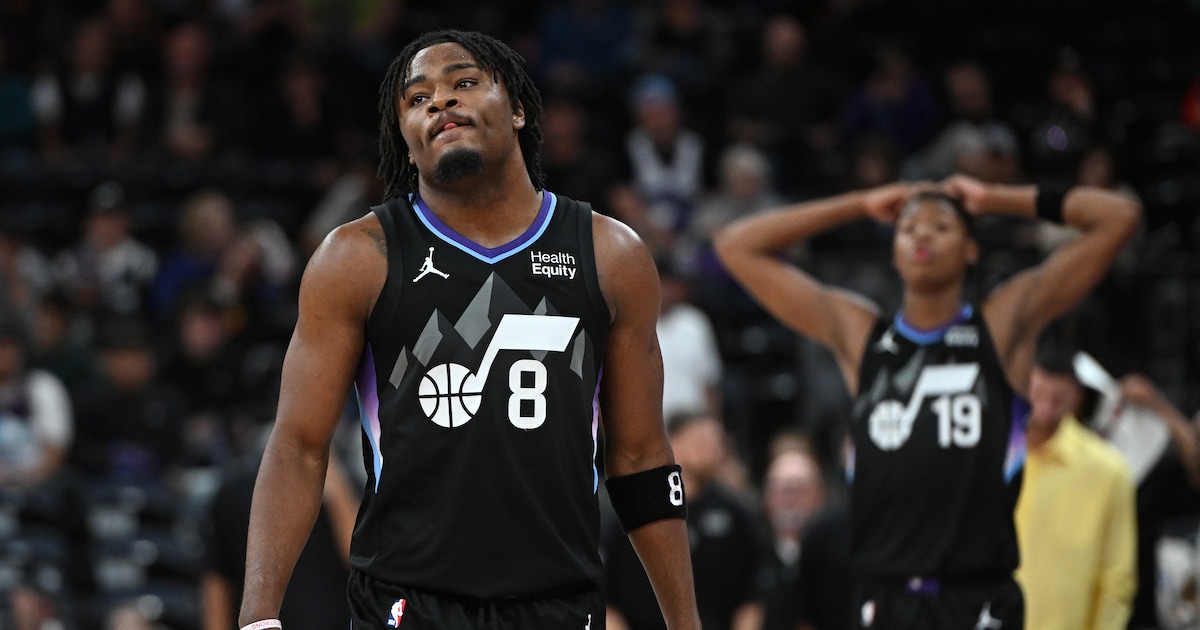
For the Utah Jazz, winning basketball games comes with a learning curve.
That’s been clear through the first six games, as Utah fell to 1-5 on Saturday after a 112-90 home loss to the Portland Trail Blazers.
Jazz guard Keyonte George tries to keep a learning mindset no matter the result. The Jazz’s last few losses were at least competitive. Saturday’s wasn’t.
“I just try to tell myself it hasn’t went our way for three years,” George told The Salt Lake Tribune after Utah’s loss to San Antonio. “Maybe it doesn’t turn the corner immediately in the next season. But how can we just get better and go from maybe 18 wins to 29, 30, 35?
“Obviously, we want to speed up the process, but that’s just a mindset we have to be in, and that’s the mindset for me. … This whole season for me, it’s just been: How can I learn after every game? Win or lose. … We’ve got to figure out how we can go over that hump.”
(Francisco Kjolseth | The Salt Lake Tribune) Utah Jazz coach Will Hardy during an NBA game at the Delta Center against the New Orleans Pelicans on Friday Oct. 23, 2026.
In the meantime, there’s some growing frustration among fans who have waited out four rebuilding seasons.
Naturally, that’s led to some overreactions, plus some valid criticisms.
Get How ‘Bout This Jazz newsletter. Utah Jazz post-game analysis and hot takes from The Tribune’s Shreyas Laddha.
Here’s a closer look at some trends, stats, and complaints categorized as either overreaction or concerning. All of the data is from Databallr, Cleaning the Glass, or NBA Advanced Stats.
1. Concern over the Jazz’s offense: Overreaction.
Right now, the Jazz rank No. 27 in offensive rating (105.3), which measures points scored per 100 possessions. Utah’s biggest issue is a poor shot diet.
The Jazz rank No. 30 in rim frequency percentage and No. 23 in 3-point frequency. Meanwhile, the Jazz rank first in mid-range frequency.
That means Utah is overly reliant on the hardest shot in basketball while struggling to get the two best shot types.
That said, it shouldn’t remain that way all season.
A big reason the offense is so reliant on the mid-range right now is that the team is missing Jaren Jackson and Jusuf Nurkic, two bigs whose screening abilities should create more opportunities for catch-and-shoot 3s and pick-and-rolls to the rim.
(Francisco Kjolseth | The Salt Lake Tribune) Utah Jazz guard Isaiah Collier (8) makes a drive to the basket defended by the Memphis Grizzlies during an NBA game at the Delta Center on Monday Oct. 26, 2026.
That said, several Jazz players like to operate in that mid-range space even with both bigs fully healthy. It’s a shot that Jazz coach Will Hardy is fine with his players taking — if that’s the best option.
“I think you get to the rim when you can,” Hardy said. “I think catapulting yourself into the bigs at the rim isn’t necessarily a great play. We are trying to make better decisions, especially with our young guards. The guys on our roster right now are a little bit more comfortable just inside the free-throw line, in the floater-type range.
“We’re also in a moment where, coming off last game against [Victor] Wembanyama, you play against the Lakers and some of their size. There are plenty of factors why those rankings are what they are this early in the season, but we’re trying to put pressure on the paint. We’d like to get on the rim more, but we also have to take what the defense is giving us … I don’t think we’ve done a great job of getting to the rim in transition.”
2. The Jazz have a turnover problem: valid concern.
Utah currently ranks No. 24 in turnover percentage. In the loss to Portland, the Jazz had 20 turnovers that led to 20 Portland points.
The Jazz place a big emphasis on winning the possession battle, but it’s hard to do when you turn the ball over 20 times. Hardy has harped on it throughout this season.
Part of the issue is Keyonte George and Isaiah Collier trying to create open shots by dribbling too much or sometimes forcing passes. Both players should have fewer turnovers when Jackson and Nurkic return, but one big issue remains.
(Francisco Kjolseth | The Salt Lake Tribune) Utah Jazz guard Darryn Peterson (22) looks for an opening past the New Orleans Pelicans during an NBA game at the Delta Center on Friday Oct. 23, 2026.
Utah hasn’t figured out how to handle physical teams.
In two straight games, the Jazz have struggled to handle opposing teams’ physicality, leading to turnovers.
“We got to play in straight lines; can’t dance the ball,” Hardy said. “We need better screening, and when we do have the advantage, we can’t give it back. I think there were plenty of times where we created some early advantages and we gave it back to them by bouncing the ball back out to the perimeter, playing step-backs, snatchback dribbles. Once you have the advantage, you have to keep it.”
3. Utah’s defense is not good: Overreaction.
Right now, the Jazz rank No. 23 in the NBA in defensive rating (115.4).
The Jazz have improved significantly in first-shot defense compared to previous seasons, and the effort is much better. There’s no doubt about that.
That said, Utah has a couple of real defensive concerns.
The Jazz have struggled to force turnovers, ranking No. 30 in opponent turnover rate (12.4), which measures turnovers forced per 100 possessions.
(Francisco Kjolseth | The Salt Lake Tribune) Utah Jazz guard Keyonte George (3) during an NBA game at the Delta Center on Friday Oct. 23, 2026.
Utah also struggles to defend without fouling. According to Cleaning the Glass, Utah ranks No. 29 in opponent free-throw rate.
That issue showed up in Saturday’s loss to the Blazers, leading to 41 free throws for Portland.
“Our fouling was a problem,” Lauri Markkanen said. “They made [34] points from the free-throw line.”
Remember, Utah is missing two key paint defenders in Nurkic and Jackson, so the defense should improve when they return. Until their return, Utah will need to find a way to play defense without fouling.
sltrib.com is now free to access — no subscription required. We made this decision because we believe access to trustworthy, independent news shouldn’t depend on what you can afford — especially as misinformation and AI-generated content continue to rise.
Free to read doesn’t mean free to produce. Our reporters show up every day to ask hard questions and hold powerful institutions to account. That work takes resources. As a nonprofit newsroom, we rely on support from people who believe it matters. Make a donation today to fund local news that serves Utah communities.
You can help us bring more local news to more communities today.