
Two cyclists can have nearly identical aerobic capacities yet produce very different results in a 30-minute time trial. A new study published in the Journal of Strength and Conditioning Research suggests that the difference may be better explained by how much power a rider can produce at a specific physiological threshold rather than by peak oxygen uptake alone. Researchers found that the respiratory compensation point (RCP), measured during laboratory exercise testing, was more strongly associated with time trial performance than VO₂peak in a group of 28 trained cyclists.
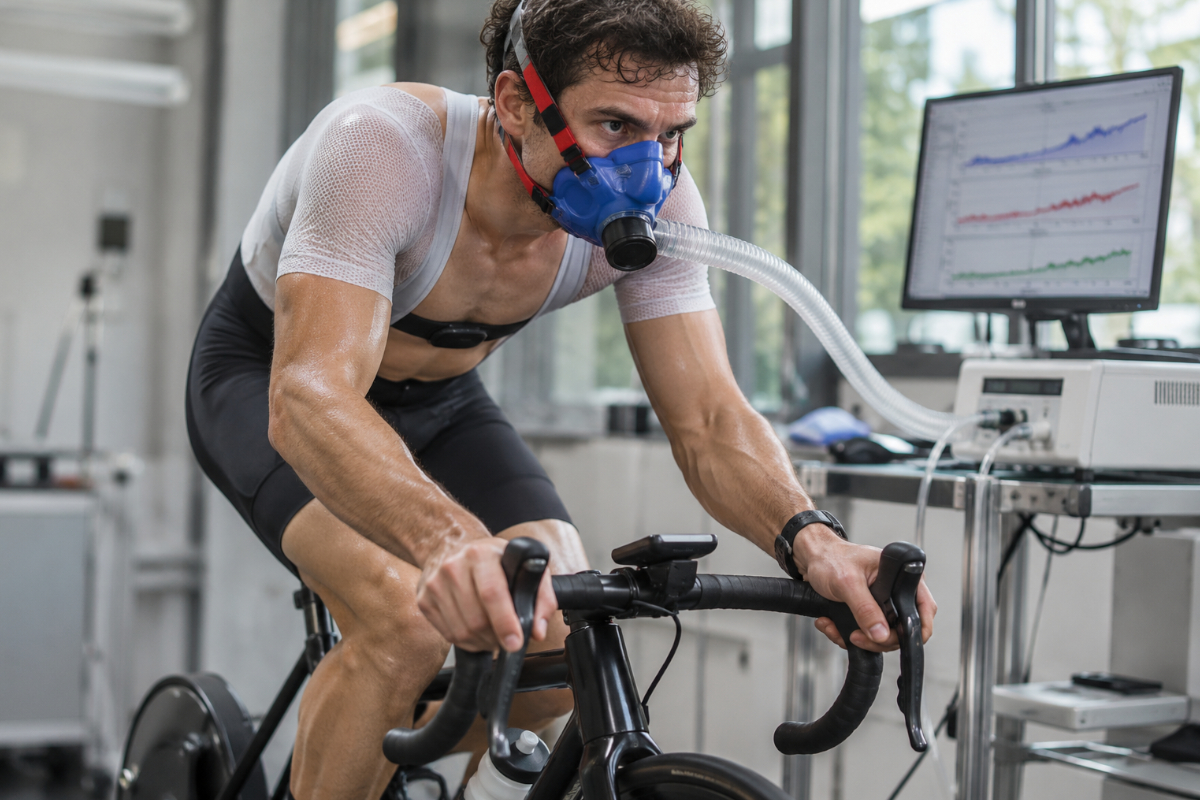
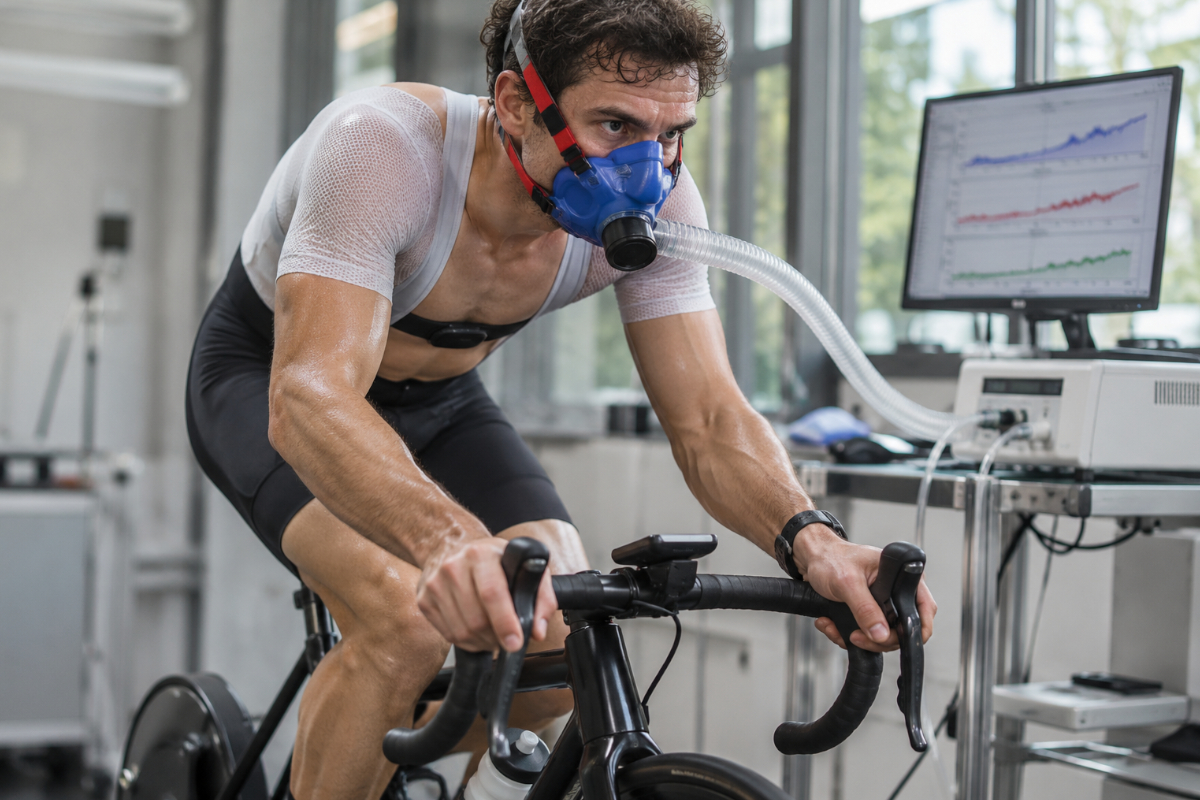 Cyclist undergoing an exercise test with a metabolic gas analysis mask in a sports science laboratory. Image: TodoMountianBikeRespiratory compensation point outperforms peak oxygen uptake in a 12-mile cycling time trial
The research, published online on November 2, 2026, under the title The Respiratory Compensation Point Predicts 19.2-km Cycling Performance in Trained Male Cyclists, examined which physiological measurements could best predict performance in a simulated 19.2-kilometer (11.9-mile) cycling time trial. The distance took approximately 30 minutes to complete, providing a controlled setting for studying sustained, high-intensity endurance performance.
The researchers recruited 28 trained male cyclists who completed the virtual time trial on their personal road bikes connected to smart trainers. Participants also underwent physiological testing before and after the effort using a specialized step-ramp-step (SRS) protocol. This approach allowed the researchers to evaluate four potential performance predictors: peak oxygen uptake (VO₂peak), cycling economy, power output at the respiratory compensation point, and fatigue resistance.
The clearest finding concerned relative cycling power at the respiratory compensation point, expressed in watts per kilogram. This measurement showed the strongest individual relationship with time trial completion time, with a correlation coefficient of -0.61. By comparison, relative VO₂peak produced a correlation of -0.42, while cycling economy reached -0.55. Fatigue resistance, assessed through changes in peak ramp-test power before and after the time trial, was not significantly correlated with finishing time.
The negative correlation indicates that cyclists who could generate more power per kilogram at their respiratory compensation point generally completed the course faster. In the multivariable analysis, the RCP measurement uniquely accounted for 30.9% of the model’s predictive variance, followed by cycling economy at 21.3%. These figures describe statistical contributions to the prediction model, not the percentage improvements a cyclist could expect from training either characteristic.
The findings are particularly relevant because VO₂max has long been one of the most recognizable indicators of aerobic fitness. However, a high maximum oxygen uptake does not necessarily reveal how effectively an athlete can translate that capacity into sustained cycling performance. The new results suggest that the power associated with a specific metabolic threshold may provide additional information when evaluating an athlete’s ability to maintain demanding race intensities.
What respiratory compensation point actually measures
The respiratory compensation point (RCP) is a physiological threshold identified during progressive exercise testing. As exercise intensity increases, the body produces more carbon dioxide and ventilation rises to meet metabolic demands. At the respiratory compensation point, breathing increases disproportionately as the respiratory system responds to the growing acid-base disturbance associated with intense exercise.
This response is generally associated with the second ventilatory threshold, often called VT2, and is identified by analyzing oxygen consumption, carbon dioxide production, and ventilation during a cardiopulmonary exercise test. Unlike an estimated training threshold derived from a power meter, RCP is determined through direct measurements of the body’s respiratory response to increasing exercise intensity.
For cyclists, the practical value comes from identifying the power output associated with that threshold. While VO₂max or VO₂peak describes an athlete’s maximum or highest measured rate of oxygen uptake, RCP provides information about the intensity at which the physiological demands of exercise change substantially. Two riders with similar peak oxygen uptake values may reach this threshold at different power outputs, potentially helping explain differences in their endurance performance.
This distinction becomes especially relevant during 30-minute cycling time trials, where performance depends heavily on maintaining a high average power output without accumulating fatigue too rapidly. The study suggests that relative power at RCP may be particularly informative for this type of sustained effort, although the findings do not establish whether the same relationship applies to longer endurance events, shorter maximal efforts, or races featuring repeated accelerations.
RCP should not be treated as interchangeable with lactate threshold, critical power, or functional threshold power (FTP). These concepts are related, but they are established through different testing methods and describe different aspects of exercise physiology. Their associated power values may be relatively close in some athletes, but they do not necessarily coincide.
What this means for cyclists who train with FTP and power meters
For American cyclists accustomed to organizing their training around FTP, the most important implication is that laboratory-based cycling performance testing can reveal physiological characteristics that are not directly visible on a bike computer. A power meter records mechanical output, and a heart rate monitor tracks cardiovascular response, but neither device directly measures the gas-exchange patterns required to identify respiratory compensation point using the method employed in this study.
The step-ramp-step protocol used by the researchers is particularly interesting because it combines different exercise intensities to improve the estimate of power associated with RCP. Conventional ramp tests can produce discrepancies between the workload displayed at a given moment and the body’s delayed oxygen uptake response. The SRS approach is designed to account for these differences, providing a more physiologically representative power estimate.
This means that the methodology matters as much as the physiological variable itself. The researchers did not simply record a ventilatory threshold during an incremental test and compare it with finishing times. They used an SRS-corrected power output at RCP, a distinction that should be considered when interpreting the findings or comparing them with results from other exercise-testing protocols.
For cyclists preparing for time trials, sustained climbs, or endurance events, a cycling metabolic test with gas analysis may therefore provide useful information alongside existing power-based assessments. It can help identify individual exercise thresholds and offer additional context for interpreting training intensity, especially when conventional indicators such as FTP and VO₂peak appear inconsistent with actual performance.
However, the study did not directly compare RCP against FTP as competing predictors of cycling performance. It would therefore be inaccurate to conclude that respiratory compensation point is a better training metric than FTP, or that cyclists should replace their existing power-based training zones with RCP-derived values. The results support its predictive value among the physiological variables examined, not its superiority over every available training metric.
There are also important limitations. The research involved just 28 participants, all of them trained men, and assessed performance over a single virtual distance. The findings cannot automatically be extended to female athletes, recreational cyclists, professional racers, or different cycling disciplines. Outdoor conditions, aerodynamics, course profiles, pacing decisions, and other race-specific variables may also influence how well laboratory measurements predict real-world performance.
The study was observational in its analysis of performance relationships. It did not test whether training specifically designed to increase RCP produces greater improvements in time trial results than traditional training methods. A strong correlation between a physiological measurement and race performance does not establish that modifying that measurement will independently cause a proportional performance gain.
The researchers also examined fatigue resistance by comparing peak ramp-test power before and after the time trial. Although this variable did not show a significant relationship with completion time, the result does not mean that fatigue resistance is unimportant in cycling. Longer races and repeated high-intensity efforts impose different demands, and the outcome may depend on how fatigue resistance is defined and measured.
The central contribution of the research is therefore more specific than a challenge to VO₂max or FTP. Among the physiological variables assessed, respiratory compensation point power was the strongest independent correlate of approximately 30-minute time trial performance. The findings also support the potential value of the step-ramp-step protocol as a way to assess several endurance-related characteristics within a single laboratory testing session, offering coaches and athletes another tool for understanding why similar aerobic capacities do not always produce similar results on the bike.