
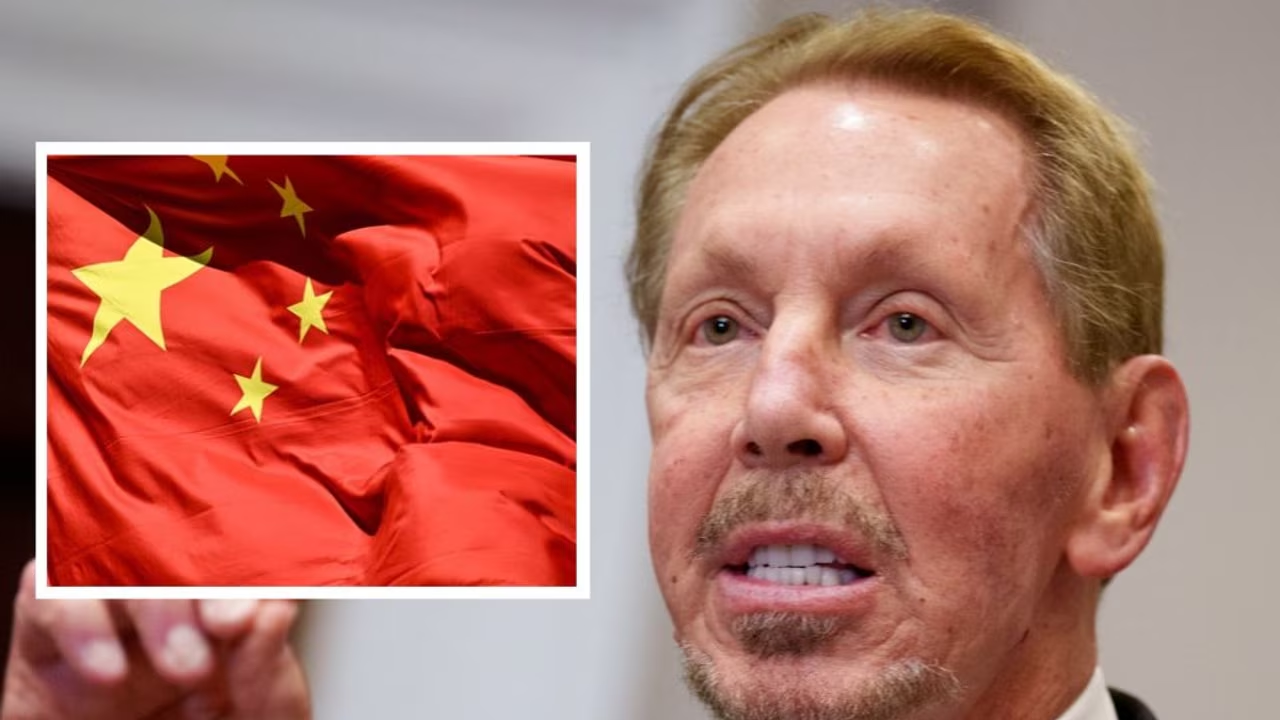
A US$7 billion (A$10 billion) artificial intelligence deal has reportedly come undone under the weight of serious political pressure between the US and China.
The two biggest nations gunning for supremacy in the frantic race towards a vague superintelligence are now reportedly taking shots, each hesitant to let another get the edge.
It is an awkward episode for an industry selling certainty about humanity’s future, while simultaneously navigating buckets of uncertainty about its own.
So what happened?
US technology giant Oracle has reportedly cancelled a deal to lease computing power to China’s Tencent following pressure from the Trump administration.
The five-year agreement would reportedly have given Tencent access to about 100,000 advanced AI chips housed in Oracle data centres across Southeast Asia.
Those chips were unavailable in China because of existing restrictions imposed by Washington and Beijing.
American officials raised serious concerns with Oracle, while senior officials in Guangdong separately visited Tencent and urged it to support Chinese-made chips, the Financial Times reported.
The Oracle report followed a separate account on Tuesday that chip-giant Nvidia had instructed cloud customers to sell at least 51 per cent of their services to non-Chinese companies.
Nvidia neither confirmed nor denied the account to AFP, but its response left little doubt about the national contest surrounding its products.
“America cannot win the AI race unless America’s AI infrastructure wins worldwide,” the company said.
Beijing’s push is mostly about reducing dependence on foreign technology. Washington’s restrictions, meanwhile, limit Chinese access to some of the most powerful American-designed chips.
It’s just one of the measures the US has taken against the rapidly-advancing Chinese tech sector.
Washington has also ordered federal civilian agencies to remove Chinese firm DeepSeek’s AI tools, including third-party products built on its technology, warning that sensitive government data could be transferred to the CCP.
Is AI a bubble?
There is a separate and increasingly uncomfortable argument about how much of the AI boom will ultimately pay for itself.
The concern is that investors may be paying extraordinary prices for businesses whose future profits are much less certain than their all-encompassing sales pitches.
Some returns are already arriving, but there are serious worries the world is sitting inside a bubble.
Oracle reported quarterly net income available to common shareholders of US$4.7 billion (A$6.7 billion) in September. Revenue from its cloud-infrastructure business more than doubled compared with a year earlier.
It’s clearly not a company surviving entirely on inspirational presentations. But its free cash flow was negative US$5 billion (A$7.1 billion) for the quarter as it poured money into expansion.
In plain English, the cash generated by running the business did not cover its spending on facilities and equipment.
Oracle also reported US$664 billion (A$947 billion) in contracted future revenue awaiting delivery. The company still has to provide the services and collect the payments.
Those company-wide results demonstrate serious business growth. But they do not explicitly establish that every dollar being committed to AI will earn an adequate return.
Going in circles?
The International Monetary Fund has identified another major complication inside the AI freight train.
Some of the industry’s money is travelling in circles.
A large technology company invests in an AI developer. The developer spends money renting computing capacity from that company. The resulting contracts help justify further investment in infrastructure.
These can be legitimate commercial arrangements, but they also mean a supplier’s apparent customer demand can depend partly on funding it helped provide.
If the developer struggles, the investor and the supplier may discover they have been relying on the same business twice.
The Fund’s October financial stability report warned of a potential market “correction”
“Weaker or less durable AI investments and profitability could be a shock that triggers a market correction,” it read.
IMF chief Kristalina Georgieva has separately warned that, in a severe scenario, “the losses could spread around the world”.
She also recognised AI’s potential to lift productivity and economic growth, but cautioned that too much hype could spill over if the major players aren’t careful.
China’s expensive reality check
In China, investors have already had a painful demonstration of the risks.
In an October 26 analysis, Reuters reported that the mainland STAR50 index, which includes prominent chip and AI-linked companies, had fallen 40 per cent in less than four months.
A whopping US$480 billion (A$684 billion) had been wiped from market value.
“The stock market later evolved into a speculative crazy bull,” Beijing-based fund manager Dong Baozhen told Reuters.
“And now we see the bubble bursting.”
At the time of the report, the index still traded at roughly 100 times its companies’ past annual earnings, down from nearly 250 times.
The US-based Oracle reports again in December, giving investors another chance to check how much of its enormous order book is actually turning into cash.
China has supplied an expensive warning ahead of that reckoning, showing AI does not necessarily have to disappoint as a technology for it to disappoint spectacularly as an investment.
Read related topics:China