
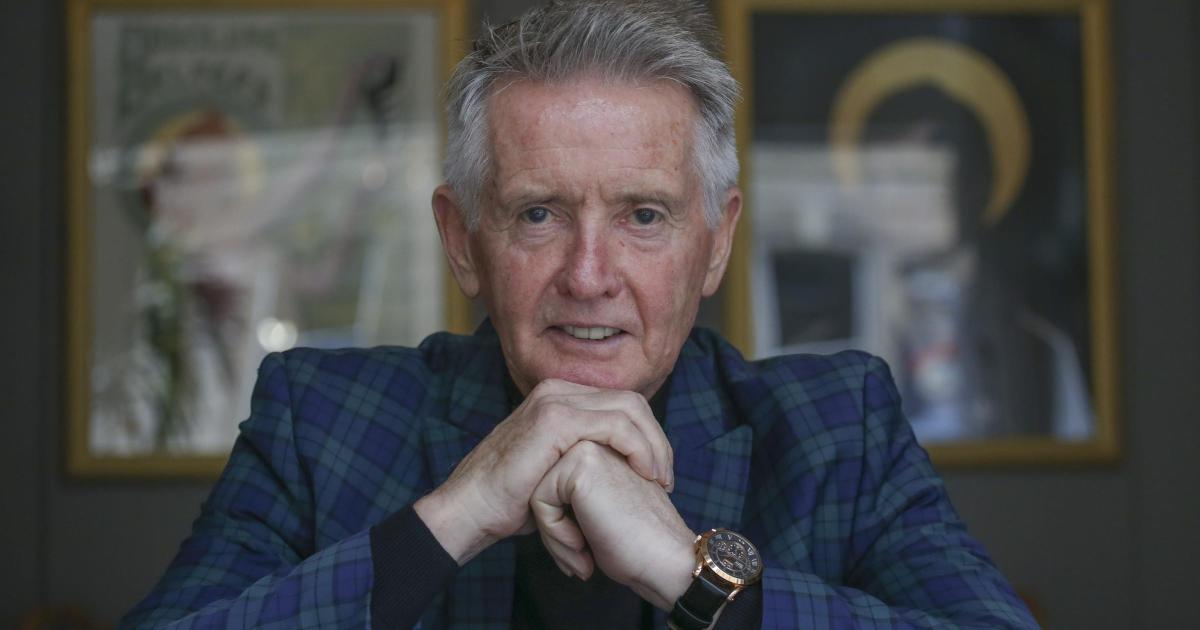
That is despite an agreement with his wife that their present venture will be their “last rodeo”.
“If I had to go back, I would go faster and bigger,” Mr Williamson says. “Even though I thought I was going fast at the time, there’s always an opportunity to say: could I really think outside the box? Could I go a bit faster?”
It is a striking conclusion from a businessman who once came close to losing not only his own home but the house he had built for his parents.
Brian Williamson and his wife Sharon at the Inspiring City Awards 2026, where he received the lifetime achievement accolade (Image: Herald and Times/Mark Gibson)
And it helps explain why Mr Williamson, after periods spent investing and serving on boards, has been drawn back to hands-on business transformation.
Passive investing, he says, is too much like betting on a horse. The investor can cheer from the sidelines but cannot ride it.
“I’m not a great passive investor because it doesn’t suit my style,” he says. “I think I can stack the odds if I go into a company.
“There’s nothing more exciting than being at the coalface. You’re at the edge of making decisions every day, and you realise how difficult that can be.”
The greatest risk of his career arose in an oil and gas business with annual turnover of about £1 million. It secured a contract worth £930,000 to deliver work in West Africa.
Read more:
The agreement was based on time and materials. Workers would be hired for about £150 a day and charged to the client at £200, leaving a £50 margin. On paper, the model appeared straightforward. But as the number of workers assigned to the contract increased, the working-capital requirement grew with it.
Mr Williamson put in his savings and guaranteed his house. When the bank asked whether he had any other assets, there remained the home he had built for his mother and father.
“I couldn’t really put that house up because I didn’t want my mum and dad to think I was risking the house so I could become a millionaire,” he recalls.
After thinking about it overnight, he returned to the bank.
“I said: ‘There’s no way I can tell my mum to put her house up and gamble it all so I can become a millionaire. So I’m just not going to tell her. I’m going to put her house up.’”
Brian Williamson, pictured in 2014 during his time with research and development tax specialist Jumpstart (Image: Gordon Terris)
Then the arrangement began to unravel. Responsibility for the contract moved from Scotland to Paris, where its validity was challenged and further payment was withheld even though the work had to be completed.
For about two weeks, Mr Williamson believed he could lose both properties and remain responsible for the mortgages. The immediate danger passed when he received a call confirming that £565,000 had been deposited into the company’s account as a first tranche.
“I knew I was safe,” he says. “That was: I’m never going to do that again.”
With hindsight, the mistake was not recognising the scale of the exposure or creating a safety net.
“I didn’t de-risk my position at all. I just went ahead, gung-ho, and thought: ‘That’ll be all right.’ And it was, but it could not have been.”
Such pressure inevitably reached beyond the business. Mr Williamson says he sacrificed parts of his family life to achieve his goals and did not see his children as much as he would have liked.
Read more:
“You can’t go back and get that time,” he says. “You end up compensating for that with the grandkids because you think: crikey, I’ve been there. I know what this is like.”
He later received a cancer diagnosis and says it caused him to look back at the stress he had experienced. He does not claim that stress caused his illness, only that a diagnosis prompts questions about how a life has been lived.
Some of his clearest lessons about leadership had arrived much earlier.
Born in a tenement flat in Stirling to a mother who worked as a waitress and a father who was a foundryman, Mr Williamson recalls a happy childhood without much money. As a boy, he collected discarded lemonade bottles to claim the refunds and ran a makeshift toy sale from his shed, splitting the proceeds with the children who supplied the stock.
His more formative management experience came at the age of 22 while undertaking a graduate training programme with Weir Pumps. He was put in charge of 200 welders and, during a period of downsizing, given responsibility for 27 employees who had been selected for redundancy.
Initially, he concentrated on rules, output and discipline. His father suggested that he was approaching the task in the wrong way. Instead, he should get to know the workers as individuals and establish what Mr Williamson now describes as a social contract based on mutual respect.
Brian Williamson says one of his earliest lessons in leadership was the importance of getting to know people as individuals (Image: Gordon Terris)
“What I did was just get to know them,” he says. “They started to befriend you and, in some respects, they would be more obliging because you were showing them some respect.”
He later associated the idea with “unconditional positive regard”, a concept developed by American psychologist Carl Rogers: begin by treating people positively while retaining the right to change that assessment in response to their actions.
“It doesn’t mean you have to be soft with people,” he says. “It means you’ve got a positive regard. They can change your opinion of them.
“How do you motivate individuals and get ordinary people to do extraordinary things?”
The answer also informs his view of a recurring Scottish economic debate: whether entrepreneurs sell successful companies too soon instead of building them into larger businesses.
Mr Williamson, who has been involved in the sales of Brightwork and Jumpstart, rejects the suggestion that founders have a duty to keep all their wealth at risk.
Read more:
If an entrepreneur sells a company for £2m, he says, the proceeds may transform life for that person and their family. Asking them to continue scaling may mean telling them to leave the entire sum “on the casino table”.
“I don’t think there’s anything at all wrong with” founders reducing their personal exposure, he says.
The more useful response would be to find ways for entrepreneurs to realise part of their wealth while retaining an interest in the company, supported by appropriate investment, coaching and mentoring.
Scotland, he argues, does not have the same funding dynamics as the US west coast. Nor should it be assumed that the person who starts a company is necessarily best equipped to lead every subsequent stage of growth.
Selling can nevertheless be emotional, particularly because of the responsibility an owner feels towards employees.
“You almost build a family,” he says. “You want to make sure you’re passing the family on to a greater opportunity.”
Read more:
In the case of Brightwork, he felt the buyer could offer employees larger jobs in a national organisation. The purchaser of Jumpstart, meanwhile, could provide international opportunities that the existing owners could not.
He would have been far less comfortable, he says, with a buyer intent on stripping assets or acquiring intellectual property without regard for the workforce.
Now, as chairman of FWB and involved in AI company Kreoh, Mr Williamson sees businesses wrestling with another transformation.
He believes many boards remain at the earliest stage of artificial intelligence adoption. Some executives use tools such as ChatGPT to find information; others buy individual products to complete particular tasks. Far fewer, he argues, have developed an integrated AI strategy.
“If I was starting my career now, I would be into AI strategy,” he says. “Very few companies strategise about AI. They tend to use a wee bit of a sticking plaster: let’s stick that over there and stick that over there. It’s not quite hung together.”
He is concerned by AI’s ability to perform harmful actions at scale and doubts whether government can regulate at the speed at which the technology is developing. Yet he also believes operational adoption remains too slow across many companies.
Read more:
The apparent contradiction does not trouble him. For an entrepreneur, disruption brings opportunity.
“You can’t surf on a flat calm,” he says. “Entrepreneurs need waves.”
After the close encounters, company sales and personal sacrifices, does Mr Williamson believe his entrepreneurial career has justified its price? He says he would not choose a different life.
“We’re all a fingerprint of our past,” he says. “We are who we are because of our past.”
He remains sceptical of the conventional idea of work-life balance because it rests on the assumption that work is inherently disagreeable. For people who love what they do, he argues, the more important consideration is the effect their choices have on those around them.
That may be the qualification behind his desire to have gone “faster and bigger”: ambition is not measured only by the businesses created or the money made, but by what an entrepreneur is willing to risk along the way.