
For tens of millions of years, moths have been fending off one of their biggest predators – bats. And to protect themselves from the snapping jaws of death, they’ve had to get quite creative.
One of the most unique defence mechanisms these insects have had to develop shows up in hawkmoths (Sphingidae), a family of moths containing around 1,600 species, also commonly known as sphinx moths. To protect themselves from echolocating bats, they produce deterring sounds with their genitalia.
Research published in the journal Proceedings of the Royal Society B shows that they’ve actually evolved it multiple times across their evolution – arriving at the same, bizarre adaptation each time.
This discovery builds on more than a decade of research into anti-bat ultrasound production in moths, carried out by Jesse Barber, a sensory ecologist at the American Museum of Natural History in New York City and Akito Kawahara, entomologist from the Florida Museum of Natural History in Gainesville. Their earlier work established this behaviour as one of the most diverse mimicry rings on the planet.
“Male hawkmoths have used their genitalia to produce these sounds across evolution, but other moths, such as tiger moths, use different organs to produce noise,” Paul Masonick, a postdoctoral researcher at the Florida Museum of Natural History and co-author of the study, told BBC Wildlife.
To investigate the evolution and anatomical details of this remarkable defence mechanism, the scientists combined field experiments, in which they recorded the ultrasound produced by male hawkmoths, with specimens from museum collections to reconstruct their phylogenetic history.
The mechanics
But why genitals? Why was that the natural starting point for an evolution of a sound-making defence? As Masonick says, this has been a known fact across scientific literature for more than a century. The ‘why’ isn’t very clear, but one thing is certain – hawkmoths are just quite weird, in general.
“Hawkmoths’ ears are on their mouth organ. They hear with their mouths and they stridulate [produce sound] with their genitals,” he remarked.
Among the 143 hawkmoth species tested thus far, 77 emit ultrasound. What the scientists uncovered in this study is that different lineages use this mechanism slightly differently.
It always involves the male’s valves – little appendages in their genitalia, which they rub against a fixed structure on their abdomen. This is known as a ‘scraper and file’ system, which Masonick likens to scraping your finger against a hair comb. “The comb is the file, and your finger is acting as the scraper. That’s stridulation,” he says.
There are three unique ways this stridulation happens in hawkmoths: scale-on-scale, in which the valve appendages are rubbing against another structure on the undersurface of the abdomen; scale-on-spine, where the scales are dragged across stiff, elongated spines sticking out of the posterior of the body; and scale-on-nodule, in which the valvular scales are rubbed against small bumps and ridges covering the male genitalia.
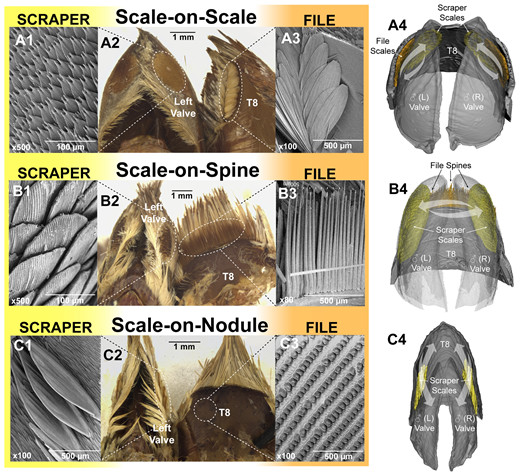 The three distinct stridulatory systems in hawkmoths. Credit: Masonick et al.
The escape
Some hawkmoths are ‘better’ at deterring bats, because the kind of sound they’re able to produce influences how they ultimately escape the predator.
“There’s one lineage in particular, Sphinginae. These moths have ears, and produce sound with a really high duty cycle,” says Masonick. “This is the proportion of time that the sound is being emitted during a stridulatory bout. We think that this can jam the bat sonar and confuse an echolocating bat.”
Not all moths are lucky enough to be able to produce sound of this quality, but they still find a way to fight off their predators. Some make sounds with lower duty cycles that the bat might associate with something negative, effectively tricking it into not even trying to target the moth.
“Hawkmoths are palatable to bats, but there are many toxic moths out there, like tiger moths,” says Masonick. “Some tiger moths also produce ultrasound. So, if a bat has had a negative experience eating a tiger moth, and encounters a hawkmoth producing similar noise, it might avoid it. This is a potential form of mimicry.”
Then there are hawkmoths who are deaf and can’t hear a bat approaching – but even those use stridulation, albeit as a last-ditch effort to escape once they’ve been captured.
“Usually, bats don’t just bite large moths out of the air, but wrap their wings and tail membranes around them, manipulating it for a second before going in for the kill,” explains Masonick. “During that split second, we think the moth might have enough time to emit noise and startle the bat enough to be released from its grasp.”
Although most hawkmoths are nocturnal, just like most bats, some of them actually prefer either the day or evening. Those species, such as the hummingbird hawkmoth, have lost the ability to stridulate. They don’t have the organs or ears, despite being closely related to the nocturnal species, which further highlights how predator-prey interactions influence diverse adaptations across the animal kingdom.
Hummingbird hawkmoth feeding nectar from flower. Credit: Ilya2k/Getty Images
Next frontier
According to Masonick, the next question to be answered when it comes to ultrasound production in hawkmoths is: what are the females doing?
“We have very limited acoustic data for females but based on some of my co-authors’ earlier work, we know there are some females that do produce ultrasound with their genitals,” he says.
“But they don’t have the same structures that the males do, so we have no idea how they’re doing it. It’s the Wild West, the next frontier when it comes to hawkmoth bioacoustics research.”
Read the full findings here.
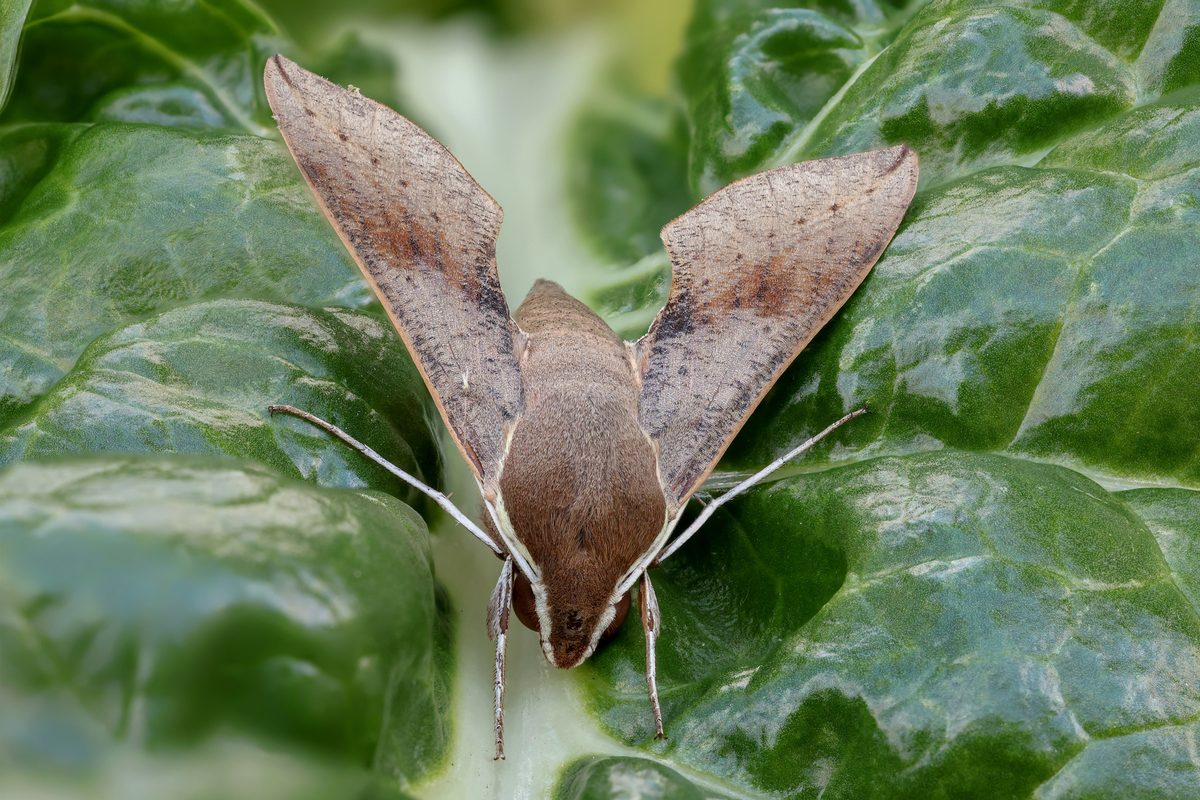
Top image: Australian hawkmoth perched on a leaf. Credit: Ken Griffiths/Getty Images