
By Reese Mautone
Date posted: 9 November 2026
Lando Norris kept his composure through a chaotic São Paulo Grand Prix to claim back-to-back victories in Brazil before a late downpour swept across Interlagos, doing little to dampen Mercedes’ spirits as the team finally ended its five-year Constructors’ Championship drought.
Mixed conditions and an unpredictable starting order were always going to make for a chaotic São Paulo outing, but few could have anticipated the immediate gains Lewis Hamilton and Max Verstappen would make when the five lights went out.
With grip at a premium into Turn 1, Hamilton struck gold on the opening lap, carving his way through the field from P20 to P9 as he picked his way around the outside of the intermediate-tyre runners through the first sector.
Verstappen was close behind, making up 10 positions himself as the pair capitalised on the treacherous conditions to launch their recovery drives, but Hamilton’s early charge quickly lost momentum, with the duo swapping positions on Lap 4 as the Ferrari driver’s rear tyres began to give way.
A Mexico City rematch had the Ferrari pit wall watching nervously as the teammates found themselves battling over 12th place, with Charles Leclerc ultimately coming out on top in the intra-team fight, while Hamilton was already on the radio pushing to take an early gamble on the slick tyres.
The slippery conditions at Turn 12 left Ferrari hesitant, so it wasn’t until Lap 15 that the Italian outfit finally pulled the trigger, calling Hamilton in for what proved to be the perfect crossover point from the intermediate tyre to the soft compound tyre.
The seven-time world champion rejoined the action in P20 and instantly recorded purple sectors, prompting the front-runners to follow suit on their next tour of the Autótodromo José Carlos Pace.
The lead order prior to the first round of pitstops had settled with Kimi Antonelli in the lead, followed by Norris, George Russell, the two Red Bull drivers, and, most notably, Liam Lawson.
As the race roared to life, the Racing Bulls driver had perfected his launch from third place to set up a stunning overtake on Lando Norris through Turn 2, holding the position and even bringing the fight to the leading Mercedes driver during the first handful of laps.
On Lap 6, Norris snatched Lawson’s top-two standing through a tentative move around Turn 11, and a few corners later, Isack Hadjar completely knocked him off the podium with an inevitable overtake into Turn 1.
He was picked off by Russell and Verstappen as a dry line started to form, but the demotions took a pause when the first round of pitstops arrived, with the Kiwi even capitalising on a costly error from the #63 in the pit exit.
Pushing his slick tyres too hard on the damp downhill approach to the pit exit, Russell spun on the soft compound and found his Mercedes facing the wrong way in the narrow lane, leaving just enough room for Lawson and Piastri to squeeze past as he clipped the metal barriers trying to recover.
The leading Mercedes was not faring much better, with Antonelli spinning out of the lead at Turn 1 and questioning whether his W17 was suffering a suspension issue before his team confirmed the car’s behaviour was simply a symptom of low tyre temperatures.
Giving up on an overcutting strategy, the newly-crowned World Champion made his way into the pits shortly after, but the fresh slick tyre wasn’t a complete fix as Antonelli ran deep into Turn 1 again, allowing Hadjar to forge an attack.
There was a sense of déjà vu when the Italian dropped out of the podium positions due to another wide journey around the first corner, with Verstappen already into the top three after starting from P21.
While Norris extended his leading margin, Verstappen’s promotion brought the Red Bull teammates closer together, and on Lap 38, the Dutchman had unlocked the overtake mode advantage, prompting the Red Bull pit wall to take matters into its own hands as team orders came into play.
Hadjar didn’t put up a fight when he was asked to let his quicker teammate by, however, when Verstappen failed to make an impression on the McLaren driver, the #6 started to question whether the positions would be reversed.
To avoid that conversation, Red Bull opted to pit Verstappen less than 10 laps later, while Hadjar’s tyre feedback confirmed he was confident enough to complete the 71-lap race on a one-stop strategy.
Following Hamilton’s experimental strategy once again, race leader Norris pitted for another set of soft compound tyre on Lap 49, rejoining the action behind Oscar Piastri, who didn’t put up a fight.
Within five laps, the Briton was back running in P1 as the rest of the front-runners made their way into the pitlane, including Hadjar, who has backflipped on his earlier plans, and Antonelli, who also abandoned the one-stop strategy.
However, a simple two-stop strategy was thrown on its head when the São Paulo skies started to open up, with the LED light panels signalling a wet track with just under 15 laps remaining, while the radio waves started to warn drivers that intermediate tyre conditions would return in the closing stages of the race.
As that crossover point neared, Hadjar and Antonelli, hunting for another piece of silverware to celebrate Mercedes’ pending Constructors’ Championship triumph, found themselves engaged in a slippery battle for the final podium position as overtake mode was disabled.
The wet conditions proved too risky for a move to be completed on the soft compound tyre, with Hamilton later spinning into light contact with the wall as he made the climb towards the pit entry, forcing the field to return to the intermediate tyre from Lap 62.
During the pitlane chaos, Antonelli was noted for an unsafe release after he was spat out into Pierre Gasly’s path in an incident that is under post-race investigation, however, a time penalty will not impact the Italian’s final standing after Mercedes opted to invert its drivers to give Russell the opportunity to attack for the final podium position.
But the margin to Hadjar only grew as the final laps ticked by, leaving the Silver Arrows almost 10 seconds adrift of the top three when the chequered flag waved.
Despite failing to bring home a trophy in the Grand Prix, the celebrations at Mercedes were huge as the team secured its first constructors’ championship title in five years, with Mercedes Team Principal and CEO Toto Wolff also celebrating the personal accolade of matching Sir Frank Williams’ record of nine constructors’ titles as a team boss.
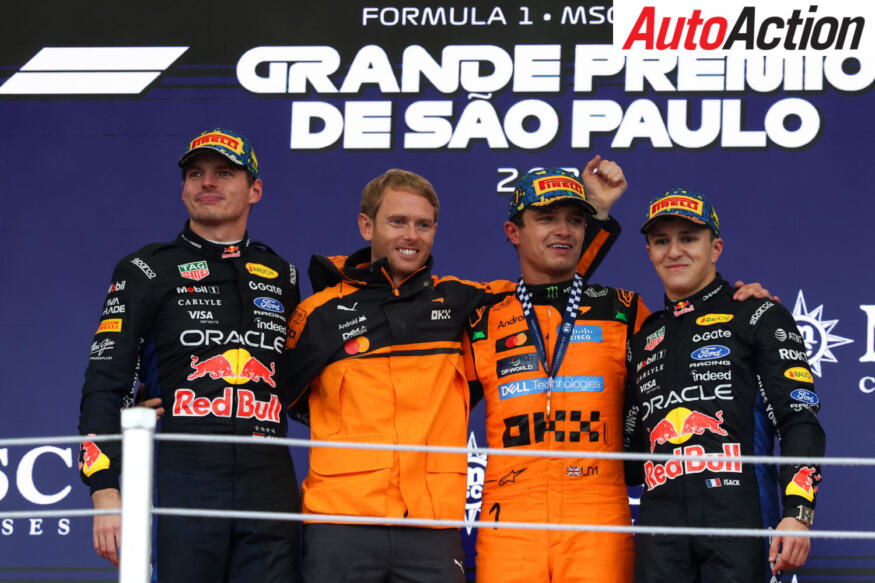
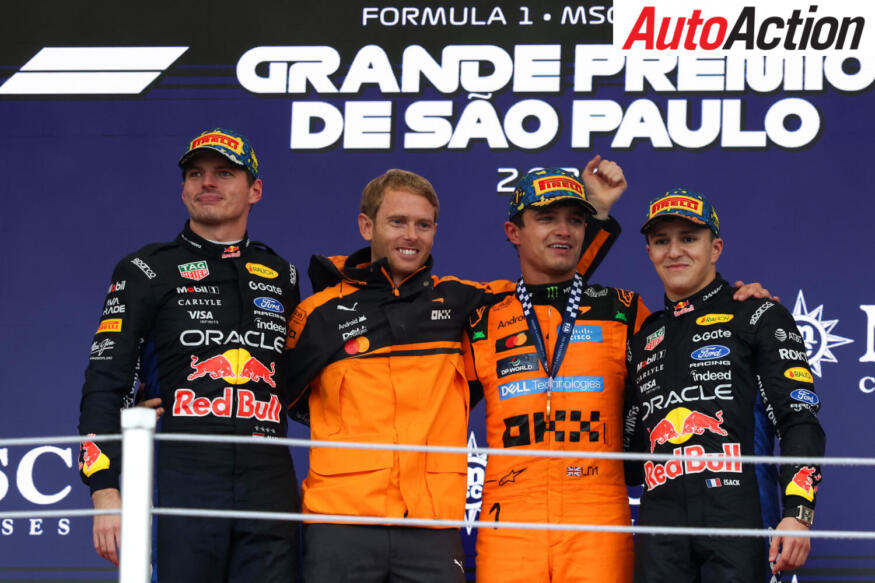
Claiming back-to-back triumphs in Brazil, Norris landed his third victory of the season when he crossed the line just before a downpour hit the circuit.
The McLaren driver outpaced both Red Bulls by 14 seconds, but despite the significant margin, Verstappen’s climb from P20 to P2 was celebration enough as it marked his third consecutive São Paulo podium finish from P17 or lower.
He was joined on the podium by Hadjar, who rounded out the weekend with his fourth career podium, totalling Red Bull’s Brazilian points haul to 33 points — equal with McLaren’s total for the weekend after Piastri rounded out his recovery drive in a lonely P6.
Also recovering from a midfield start, Leclerc trailed Piastri by 17 seconds when the chequered flag waved, with Lawson only just losing P7 to the Ferrari driver on the penultimate lap after Leclerc shoved his way past.
Hamilton’s late spin contributed to the 20-second deficit between himself and the Racing Bulls driver, but after making up 11 places, the two points from P9 were welcome.
Nico Hulkenberg also welcomed a one-point finish after serving a 10-second time penalty for leaving the track and gaining an advantage in the tight midfield fight, rounding out the top ten in Brazil.
There were two retirements on Sunday, with the first taking place before the lights went out as Valtteri Bottas’ Cadillac was wheeled off the grid and back to the garage due to a cross-threaded wheel nut, while Lance Stroll suffered his 13th DNF of the year when the Aston Martin pit wall called him home with a battery issue.
Rafael Câmara brought his debut Formula 1 Grand Prix to a close two laps down on the race leader, using his home event as a valuable learning experience ahead of an announcement on whether he will continue racing with the team in Las Vegas.
Formula 1 will take a week-long break before returning for the Las Vegas Grand Prix, which kicks off the final triple-header of the 2026 season with the night-time event running from November 20-22 (AEDT).
Image: Simon Galloway/LAT Images // Getty Images / Red Bull Content Pool.
2026 São Paulo Grand Prix Results:
POS.
NO.
DRIVER
TEAM
LAPS
TIME / RETIRED
PTS.
1
1
Lando Norris
McLaren
71
1:35:23.504
25
2
3
Max Verstappen
Red Bull Racing
71
+14.602s
18
3
6
Isack Hadjar
Red Bull Racing
71
+24.485s
15
4
63
George Russell
Mercedes
71
+33.991s
12
5
12
Kimi Antonelli
Mercedes
71
+36.017s
10
6
81
Oscar Piastri
McLaren
71
+56.475s
8
7
16
Charles Leclerc
Ferrari
71
+73.586s
6
8
30
Liam Lawson
Racing Bulls
71
+75.402s
4
9
44
Lewis Hamilton
Ferrari
70
+1 lap
2
10
27
Nico Hulkenberg
Audi
70
+1 lap
1
11
41
Arvid Lindblad
Racing Bulls
70
+1 lap
0
12
14
Fernando Alonso
Aston Martin
70
+1 lap
0
13
43
Franco Colapinto
Alpine
70
+1 lap
0
14
10
Pierre Gasly
Alpine
70
+1 lap
0
15
23
Alexander Albon
Williams
70
+1 lap
0
16
5
Gabriel Bortoleto
Audi
70
+1 lap
0
17
87
Oliver Bearman
Haas F1 Team
70
+1 lap
0
18
11
Sergio Perez
Cadillac
69
+2 laps
0
19
55
Carlos Sainz
Williams
69
+2 laps
0
20
51
Rafael Câmara
Haas F1 Team
69
+2 laps
0
NC
18
Lance Stroll
Aston Martin
30
DNF
0
NC
77
Valtteri Bottas
Cadillac
0
DNS
0
Recent Storiesarray (
0 =>
WP_Term::__set_state(array(
‘term_id’ => 37,
‘name’ => ‘F1’,
‘slug’ => ‘f1’,
‘term_group’ => 0,
‘term_taxonomy_id’ => 37,
‘taxonomy’ => ‘category’,
‘description’ => ‘An Introduction to Formula One (F1)
Formula One, or F1, is the highest class of single-seater auto racing, governed by the Fédération Internationale de l\’Automobile (FIA) and is owned by Liberty Media. The name “Formula One” refers to the set of rules or formula that all cars and drivers must comply with.
The F1 season consists of a series of races, known as Grands Prix, held on purpose-built circuits or public roads around the world. The results of each race are combined to determine two annual championships: one for drivers and one for constructors (teams).
The history of Formula One can be traced back to the pre-war Grand Prix racing, which featured open-wheel cars with supercharged engines. The first World Championship of Drivers was organised by the FIA in 1950, following the end of World War II. The first race was held at Silverstone, England, and was won by Giuseppe Farina, driving an Alfa Romeo. The first constructors\’ championship was introduced in 1958 and was won by Vanwall.
Formula One has seen many changes and innovations over the years, both in terms of technology and regulations. Some of the most notable developments include the introduction of rear-engined cars in the late 1950s, the use of aerodynamic wings in the late 1960s, the adoption of turbocharged engines in the late 1970s, the emergence of electronic driver aids in the late 1980s, the switch to V10 and then V8 engines in the 1990s and 2000s, and the introduction of hybrid power units in 2014.
Formula One has also produced some of the greatest drivers and rivalries in the history of motorsport. Some of the most famous names include Juan Manuel Fangio, Jim Clark, Jackie Stewart, Niki Lauda, Ayrton Senna, Alain Prost, Michael Schumacher, Lewis Hamilton, and Sebastian Vettel. Some of the most intense battles for the championship have been between Fangio and Stirling Moss in the 1950s, Lauda and James Hunt in the 1970s, Senna and Prost in the late 1980s, Schumacher and Mika Hakkinen in the late 1990s, and Hamilton and Vettel in the 2010s.
Formula One is widely regarded as the pinnacle of motorsport, attracting millions of fans and viewers worldwide. The sport is also a huge business, involving billions of dollars in revenue and expenditure. The teams compete for prize money, sponsorship deals, and media rights, while the drivers earn millions of dollars in salaries and endorsements. The sport is also influenced by politics, regulations, and controversies, such as doping scandals, espionage cases, safety issues, and environmental concerns.
The following is a list of all F1 World Drivers Champions by year, from 1950 to 2020:
1950-1959
1950: Giuseppe Farina (Italy) – Alfa Romeo 158, Alfa Romeo
1951: Juan Manuel Fangio (Argentina) – Alfa Romeo 159, Alfa Romeo
1952: Alberto Ascari (Italy) – Ferrari 500, Ferrari
1953: Alberto Ascari (Italy) – Ferrari 500, Ferrari
1954: Juan Manuel Fangio (Argentina) – Maserati 250F, Maserati / Mercedes-Benz W196, Mercedes-Benz
1955: Juan Manuel Fangio (Argentina) – Mercedes-Benz W196, Mercedes-Benz
1956: Juan Manuel Fangio (Argentina) – Ferrari D50, Ferrari
1957: Juan Manuel Fangio (Argentina) – Maserati 250F, Maserati
1958: Mike Hawthorn (United Kingdom) – Ferrari 246, Ferrari
1959: Jack Brabham (Australia) – Cooper T51, Cooper-Climax
1960-1969
1960: Jack Brabham (Australia) – Cooper T53, Cooper-Climax
1961: Phil Hill (United States) – Ferrari 156, Ferrari
1962: Graham Hill (United Kingdom) – BRM P57, BRM
1963: Jim Clark (United Kingdom) – Lotus 25, Lotus-Climax
1964: John Surtees (United Kingdom) – Ferrari 158, Ferrari
1965: Jim Clark (United Kingdom) – Lotus 33, Lotus-Climax
1966: Jack Brabham (Australia) – Brabham BT19, Brabham-Repco
1967: Denny Hulme (New Zealand) – Brabham BT20, Brabham-Repco
1968: Graham Hill (United Kingdom) – Lotus 49, Lotus-Ford
1969: Jackie Stewart (United Kingdom) – Matra MS80, Matra-Ford
1970-1979
1970: Jochen Rindt (Austria) – Lotus 72, Lotus-Ford
1971: Jackie Stewart (United Kingdom) – Tyrrell 003, Tyrrell-Ford
1972: Emerson Fittipaldi (Brazil) – Lotus 72D, Lotus-Ford
1973: Jackie Stewart (United Kingdom) – Tyrrell 006, Tyrrell-Ford
1974: Emerson Fittipaldi (Brazil) – McLaren M23, McLaren-Ford
1975: Niki Lauda (Austria) – Ferrari 312T, Ferrari
1976: James Hunt (United Kingdom) – McLaren M23, McLaren-Ford
1977: Niki Lauda (Austria) – Ferrari 312T2, Ferrari
1978: Mario Andretti (United States) – Lotus 79, Lotus-Ford
1979: Jody Scheckter (South Africa) – Ferrari 312T4, Ferrari
1980-1989
1980: Alan Jones (Australia) – Williams FW07B, Williams-Ford
1981: Nelson Piquet (Brazil) – Brabham BT49C, Brabham-Ford
1982: Keke Rosberg (Finland) – Williams FW08, Williams-Ford
1983: Nelson Piquet (Brazil) – Brabham BT52, Brabham-BMW
1984: Niki Lauda (Austria) – McLaren MP4/2, McLaren-TAG
1985: Alain Prost (France) – McLaren MP4/2B, McLaren-TAG
1986: Alain Prost (France) – McLaren MP4/2C, McLaren-TAG
1987: Nelson Piquet (Brazil) – Williams FW11B, Williams-Honda
1988: Ayrton Senna (Brazil) – McLaren MP4/4, McLaren-Honda
1989: Alain Prost (France) – McLaren MP4/5, McLaren-Honda
1990-1999
1990: Ayrton Senna (Brazil) – McLaren MP4/5B, McLaren-Honda
1991: Ayrton Senna (Brazil) – McLaren MP4/6, McLaren-Honda
1992: Nigel Mansell (United Kingdom) – Williams FW14B, Williams-Renault
1993: Alain Prost (France) – Williams FW15C, Williams-Renault
1994: Michael Schumacher (Germany) – Benetton B194, Benetton-Ford
1995: Michael Schumacher (Germany) – Benetton B195, Benetton-Renault
1996: Damon Hill (United Kingdom) – Williams FW18, Williams-Renault
1997: Jacques Villeneuve (Canada) – Williams FW19, Williams-Renault
1998: Mika Häkkinen (Finland) – McLaren MP4/13, McLaren-Mercedes
1999: Mika Häkkinen (Finland) – McLaren MP4/14, McLaren-Mercedes
2000-2009
2000: Michael Schumacher (Germany) – Ferrari F1-2000, Ferrari
2001: Michael Schumacher (Germany) – Ferrari F2001, Ferrari
2002: Michael Schumacher (Germany) – Ferrari F2002, Ferrari
2003: Michael Schumacher (Germany) – Ferrari F2003-GA, Ferrari
2004: Michael Schumacher (Germany) – Ferrari F2004, Ferrari
2005: Fernando Alonso (Spain) – Renault R25, Renault
2006: Fernando Alonso (Spain) – Renault R26, Renault
2007: Kimi Räikkönen (Finland) – Ferrari F2007, Ferrari
2008: Lewis Hamilton (United Kingdom) – McLaren MP4-23, McLaren-Mercedes
2009: Jenson Button (United Kingdom) – Brawn BGP 001, Brawn-Mercedes
2010-2020
2010: Sebastian Vettel (Germany) – Red Bull RB6, Red Bull-Renault
2011: Sebastian Vettel (Germany) – Red Bull RB7, Red Bull-Renault
2012: Sebastian Vettel (Germany) – Red Bull RB8, Red Bull-Renault
2013: Sebastian Vettel (Germany) – Red Bull RB9, Red Bull-Renault
2014: Lewis Hamilton (United Kingdom) – Mercedes F1 W05 Hybrid, Mercedes
2015: Lewis Hamilton (United Kingdom) – Mercedes F1 W06 Hybrid, Mercedes
2016: Nico Rosberg (Germany) – Mercedes F1 W07 Hybrid, Mercedes
2017: Lewis Hamilton (United Kingdom) – Mercedes F1 W08 EQ Power+, Mercedes
2018: Lewis Hamilton (United Kingdom) – Mercedes F1 W09 EQ Power+, Mercedes
2019: Lewis Hamilton (United Kingdom) – Mercedes F1 W10 EQ Power+, Mercedes
2020: Lewis Hamilton (United Kingdom) – Mercedes F1 W11 EQ Power+, Mercedes
2021-
2021: Max Verstappen (Netherlands) – Red Bull RB16B, Honda
2022: Max Verstappen (Netherlands) – Red Bull RB18, Red Bull Power Trains Honda
2023: Max Verstappen (Netherlands) – Red Bull RB19, Red Bull Power Trains Honda
2024: Max Verstappen (Netherlands) – Red Bull RB20, Red Bull Power Trains Honda’,
‘parent’ => 660,
‘count’ => 3486,
‘filter’ => ‘raw’,
‘cat_ID’ => 37,
‘category_count’ => 3486,
‘category_description’ => ‘An Introduction to Formula One (F1)
Formula One, or F1, is the highest class of single-seater auto racing, governed by the Fédération Internationale de l\’Automobile (FIA) and is owned by Liberty Media. The name “Formula One” refers to the set of rules or formula that all cars and drivers must comply with.
The F1 season consists of a series of races, known as Grands Prix, held on purpose-built circuits or public roads around the world. The results of each race are combined to determine two annual championships: one for drivers and one for constructors (teams).
The history of Formula One can be traced back to the pre-war Grand Prix racing, which featured open-wheel cars with supercharged engines. The first World Championship of Drivers was organised by the FIA in 1950, following the end of World War II. The first race was held at Silverstone, England, and was won by Giuseppe Farina, driving an Alfa Romeo. The first constructors\’ championship was introduced in 1958 and was won by Vanwall.
Formula One has seen many changes and innovations over the years, both in terms of technology and regulations. Some of the most notable developments include the introduction of rear-engined cars in the late 1950s, the use of aerodynamic wings in the late 1960s, the adoption of turbocharged engines in the late 1970s, the emergence of electronic driver aids in the late 1980s, the switch to V10 and then V8 engines in the 1990s and 2000s, and the introduction of hybrid power units in 2014.
Formula One has also produced some of the greatest drivers and rivalries in the history of motorsport. Some of the most famous names include Juan Manuel Fangio, Jim Clark, Jackie Stewart, Niki Lauda, Ayrton Senna, Alain Prost, Michael Schumacher, Lewis Hamilton, and Sebastian Vettel. Some of the most intense battles for the championship have been between Fangio and Stirling Moss in the 1950s, Lauda and James Hunt in the 1970s, Senna and Prost in the late 1980s, Schumacher and Mika Hakkinen in the late 1990s, and Hamilton and Vettel in the 2010s.
Formula One is widely regarded as the pinnacle of motorsport, attracting millions of fans and viewers worldwide. The sport is also a huge business, involving billions of dollars in revenue and expenditure. The teams compete for prize money, sponsorship deals, and media rights, while the drivers earn millions of dollars in salaries and endorsements. The sport is also influenced by politics, regulations, and controversies, such as doping scandals, espionage cases, safety issues, and environmental concerns.
The following is a list of all F1 World Drivers Champions by year, from 1950 to 2020:
1950-1959
1950: Giuseppe Farina (Italy) – Alfa Romeo 158, Alfa Romeo
1951: Juan Manuel Fangio (Argentina) – Alfa Romeo 159, Alfa Romeo
1952: Alberto Ascari (Italy) – Ferrari 500, Ferrari
1953: Alberto Ascari (Italy) – Ferrari 500, Ferrari
1954: Juan Manuel Fangio (Argentina) – Maserati 250F, Maserati / Mercedes-Benz W196, Mercedes-Benz
1955: Juan Manuel Fangio (Argentina) – Mercedes-Benz W196, Mercedes-Benz
1956: Juan Manuel Fangio (Argentina) – Ferrari D50, Ferrari
1957: Juan Manuel Fangio (Argentina) – Maserati 250F, Maserati
1958: Mike Hawthorn (United Kingdom) – Ferrari 246, Ferrari
1959: Jack Brabham (Australia) – Cooper T51, Cooper-Climax
1960-1969
1960: Jack Brabham (Australia) – Cooper T53, Cooper-Climax
1961: Phil Hill (United States) – Ferrari 156, Ferrari
1962: Graham Hill (United Kingdom) – BRM P57, BRM
1963: Jim Clark (United Kingdom) – Lotus 25, Lotus-Climax
1964: John Surtees (United Kingdom) – Ferrari 158, Ferrari
1965: Jim Clark (United Kingdom) – Lotus 33, Lotus-Climax
1966: Jack Brabham (Australia) – Brabham BT19, Brabham-Repco
1967: Denny Hulme (New Zealand) – Brabham BT20, Brabham-Repco
1968: Graham Hill (United Kingdom) – Lotus 49, Lotus-Ford
1969: Jackie Stewart (United Kingdom) – Matra MS80, Matra-Ford
1970-1979
1970: Jochen Rindt (Austria) – Lotus 72, Lotus-Ford
1971: Jackie Stewart (United Kingdom) – Tyrrell 003, Tyrrell-Ford
1972: Emerson Fittipaldi (Brazil) – Lotus 72D, Lotus-Ford
1973: Jackie Stewart (United Kingdom) – Tyrrell 006, Tyrrell-Ford
1974: Emerson Fittipaldi (Brazil) – McLaren M23, McLaren-Ford
1975: Niki Lauda (Austria) – Ferrari 312T, Ferrari
1976: James Hunt (United Kingdom) – McLaren M23, McLaren-Ford
1977: Niki Lauda (Austria) – Ferrari 312T2, Ferrari
1978: Mario Andretti (United States) – Lotus 79, Lotus-Ford
1979: Jody Scheckter (South Africa) – Ferrari 312T4, Ferrari
1980-1989
1980: Alan Jones (Australia) – Williams FW07B, Williams-Ford
1981: Nelson Piquet (Brazil) – Brabham BT49C, Brabham-Ford
1982: Keke Rosberg (Finland) – Williams FW08, Williams-Ford
1983: Nelson Piquet (Brazil) – Brabham BT52, Brabham-BMW
1984: Niki Lauda (Austria) – McLaren MP4/2, McLaren-TAG
1985: Alain Prost (France) – McLaren MP4/2B, McLaren-TAG
1986: Alain Prost (France) – McLaren MP4/2C, McLaren-TAG
1987: Nelson Piquet (Brazil) – Williams FW11B, Williams-Honda
1988: Ayrton Senna (Brazil) – McLaren MP4/4, McLaren-Honda
1989: Alain Prost (France) – McLaren MP4/5, McLaren-Honda
1990-1999
1990: Ayrton Senna (Brazil) – McLaren MP4/5B, McLaren-Honda
1991: Ayrton Senna (Brazil) – McLaren MP4/6, McLaren-Honda
1992: Nigel Mansell (United Kingdom) – Williams FW14B, Williams-Renault
1993: Alain Prost (France) – Williams FW15C, Williams-Renault
1994: Michael Schumacher (Germany) – Benetton B194, Benetton-Ford
1995: Michael Schumacher (Germany) – Benetton B195, Benetton-Renault
1996: Damon Hill (United Kingdom) – Williams FW18, Williams-Renault
1997: Jacques Villeneuve (Canada) – Williams FW19, Williams-Renault
1998: Mika Häkkinen (Finland) – McLaren MP4/13, McLaren-Mercedes
1999: Mika Häkkinen (Finland) – McLaren MP4/14, McLaren-Mercedes
2000-2009
2000: Michael Schumacher (Germany) – Ferrari F1-2000, Ferrari
2001: Michael Schumacher (Germany) – Ferrari F2001, Ferrari
2002: Michael Schumacher (Germany) – Ferrari F2002, Ferrari
2003: Michael Schumacher (Germany) – Ferrari F2003-GA, Ferrari
2004: Michael Schumacher (Germany) – Ferrari F2004, Ferrari
2005: Fernando Alonso (Spain) – Renault R25, Renault
2006: Fernando Alonso (Spain) – Renault R26, Renault
2007: Kimi Räikkönen (Finland) – Ferrari F2007, Ferrari
2008: Lewis Hamilton (United Kingdom) – McLaren MP4-23, McLaren-Mercedes
2009: Jenson Button (United Kingdom) – Brawn BGP 001, Brawn-Mercedes
2010-2020
2010: Sebastian Vettel (Germany) – Red Bull RB6, Red Bull-Renault
2011: Sebastian Vettel (Germany) – Red Bull RB7, Red Bull-Renault
2012: Sebastian Vettel (Germany) – Red Bull RB8, Red Bull-Renault
2013: Sebastian Vettel (Germany) – Red Bull RB9, Red Bull-Renault
2014: Lewis Hamilton (United Kingdom) – Mercedes F1 W05 Hybrid, Mercedes
2015: Lewis Hamilton (United Kingdom) – Mercedes F1 W06 Hybrid, Mercedes
2016: Nico Rosberg (Germany) – Mercedes F1 W07 Hybrid, Mercedes
2017: Lewis Hamilton (United Kingdom) – Mercedes F1 W08 EQ Power+, Mercedes
2018: Lewis Hamilton (United Kingdom) – Mercedes F1 W09 EQ Power+, Mercedes
2019: Lewis Hamilton (United Kingdom) – Mercedes F1 W10 EQ Power+, Mercedes
2020: Lewis Hamilton (United Kingdom) – Mercedes F1 W11 EQ Power+, Mercedes
2021-
2021: Max Verstappen (Netherlands) – Red Bull RB16B, Honda
2022: Max Verstappen (Netherlands) – Red Bull RB18, Red Bull Power Trains Honda
2023: Max Verstappen (Netherlands) – Red Bull RB19, Red Bull Power Trains Honda
2024: Max Verstappen (Netherlands) – Red Bull RB20, Red Bull Power Trains Honda’,
‘cat_name’ => ‘F1’,
‘category_nicename’ => ‘f1’,
‘category_parent’ => 660,
)),
1 =>
WP_Term::__set_state(array(
‘term_id’ => 11,
‘name’ => ‘Latest News’,
‘slug’ => ‘latest-news’,
‘term_group’ => 0,
‘term_taxonomy_id’ => 11,
‘taxonomy’ => ‘category’,
‘description’ => ”,
‘parent’ => 0,
‘count’ => 19143,
‘filter’ => ‘raw’,
‘cat_ID’ => 11,
‘category_count’ => 19143,
‘category_description’ => ”,
‘cat_name’ => ‘Latest News’,
‘category_nicename’ => ‘latest-news’,
‘category_parent’ => 0,
)),
2 =>
WP_Term::__set_state(array(
‘term_id’ => 2029,
‘name’ => ‘ZZZ-Email’,
‘slug’ => ’email’,
‘term_group’ => 0,
‘term_taxonomy_id’ => 2029,
‘taxonomy’ => ‘category’,
‘description’ => ”,
‘parent’ => 2031,
‘count’ => 9699,
‘filter’ => ‘raw’,
‘cat_ID’ => 2029,
‘category_count’ => 9699,
‘category_description’ => ”,
‘cat_name’ => ‘ZZZ-Email’,
‘category_nicename’ => ’email’,
‘category_parent’ => 2031,
)),
3 =>
WP_Term::__set_state(array(
‘term_id’ => 2031,
‘name’ => ‘ZZZ-RSSFeeds’,
‘slug’ => ‘zzz-rssfeeds’,
‘term_group’ => 0,
‘term_taxonomy_id’ => 2031,
‘taxonomy’ => ‘category’,
‘description’ => ”,
‘parent’ => 0,
‘count’ => 9056,
‘filter’ => ‘raw’,
‘cat_ID’ => 2031,
‘category_count’ => 9056,
‘category_description’ => ”,
‘cat_name’ => ‘ZZZ-RSSFeeds’,
‘category_nicename’ => ‘zzz-rssfeeds’,
‘category_parent’ => 0,
)),
)