
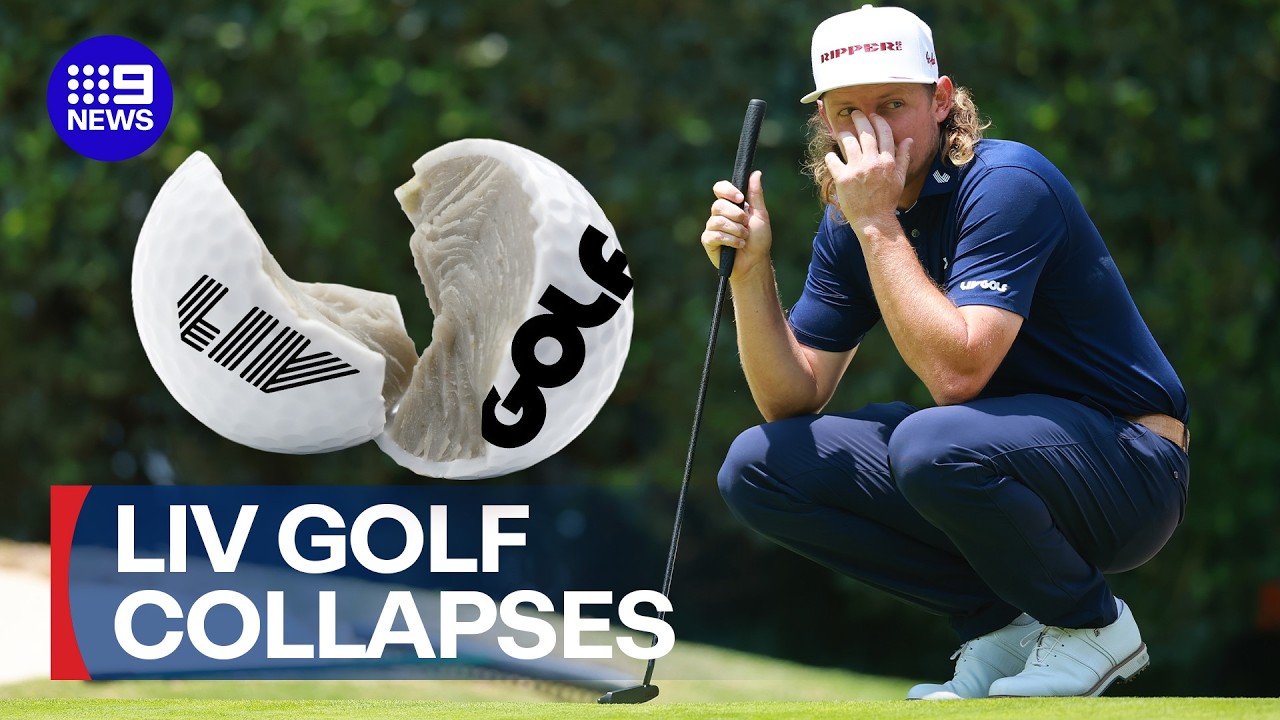
LIV Golf will wind down and head into liquidation after its last rescue deal collapsed in a US bankruptcy court. There will be no LIV in 2027, and South Australia is left with a $45 million golf course built for a league that no longer exists.
Five years. More than US$5 billion. Four sell-out Adelaide events.
And it ended with a lawyer reading one sentence in a New Jersey courtroom.
“The debtors are not currently proceeding with the LIV 2.0 plan,” Matthew Williams of Gibson Dunn told the hearing late last week.
That’s it. LIV Golf is done.
The hearing was on Thursday 5 November in the US, Friday morning here. By the weekend, the obituaries were everywhere.
The league’s board special committee said “shifting toward an orderly wind-down is the most responsible path forward for the League at this time.” There will be no LIV in 2027. A formal liquidation plan is being lodged with the New Jersey bankruptcy court this week.
BC Partners Credit, which had pledged US$300 million to a cut-price LIV 2.0, was the last to walk.
“We are disappointed that mutually acceptable terms could not be reached among the various stakeholders,” it said.
CEO Scott O’Neil called the whole thing “the round of a lifetime for all of us.”
It certainly was for some. Before filing for bankruptcy, LIV paid US$15.6 million to retain seven executives, US$6.375 million of it to O’Neil. Whether those payments can be clawed back is now a question for the court.
The players are further down the queue. An attorney for the unsecured creditors, a list that includes plenty of players, told Yahoo Sports they hope to reach a settlement with the Saudi Public Investment Fund within weeks.
And LIV’s biggest name has already moved on. Bryson DeChambeau released a statement on Sunday, saying “I’m not going to rewrite the last four years” and that “whatever comes next, I’ll approach it with humility and respect.” He’s playing the Nedbank Golf Challenge in South Africa from 3 to 6 December, with the DP World Tour paperwork due by 14 November.
It fell apart quickly
The Public Investment Fund stopped paying in April, two weeks after the Masters, after pouring in more than US$5 billion. LIV filed for Chapter 11 on 8 September. LIV 2.0 promised fewer events and smaller purses, and almost nobody wanted it.
The exodus we wrote about last month did the rest. Jon Rahm reportedly gave up claims worth about US$100 million just to get out. Tyrrell Hatton, Sergio Garcia, Ian Poulter, Louis Oosthuizen and our own Lucas Herbert had all gone before the end.
Greg Norman, the Australian who founded it, saw this coming back in August. “I hate to see it wither away,” he told Skratch. “I would rather just see it end.”
Where does that leave the Rippers?
Ripper GC, the all-Australian team that finished second in the standings this year, is finished too.
Cam Smith is a free agent. His contract was one of 19 a bankruptcy judge let LIV reject, and he’s listed as an unsecured creditor owed about US$4.84 million. The problem is where he goes next. He turned down the PGA Tour’s Returning Player Program in January, and the earliest he can now play there is 24 August 2027. As Sky Sports points out, past major champions like Smith also don’t have the DP World Tour membership route open to others.
Marc Leishman and Elvis Smylie haven’t said what they’ll do either.
Smith is confirmed for the Australian Open at Kingston Heath, 3 to 6 December.
North Adelaide: we did ask
LIV Adelaide was the league’s best event by a distance, drawing around 115,000 fans in February. The 2027 stopover at Kooyonga won’t happen.
“It feels like it’s game, set and match as far as I can tell,” Premier Peter Malinauskas told ABC Radio Adelaide.
The bigger hangover is North Adelaide. The SA Government is spending at least $45 million on a Greg Norman Golf Course Design rebuild of the public course, losing 585 trees along the way, so it could host LIV from 2028 to 2031. Work on the South Course started in April.
On 21 May 2025, when the deal looked locked in, I wrote Adelaide’s LIV Investment: A High-Stakes Bet With No Guarantees. The question at the heart of it was simple:
“What happens to the golf course if LIV Golf collapses or, like the Grand Prix, moves to Melbourne?”
And the follow-up:
“If LIV pulls out, who foots the bill for keeping this championship-level course in top shape?”
The piece closed with a list of open questions. One of them was “What happens if LIV Golf disappears?”
Eighteen months later, we’re about to find out.
To be fair to the SA Government, it hedged. North Adelaide has since secured the Australian Open, with three men’s and three women’s championships between 2028 and 2034.
“We didn’t want to invest heavily in North Adelaide and face the prospect of it [LIV Golf] being lost from South Australia,” Malinauskas said in September.
That was the right call, and it means the course has a marquee event whatever happens. But the other questions from 2025 are still sitting there. Will it stay affordable for everyday golfers? Who pays for the upkeep in the years without a tournament?
Why Greg Norman?
And then there’s the question I still can’t get past.
Greg Norman Golf Course Design was handed the job without a tender. The government went with direct engagement, saying the firm had specialist skills and a strong reputation. When the ABC asked in July 2025 how much Norman’s firm would be paid, the government wouldn’t say.
This is a state government project, paid for with at least $45 million of taxpayers’ money. A tender is the bare minimum.
“The government needs to be up-front about it, it’s taxpayers’ money,” crossbench MP Frank Pangallo said at the time.
The only real logic for picking Norman was LIV. He founded it and sat on its board, and a Norman course for a Norman league made a certain kind of sense. That logic is now gone.
I’m also not convinced he’s the right designer for this course anyway.
North Adelaide now has two jobs. It has to be good enough to host the Australian Open, and it has to be fun for the bloke who plays off 22 on a Saturday morning. Those aren’t the same brief, and plenty of championship courses never manage both.
There’s a neat irony to all this. Greg Norman’s league is gone, but a Greg Norman golf course will outlive it.
If the green fees stay sensible, Adelaide’s public golfers might end up the real winners of the whole LIV experiment.