
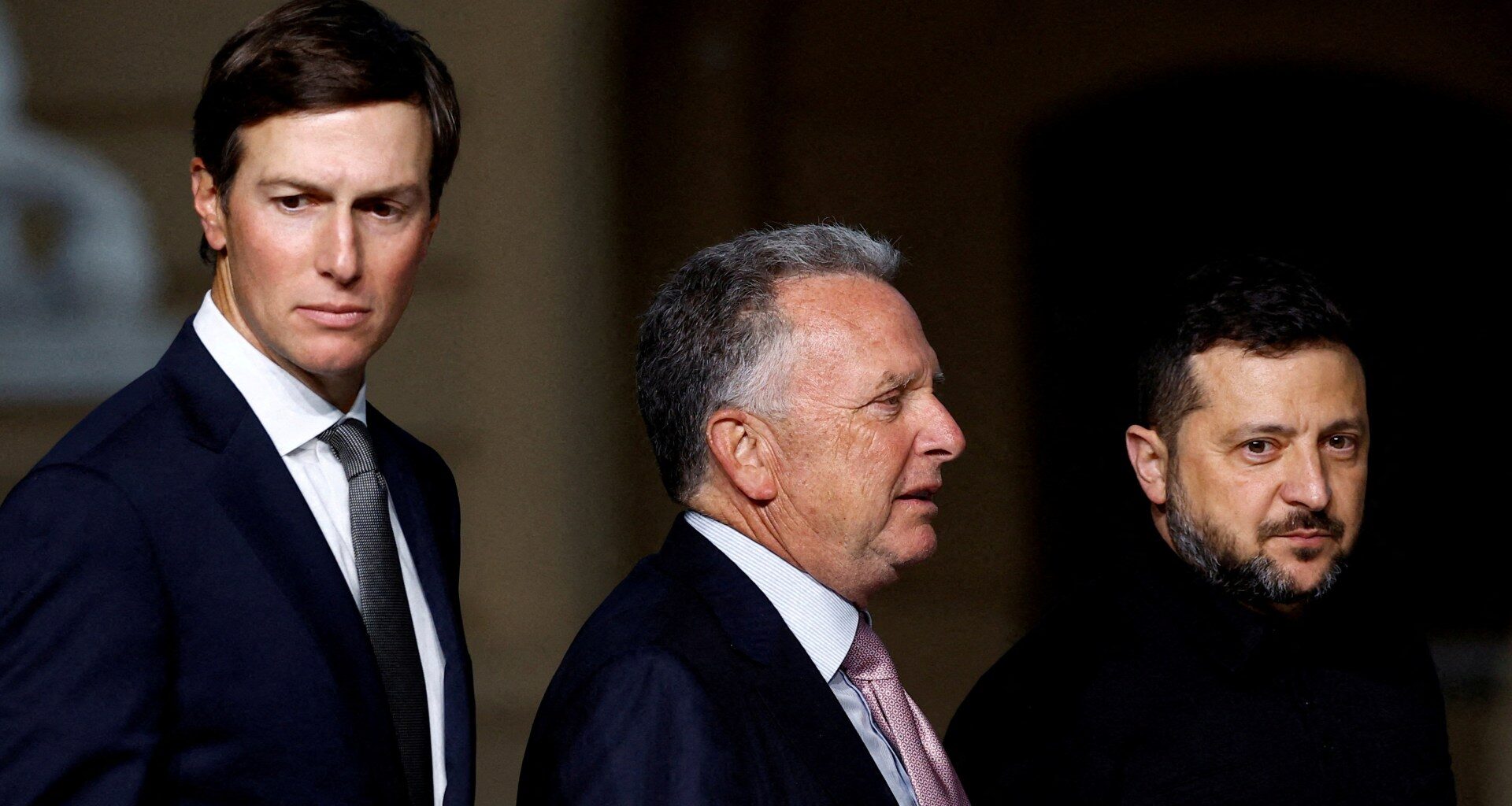
Negotiators from Moscow, Kyiv, and Washington are holding talks in Abu Dhabi aimed at ending the war in Ukraine, the Russian news agency RIA Novosti reported.
The meeting in the United Arab Emirates capital on Tuesday is the third round of talks there this year, following security consultations in January and February.
The US delegation is led by President Donald Trump’s envoys, Steve Witkoff and Jared Kushner, who have spearheaded Washington’s mediation.
Russia’s delegation is headed by presidential aide Vladimir Medinsky, while Ukraine is being represented by a team led by Rustem Umerov, head of the Foreign Intelligence Service.
The three delegations last met in Geneva on February 18.
Ahead of the talks, Ukrainian President Volodymyr Zelenskyy said that recent gains on the battlefield had strengthened his country’s hand.
“Ukrainian forces are currently genuinely strengthening Ukraine’s negotiating position,” Zelenskyy said in his nightly video address on Monday. He said Russia was “suffering record losses”, a claim Moscow disputes, and urged Washington to persuade the Kremlin to end the war.
Zelenskyy said armed forces chief General Mykhailo Drapatyi had presented a report on Ukraine’s military positions that pointed to heavy recent Russian losses. Zelenskyy also said Kyiv’s long-range strikes on targets inside Russia, including oil facilities, were having an effect.
“We are responding to Russia’s war in a fully justified manner and demonstrating that this war must end,” he said. “Russia can do this. It can end its war. It is important that the United States convince Russia of precisely this.”
‘Strong inclination’
In Washington, DC, Trump told reporters that he saw a “very strong inclination” towards ending the war and that both sides were “tired of fighting”.
“We’re having a very good conversation about that in Abu Dhabi,” he said.
Trump had promised to end the war quickly when he took office in January 2025, but a settlement has remained elusive nearly five years after Russia launched a full-scale invasion of its neighbour in February 2022.
A US official, briefing reporters on condition of anonymity, said on Monday that both Moscow and Kyiv had privately shown some flexibility on Ukrainian territory occupied by Russia. Security guarantees for Ukraine would be a central topic, the official said, including the possibility of a defence commitment modelled on Article 5 of NATO’s founding treaty.
Both Ukraine and Russia have been adamant about territory.
Ukraine wants Russia pushed back to the original border between the two countries, while Russian President Vladimir Putin wants to obtain all of Ukraine’s Donbas region.
Russia occupies roughly 20 percent of Ukraine, including Crimea and parts of eastern Donbas. Moscow’s claims to the Ukrainian regions it has occupied have not been recognised by the international community, but Trump has previously urged Kyiv to cede territory for a deal to end the war.
The US official said any territorial agreement would most likely come at the end of the negotiations, once other issues, including a post-war security framework, had been settled.
‘Ways to go’
US Secretary of State Marco Rubio, meanwhile, struck a cautious note, saying the process to end the war still has “a ways to go”.
“We’ll keep trying. And that’s what we’ve been trying to do the whole time, is try to be creative and find ways that we can help bring that conflict and that war to an end,” Rubio said.
European powers, including France, Germany and the European Commission, said they would send officials to the talks in Abu Dhabi, but Russia made it clear it did not want the Europeans to take part in negotiations.
Kremlin spokesperson Dmitry Peskov said the talks would focus on security guarantees. European officials would not take part, he added, because the negotiations had been agreed to as a three-way format.
“What will take place in Abu Dhabi in the coming days is trilateral negotiations between Russia and Ukraine with US mediation,” Peskov said. “As for the presence of Europeans, you know that the Americans have their own channels of communication with Europeans, and Ukrainians with Europeans.”